
About This Worksheet
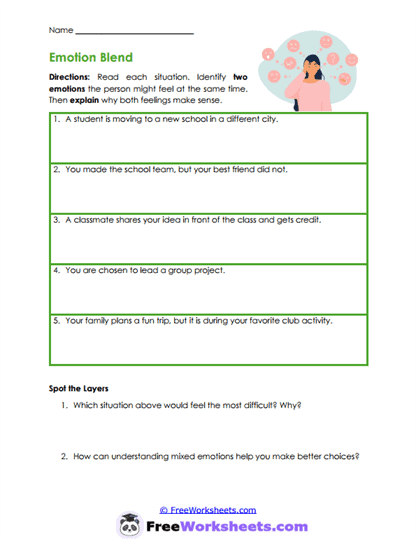
This worksheet helps children understand that two emotions can exist at the same time, even when those feelings seem to pull in different directions. Students read situations such as moving to a new school, earning a place on a team when a friend does not, or being chosen to lead a group project. For each one, they identify two possible emotions and explain why both feelings make sense. This is a helpful lesson because children sometimes believe they must choose only one feeling, when real experiences are often more complicated.
Skills Developed
Students build emotional vocabulary, flexible thinking, and self-awareness as they look for more than one reasonable reaction to each event. They practice explaining the cause of an emotion instead of simply naming a feeling word. The reflection questions also ask children to think about why mixed emotions can make decisions harder and how understanding those feelings can lead to better choices. These skills can help children feel less confused when they are excited and nervous, proud and guilty, or happy and disappointed at the same time.
Connections to Collaborative for Academic, Social and Emotional Learning (CASEL)
This worksheet connects most strongly with the CASEL areas of self-awareness, self-management, and responsible decision-making. Children first learn to notice and name the different feelings happening inside them, and then they begin thinking about how those emotions may affect their actions. In my experience, students often feel relieved when they learn that mixed emotions are normal and do not mean something is wrong. I like to remind them that understanding both feelings can help them pause, think clearly, and make a choice that respects both themselves and other people.
Using This Worksheet
Teachers can use this page during a lesson about emotional complexity, friendship problems, decision-making, or major life changes. It works especially well when the class discusses each situation aloud before students write, because children often hear emotional possibilities they had not considered. Parents and homeschool educators can connect the examples to real experiences, such as starting a new activity, sharing attention with a sibling, or missing one event because of another commitment. Encourage your child to explain why both emotions fit rather than searching for one perfect answer.