
About This Worksheet
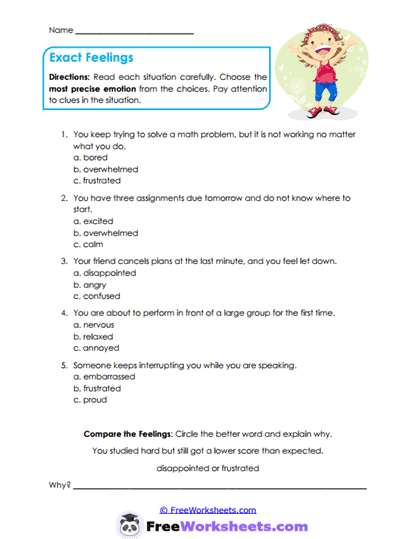
This worksheet teaches children how to choose the most exact emotion word for a situation. Students read short examples and select among related feelings such as proud, overwhelmed, frustrated, nervous, disappointed, excited, calm, or confused. The choices may seem similar at first, so children must pay close attention to what is happening in each situation. This helps them move beyond broad words such as happy, sad, or mad and describe emotions with greater accuracy.
Skills Developed
Students strengthen emotional vocabulary, reading comprehension, and the ability to use context clues. They learn that the best feeling word depends on the cause of the emotion and the details of the situation. The final comparison asks children to decide whether a student who earned a lower score than expected would feel disappointed or frustrated and explain the difference. This kind of thinking helps children communicate their needs more clearly because the words they choose give others better information.
Connections to Collaborative for Academic, Social and Emotional Learning (CASEL)
This worksheet supports the CASEL skill of self-awareness by helping children identify and name emotions with greater precision. It also connects with relationship skills because children who can explain whether they feel embarrassed, worried, overwhelmed, or disappointed are often better able to ask for the right kind of help. In the classroom, I have seen that children sometimes act out simply because they do not yet have the words to describe what is bothering them. Building a stronger feeling vocabulary gives them a calmer and more useful way to communicate.
Using This Worksheet
Teachers can use this page during an SEL lesson, vocabulary lesson, morning meeting, or small counseling group. It is helpful to ask students to explain why the other choices do not fit as well, because that discussion deepens their understanding of each emotion. Parents can read the situations aloud and connect them to moments their child has experienced at school, at home, or during activities. After the worksheet is complete, practice using one or two of the new feeling words in a sentence about a real event.