
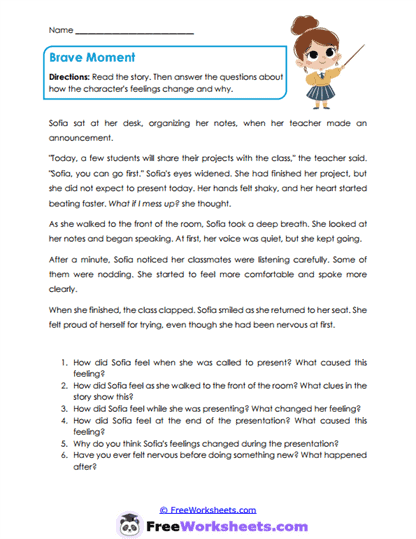
About This Worksheet
This worksheet uses a short story about Sofia, a student who is asked to present her project in front of the class. She immediately feels nervous, and the story describes clues such as shaky hands and a fast heartbeat. Sofia then takes a deep breath, looks at her notes, and begins speaking. As she continues, she becomes more comfortable and ends the experience feeling proud.
Students answer questions about how Sofia’s feelings change from the beginning of the story to the end. They identify what caused her nervousness, what helped her move forward, and how her classmates’ attention affected her confidence. The questions also ask children to explain why pride may have been Sofia’s strongest feeling after the presentation. This helps students understand that courage does not mean a person feels no fear.
The final question invites children to think about a time when they felt nervous before trying something new. They describe what happened afterward and may notice that the worry was strongest before the activity began. This personal connection makes the story useful for children who fear speaking, performing, joining a group, or attempting unfamiliar work. It gives them a hopeful example of how emotions can change through action.
Skills Developed
Children practice identifying emotions by noticing physical reactions, thoughts, actions, and changes in behavior. They learn that a fast heartbeat, shaky hands, and worried thoughts can be signs of nervousness. Students also examine cause and effect as they connect each part of the story with Sofia’s changing emotions. This supports both reading comprehension and emotional understanding.
The activity also develops confidence and healthy risk-taking. Children see that Sofia does not wait until she feels completely calm before starting her presentation. She uses a few helpful steps and becomes more comfortable as she continues. This teaches students that confidence often grows after we begin, not before.
Connections to Collaborative for Academic, Social and Emotional Learning (CASEL)
This worksheet aligns closely with the CASEL areas of self-awareness, self-management, and responsible decision-making. Sofia notices her nervous feelings, which shows self-awareness. She uses deep breathing, preparation, and positive action to manage those emotions. She also makes the responsible choice to continue with the presentation instead of immediately giving up.
When I have used stories like this with children, I always point out that Sofia was brave while she was still nervous. That idea is important because many children believe brave people never feel afraid. We talk about courage as taking a safe and helpful step even when your body feels uncomfortable. Students often feel relieved when they learn that nervousness does not mean they are unprepared or unable to succeed.
Using This Worksheet
Teachers can use this worksheet before student presentations, performances, class discussions, or other activities that may create nervous feelings. Reading the story together gives the class a safe way to talk about fear without asking anyone to share a personal experience right away. The teacher can pause at the moment Sofia is called to the front and ask students what they notice in her body and thoughts. Afterward, the class can make a short list of helpful strategies for brave moments.
Parents can use this page before a child faces a new or uncomfortable experience. It may be helpful before the first day of an activity, a sports event, a test, or a performance. Ask your child which of Sofia’s strategies might work for them, and practice that strategy together. A calm reminder such as “You can feel nervous and still take the next step” can be very encouraging.