
About This Worksheet
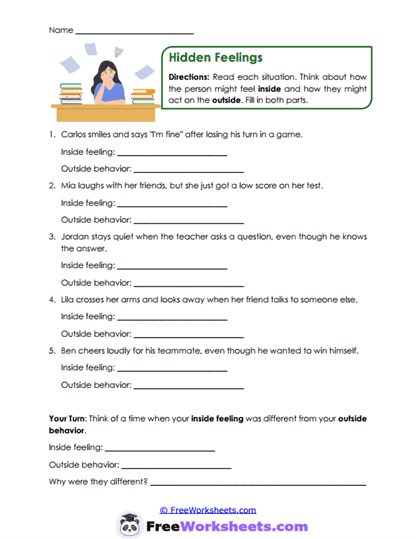
This worksheet helps children understand that the feeling a person has inside may not match the behavior other people see. A child may smile even though they feel disappointed, stay quiet even though they feel nervous, or congratulate someone while feeling jealous. These situations can be confusing because we often judge feelings only by someone’s face, words, or actions. This page teaches children to slow down and think about what may be happening beneath the surface.
Students read five short situations and name both the character’s possible inside feeling and outside behavior. For example, Carlos says that he is fine after losing his turn in a game, but he may actually feel upset or disappointed. Another child laughs with friends after receiving a low test score, even though she may feel embarrassed inside. These examples show children that people sometimes hide emotions because they do not know what to say, want to avoid attention, or are trying to protect themselves.
The final section asks students to think of a time when their own inside feeling was different from their outside behavior. They describe the emotion, explain what they did, and think about why the two were different. This personal connection makes the lesson more meaningful because children are not only studying made-up characters. They are learning how the same idea may appear in their own lives.
Skills Developed
Children build emotional awareness by looking beyond obvious behavior and considering several possible feelings. They practice perspective-taking, which means thinking about an experience from another person’s point of view. Students also strengthen empathy because they begin to understand that someone who looks calm, cheerful, or uninterested may still be struggling inside. This can help children respond to classmates with more patience and kindness.
The worksheet also supports self-awareness. Children think about times when they hid disappointment, worry, jealousy, sadness, or embarrassment. Naming that difference can make it easier for them to communicate honestly with a trusted adult. Over time, this skill can help children recognize when they need support instead of pretending that everything is fine.
Connections to Collaborative for Academic, Social and Emotional Learning (CASEL)
This worksheet connects strongly with the CASEL areas of self-awareness, social awareness, and relationship skills. Self-awareness is practiced when children identify their own private emotions and compare them with the behavior they showed others. Social awareness grows as they consider what another person might be feeling, even when that emotion is not easy to see. Relationship skills are supported because children learn that asking a caring question can be more helpful than making a quick judgment.
I have found that children often become very thoughtful during this activity. Many students are surprised to realize that a person can act happy and still feel hurt or worried. I usually remind them that they do not have to guess another person’s exact emotion, but they can remain curious and kind. A simple question such as “Are you really okay?” can help children show care without pushing someone to talk before they are ready.
Using This Worksheet
Teachers can use this page during an SEL lesson about empathy, emotional expression, or understanding body language. It works especially well after a classroom disagreement because it helps students see that the same event can look different from each person’s point of view. The teacher may read each situation aloud and invite students to suggest more than one possible inside feeling. This keeps children from believing there is always only one correct emotional response.
Parents and homeschool educators can use the page during a calm conversation at home. Complete one example together and explain that adults also sometimes hide feelings. Encourage your child to share only what feels comfortable, especially during the personal reflection section. The goal is not to force a private story but to help children understand that hidden feelings are normal and can be shared safely with trusted people.