
About This Worksheet
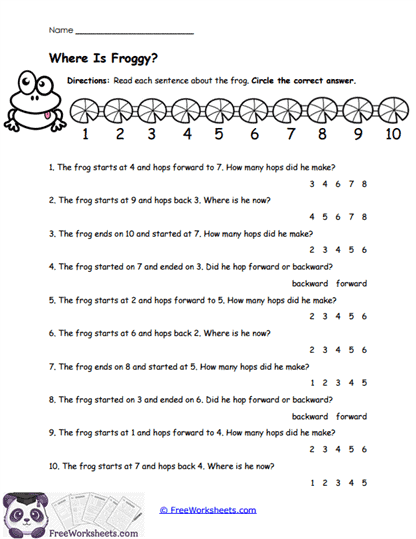
This worksheet is a Kindergarten counting activity that helps students practice counting forward and backward within 10 using a frog hopping theme. Children read short counting stories and decide where the frog lands after hopping forward or backward along the number path. The activity strengthens counting fluency, sequencing skills, and early reasoning through simple movement-based problems. For example, if the frog starts at 4 and hops forward 3, the frog lands on 7. The playful frog theme keeps young learners engaged while building confidence with number patterns.
Curriculum and Grade Alignment
This worksheet is designed for Kindergarten students learning how to count forward and backward within 10. The primary learning goal is helping children understand how numbers change as they move through a counting sequence. Students should already recognize numbers from 1-10 before beginning the activity. These foundational counting skills prepare learners for future work with number lines, addition, and subtraction strategies in first grade. This worksheet supports Common Core Standard K.CC.A.1 and aligns with TEKS K.2.A for counting forward and backward using concrete and visual models.
Student Tasks
On this worksheet, students will read frog hopping stories and determine where the frog lands after moving forward or backward. Children count hops carefully before circling or selecting the correct answer choice. Learners practice sequencing numbers while strengthening counting fluency and problem-solving skills. Students also improve reading comprehension as they follow the directions within each short story problem. The repeated hopping patterns help children become more comfortable with forward and backward counting concepts.
Common Challenges and Misconceptions
Some students may confuse hopping forward with hopping backward while solving the problems. Young learners sometimes count the starting number as the first hop instead of moving after it. A few children may lose track of the hops if they move too quickly through the counting sequence. Students who are still building number recognition skills may also choose incorrect answer choices even after counting correctly. Teachers and parents can help by encouraging children to use fingers or counters to track each hop one step at a time.
Implementation Guidance
Teachers can use this worksheet during counting lessons, math centers, or guided problem-solving activities. Parents may enjoy the frog theme because it makes counting practice feel playful and less stressful during home review sessions. Students can act out the hopping movements using number lines, counters, or toy frogs before selecting answers on paper. This worksheet also works well as preparation for beginner addition and subtraction strategies using movement and counting. Adults should encourage learners to explain how they counted the hops to reach the answer.
Details and Features
This printable worksheet includes ten frog-themed counting story problems within 10. Clear answer choices and organized spacing support Kindergarten students who are still developing confidence with reading and counting skills. The black-and-white format prints clearly for classroom packets, homework assignments, or homeschool lessons. Fun frog illustrations and simple directions help keep young learners engaged during math practice. Its beginner-friendly structure makes the worksheet useful for review activities, intervention, or early counting assessments.