
About This Worksheet
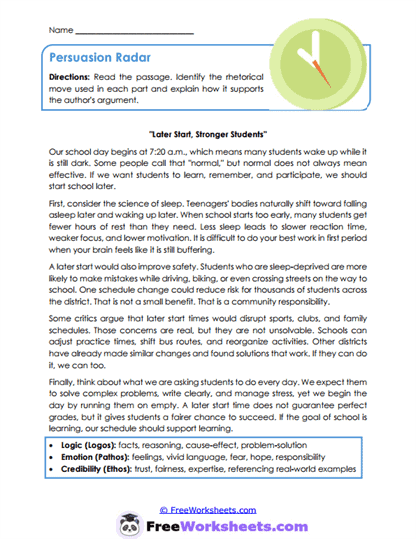
This worksheet is about rhetorical appeals, which means how writers use logic, emotions, and trust to convince readers. The passage argues for starting school later in the day. Students learn how different types of arguments work together to persuade people. For example, facts become logical appeals, while feelings become emotional appeals. This helps your child understand how persuasion works in real life.
Curriculum and Grade Alignment
This worksheet is designed for 9th grade students learning to analyze arguments. The goal is to help students identify different types of persuasive techniques. Before this, students should understand basic argument structure. Next, they will evaluate how strong arguments are. This aligns with CCSS.ELA-LITERACY.RI.9-10.8 and TEKS 9.6.
Student Tasks
On this worksheet, students will read a passage about school start times. They will identify examples of logical, emotional, and credibility-based appeals. Students must explain how each example supports the argument. They will use evidence from the text in their answers. This builds strong critical thinking skills.
Common Challenges and Misconceptions
Students may confuse the different types of appeals. Some might find examples but not explain them clearly. Others may focus only on one type of appeal. A common mistake is labeling without understanding. Teachers can help by reviewing each type with simple examples.
Implementation Guidance
Teachers can use this worksheet during lessons on persuasive writing or debates. It works well as preparation for writing arguments. At home, you can talk with your child about how people try to persuade others. This builds awareness of real-world communication. Over time, your child will become a stronger thinker and writer.
Details and Features
The worksheet includes a relevant and engaging topic about school schedules. It clearly explains different types of appeals. The format allows for written explanations. It is printable and easy to use. The design supports deeper thinking and discussion.