
About This Worksheet
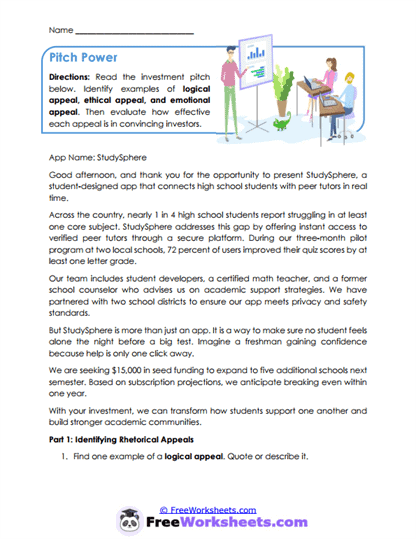
This worksheet is about understanding rhetorical appeals, which means how writers use logic, emotions, and credibility to persuade others. It focuses on an investment pitch for a business idea. Students learn how different types of appeals work together to convince an audience. For example, statistics become a logical appeal to support a claim. This helps students understand persuasive communication.
Curriculum and Grade Alignment
This worksheet is designed for Grade 9 students studying persuasive writing and argument analysis. The main goal is to help students identify logical, emotional, and ethical appeals. Students should already understand basic argument structure. Next, they will evaluate how effective these appeals are. This aligns with CCSS.ELA-LITERACY.RI.9-10.8 and RI.9-10.6, along with TEKS 9.6.
Student Tasks
On this worksheet, students will read an investment pitch carefully. They will identify examples of logical, emotional, and ethical appeals. Students must quote or describe parts of the text. They also explain how these appeals influence the audience. This builds strong analytical and reasoning skills.
Common Challenges and Misconceptions
Students may confuse different types of appeals. Some might struggle to find clear examples in the text. Others may give answers without explaining their reasoning. A common mistake is labeling appeals without understanding them. Teachers can help by reviewing each type with examples.
Implementation Guidance
Teachers can use this worksheet during lessons on persuasive writing or rhetoric. It works well as a preparation activity before writing arguments. Parents can use it at home by discussing how people persuade others. This activity helps students understand real-world communication. It also builds strong critical thinking skills.
Details and Features
The worksheet includes a realistic and engaging business pitch. It focuses on identifying and explaining persuasive techniques. The format allows for written responses and evidence. It is printable and classroom-ready. The design supports deeper analysis and discussion.