
About This Worksheet
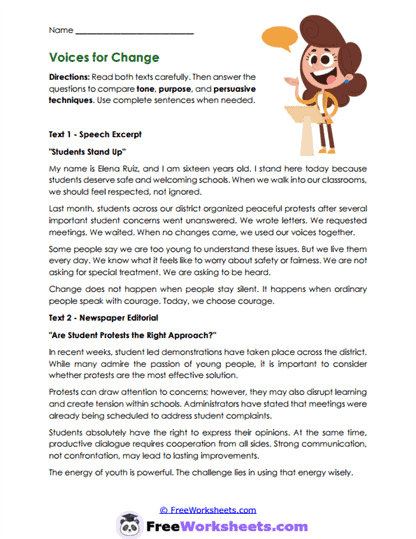
This worksheet helps students compare how two texts present different perspectives on the same issue. A teacher might explain to a parent, “This is a powerful one because students see how the same topic can be viewed in completely different ways.” It’s designed for Grade 6 students to analyze purpose, tone, and persuasive techniques. For example, one text supports student protests while the other raises concerns.
Curriculum and Grade Alignment
This activity aligns with CCSS.ELA-LITERACY.RI.6.9, focusing on comparing how authors present ideas and arguments. A teacher might say, “Students are learning to look at both sides instead of just accepting one viewpoint.” This builds critical thinking and evaluation skills. It also supports understanding of persuasive writing.
Student Tasks
On this worksheet, students will read a speech excerpt and an opinion article. A teacher might explain, “They’ll compare how each author presents their ideas and supports their viewpoint.” Students answer questions about purpose, tone, and persuasive techniques. They also explain similarities and differences between the texts.
Common Challenges and Misconceptions
Students may focus on which side they agree with instead of analyzing both texts. A teacher might note, “They’ll give opinions instead of comparing the writing.” Another challenge is identifying specific techniques used by each author. Teachers can support students by guiding them to look for evidence.
Implementation Guidance
In the classroom, this worksheet works well for group discussion and debate. A teacher might say, “We often talk through both perspectives before answering questions.” At home, parents can support by discussing different viewpoints on real issues. This helps students apply the skill beyond the worksheet.
Details and Features
The worksheet includes two engaging texts with contrasting viewpoints. A teacher might point out, “It’s a great way to build discussion and deeper thinking.” The questions are structured to guide comparison step by step. It is easy to print and use in classroom or home settings.