
Synonyms and Antonyms Worksheets
Replacing a word with a synonym can preserve a sentence's meaning, while choosing an antonym may reverse it completely. These grade 2 synonyms and antonyms worksheets explore those relationships through matching word pairs, identifying opposites, and rewriting sentences with alternative vocabulary. The free printable PDFs begin with familiar word comparisons and extend into activities requiring children to generate their own examples. Encourage learners to reread each revised sentence and consider whether the replacement maintains the original idea or changes it in an intended way.
About This Collection of Worksheets
Words do more than name objects, actions, and feelings; they help us communicate exactly what we mean. Understanding synonyms and antonyms gives young readers a way to explore those meanings and recognize how words connect. Synonyms introduce the idea that different words can communicate similar thoughts, while antonyms help children recognize contrasts and changes in meaning. For 2nd grade students, these relationships are especially valuable as reading materials become more descriptive and writing begins to involve more deliberate vocabulary choices. Learning that enormous and big describe similar qualities, for example, allows children to understand unfamiliar language through words they already know.
This collection introduces word relationships through a progression of activities that move from recognition toward independent application. Students begin by matching familiar synonyms and antonyms, then advance to choosing the correct word from multiple options, identifying several synonyms for one word, and distinguishing between similar and opposite meanings. Sentence-based activities add another layer of thinking by asking children to replace vocabulary words and observe how the sentence changes or stays the same. Word maps and open-response exercises encourage students to retrieve vocabulary independently, helping them move beyond recognizing correct answers to generating their own meaningful word connections.
Teachers can use these printables to introduce new vocabulary concepts, reinforce classroom instruction, or identify students who need additional support with word meanings. Matching and multiple-choice activities provide accessible starting points for developing readers, while sentence rewriting and word mapping offer more challenging opportunities for students ready to apply their understanding. Parents, tutors, and homeschool educators can also use the collection for short, focused lessons that connect vocabulary practice to everyday conversations, shared reading, and creative writing. The worksheets work particularly well when children are encouraged to explain their choices, because discussing why two words are similar or opposite often reveals more about their understanding than simply selecting the correct answer.
Paul’s Teacher Tip
One of the most important distinctions to teach is that synonyms often have similar meanings without being perfectly interchangeable. For example, warm and hot both describe temperature, but children can recognize that a warm bath and a hot stove create very different impressions. Before beginning the sentence-rewriting worksheets, demonstrate this distinction by replacing a familiar word with two possible synonyms and asking students which one best preserves the original meaning. When introducing antonyms, encourage children to look for genuine opposites rather than words that are simply different, using concrete examples such as open/closed before progressing to less obvious relationships. As students gain confidence, ask them to explain how changing one word affects the meaning or feeling of an entire sentence; this simple discussion develops the thoughtful vocabulary choices that make both reading comprehension and written expression stronger.
Worksheet Collection Skill Spotlights
Antonym Swap
What Kids Do:
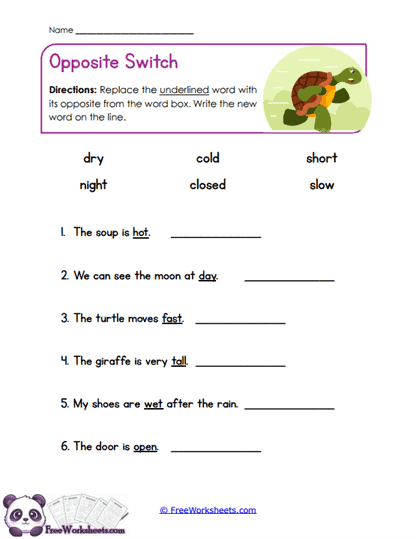
Students read six short sentences and identify the underlined vocabulary word in each one. Using a word bank containing choices such as dry, cold, short, night, closed, and slow, they select the word that expresses the opposite meaning and write it on the corresponding line. After completing each replacement, students can reread the sentence to hear how the meaning changes when an antonym takes the place of the original word.
Target Skill:
This activity develops students’ ability to recognize and apply antonyms within meaningful sentence contexts. Rather than identifying isolated opposite pairs, children must connect vocabulary knowledge to what they read and distinguish genuine opposites from words that might merely sound appropriate. The exercise strengthens semantic understanding, sentence comprehension, and the ability to recognize how a single word can change the message being communicated.
Meaning Mix
What Kids Do:
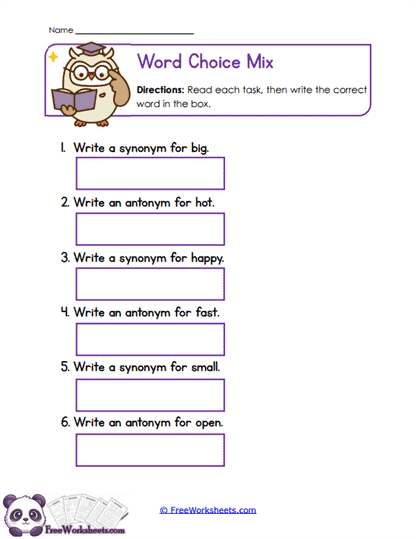
Children work through six short vocabulary prompts that alternate between requesting a synonym and an antonym. Each prompt identifies a familiar word, such as big, hot, happy, fast, small, or open, and asks students to supply a word with the appropriate meaning relationship. Students carefully read the direction, determine whether they need a similar or opposite meaning, and independently write their answer inside the provided response box.
Target Skill:
By mixing both vocabulary relationships within one activity, this worksheet strengthens students’ understanding of the difference between synonyms and antonyms. Children must retrieve appropriate words from memory rather than simply recognize correct choices, encouraging more independent command of vocabulary. The alternating directions also reinforce careful reading, flexible thinking, and the ability to shift between identifying similarities and contrasts in word meanings.
Opposite Choices
What Kids Do:
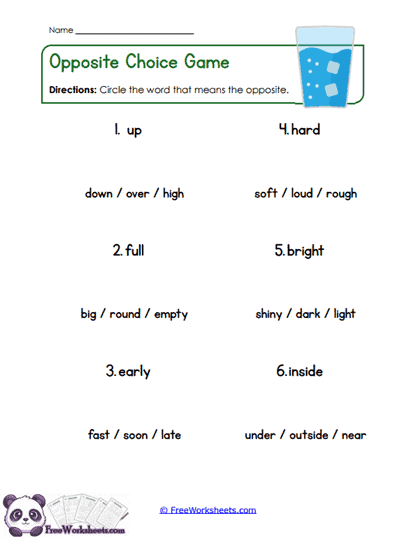
Students examine six target words, including up, full, early, hard, bright, and inside, and consider three possible answer choices for each one. They compare the meanings of the choices before circling the word that expresses the opposite of the target. For example, students recognize that empty is the opposite of full and outside is the opposite of inside. The multiple-choice structure encourages careful consideration of each option before selecting an answer.
Target Skill:
This worksheet helps students refine their ability to identify precise antonyms while distinguishing true opposites from merely different or loosely related words. Evaluating multiple possibilities encourages children to focus on meaning rather than making quick associations. The practice strengthens vocabulary discrimination, reading comprehension, and recognition of contrasting concepts, supporting the increasingly detailed language students encounter in 2nd grade reading and writing.
Opposite Pairs
What Kids Do:
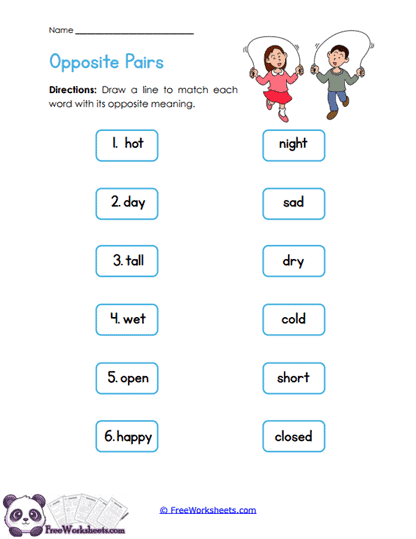
Children match six familiar vocabulary words with their opposites by drawing connecting lines between two columns. They work with recognizable pairs such as hot and cold, day and night, tall and short, wet and dry, open and closed, and happy and sad. Students read each word, compare it with the available choices, and identify the word that expresses the clearest opposite meaning before completing the match.
Target Skill:
The matching activity builds a foundational understanding of antonyms through concrete, familiar vocabulary relationships. Students learn to recognize contrasting meanings quickly while strengthening their understanding of descriptive language and common word pairs. By connecting words that communicate opposite conditions, feelings, or qualities, children develop vocabulary knowledge that supports comprehension of comparisons and contrasts in everyday language and written texts.
Opposite Rewrite
What Kids Do:
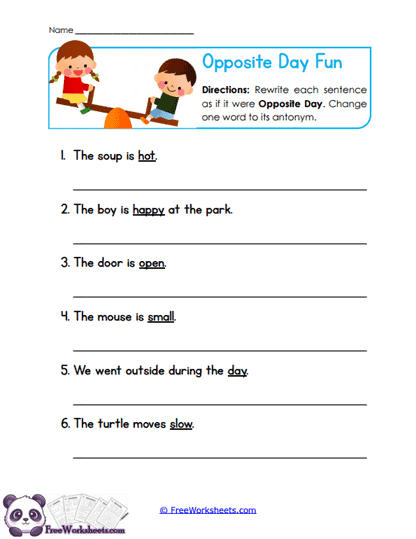
Students participate in an “Opposite Day” writing activity by reading six short sentences and locating the underlined vocabulary word in each one. They determine an appropriate antonym for words such as hot, happy, open, small, day, and slow, then rewrite the entire sentence using the opposite word. After rewriting, students can compare the two versions to observe how the replacement changes what the sentence communicates.
Target Skill:
This activity advances antonym understanding from individual word recognition to meaningful application in complete sentences. Students strengthen their ability to identify opposite meanings, maintain correct sentence structure, and understand how vocabulary choices influence a statement’s message. Rewriting sentences also supports written expression and encourages children to recognize that changing one carefully selected word can create a substantially different meaning.
Synonym Buddies
What Kids Do:
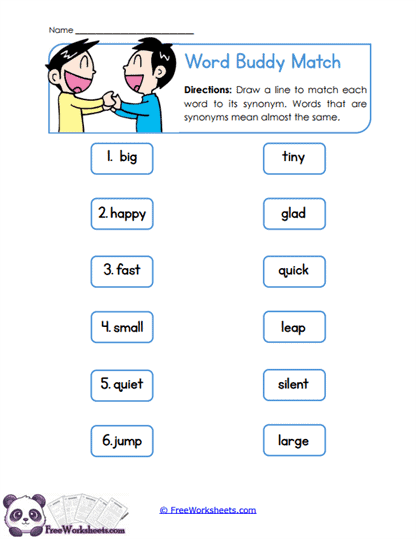
Students examine two columns of familiar vocabulary words and draw lines connecting pairs with the same or nearly the same meaning. They encounter relationships such as big and large, happy and glad, fast and quick, small and tiny, quiet and silent, and jump and leap. Each match requires children to consider what the words communicate rather than relying on spelling or appearance to determine which words belong together.
Target Skill:
This introductory synonym activity develops students’ understanding that different words can express similar ideas. Recognizing equivalent or nearly equivalent meanings supports vocabulary expansion and helps children connect unfamiliar terms with words they already understand. The matching format also strengthens semantic reasoning and provides an accessible foundation for using varied vocabulary when reading, speaking, and composing sentences.
Synonym Rewrite
What Kids Do:
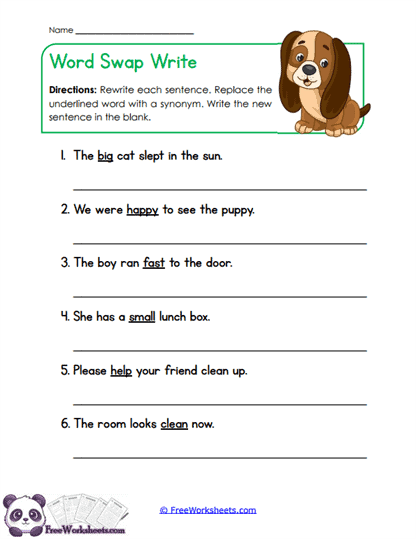
Children read six short sentences containing an underlined target word, such as big, happy, fast, small, help, or clean. They think of an appropriate synonym and rewrite the complete sentence on the provided writing line, replacing the original word while leaving the central message unchanged. Students can then reread both versions to determine whether their chosen vocabulary word fits naturally within the sentence.
Target Skill:
This worksheet strengthens students’ ability to apply synonym knowledge directly to written expression. Choosing replacement words within sentences requires children to consider both individual meanings and the surrounding context, encouraging more deliberate vocabulary choices. The rewriting component also reinforces sentence construction, fluency, and the understanding that writers can communicate similar ideas using different but carefully selected words.
Synonym Search
What Kids Do:
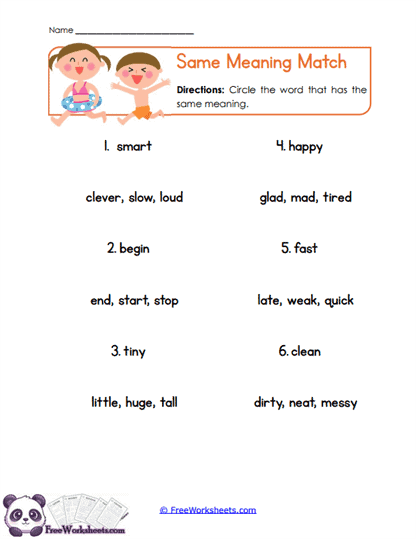
Students read six target words, including smart, begin, tiny, happy, fast, and clean, and examine three possible synonyms for each one. They compare the choices and circle the word that has the same or nearly the same meaning as the target. For example, they recognize clever as a synonym for smart and little as a synonym for tiny. Each question asks students to identify the strongest meaning connection while disregarding unrelated or opposite choices.
Target Skill:
The multiple-choice activity develops careful synonym recognition by requiring students to evaluate several vocabulary possibilities. Students strengthen their ability to distinguish similar meanings from unrelated associations, an important skill when determining the meaning of unfamiliar words in reading passages. The exercise also reinforces word relationships and promotes more accurate vocabulary selection, supporting comprehension and expressive language development.
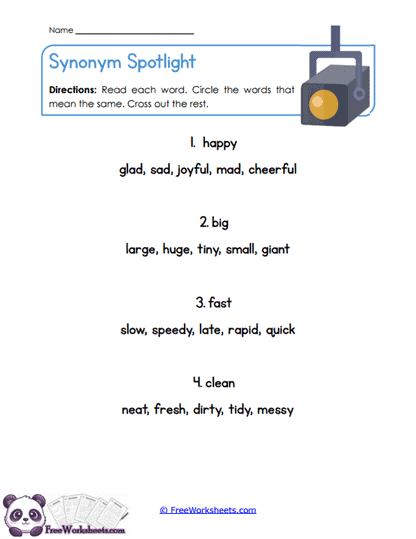
Synonym Spotlight
What Kids Do:
Children explore four familiar target words-happy, big, fast, and clean-and examine five vocabulary choices associated with each one. Instead of selecting only one correct answer, they circle every word that expresses the same or nearly the same meaning and cross out words that do not belong. For example, students can connect happy with glad, joyful, and cheerful while recognizing that sad and mad communicate different feelings.
Target Skill:
This activity deepens vocabulary understanding by demonstrating that a word can have several synonyms rather than one fixed equivalent. Students learn to identify groups of related meanings, compare vocabulary choices, and recognize words that do not fit a particular meaning family. The multiple-answer format encourages more flexible thinking about language and supports the development of richer vocabulary for reading comprehension and descriptive writing.
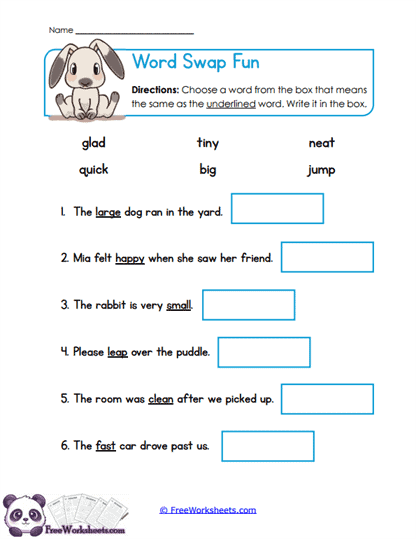
Synonym Swap
What Kids Do:
Students use a six-word bank containing glad, tiny, neat, quick, big, and jump to replace underlined words in short sentences. They identify the target word, consider which word-bank choice shares its meaning, and write the appropriate synonym in the answer space. Examples include replacing large with big and fast with quick. After each substitution, students can reread the sentence to confirm that its essential meaning has been preserved.
Target Skill:
This sentence-based activity helps students understand how synonyms function within meaningful language rather than existing only as isolated vocabulary pairs. Children practice selecting words with similar meanings and checking whether those replacements make sense in context. The process develops vocabulary flexibility, sentence comprehension, and word-choice awareness while reinforcing the relationship between individual vocabulary decisions and overall sentence meaning.
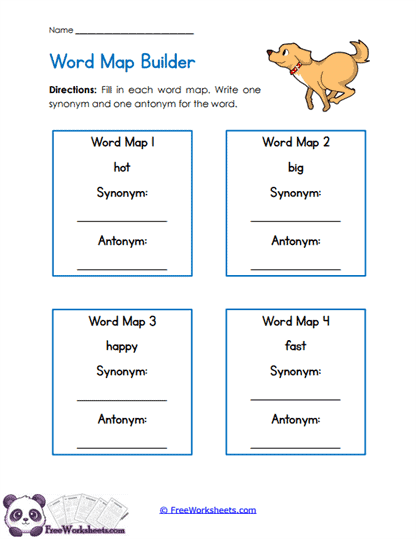
Word Maps
What Kids Do:
Students complete four visual vocabulary maps centered on the words hot, big, happy, and fast. For each target word, they independently generate one synonym and one antonym, writing both responses in the designated spaces. A word such as hot might be connected with warm as a similar meaning and cold as an opposite meaning. Students repeat this process to create a compact visual representation of both word relationships.
Target Skill:
Word mapping strengthens students’ ability to organize vocabulary according to meaning and recognize how one word connects to multiple related concepts. Generating both a synonym and an antonym encourages children to think about vocabulary from two complementary perspectives rather than relying on a single memorized association. This visual approach supports semantic organization, independent word retrieval, and stronger vocabulary connections that aid reading comprehension.
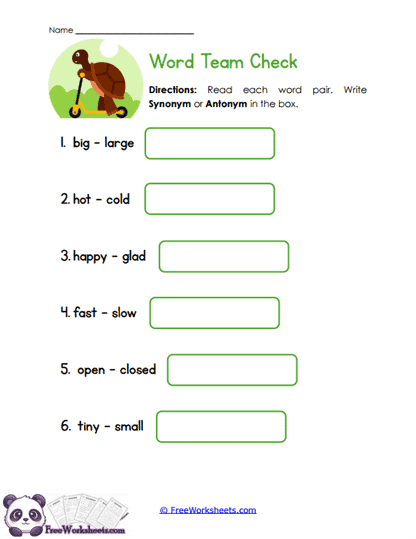
Word Teams
What Kids Do:
Children read six pairs of vocabulary words and determine whether each pair represents synonyms or antonyms. They examine combinations such as big and large, hot and cold, happy and glad, fast and slow, open and closed, and tiny and small. After considering how each pair is related, students write Synonym or Antonym in the corresponding answer box, classifying each relationship according to its meaning.
Target Skill:
This classification activity consolidates students’ understanding of the distinction between similar and opposite word meanings. Because synonyms and antonyms appear together, children must analyze each pair rather than assume every relationship follows the same pattern. The exercise strengthens semantic categorization, vocabulary reasoning, and familiarity with essential language terminology while helping students apply these concepts more confidently during reading and writing.