
Homophones and Homonyms Worksheets
Words that sound alike or share the same spelling can confuse young readers when their meanings differ. These grade 2 homophones and homonyms worksheets help children distinguish pairs such as see and sea while exploring multiple meanings of words like bat and bank. Learners select appropriate spellings in sentences, identify homophones in short passages, and explain alternative word meanings. The free printable PDFs include guided choices and written challenges. Read complete sentences together and discuss which contextual clues reveal the intended meaning.
About This Collection of Worksheets
Understanding homophones and homonyms helps young readers recognize that words can sound alike or look alike while communicating different meanings. These 2nd grade vocabulary worksheets introduce familiar homophones such as see/sea, right/write, and hear/here, along with homonyms such as bat, park, and bank. Students learn that homophones share the same pronunciation but have different meanings and often different spellings, while the homonym activities focus on words with the same spelling that carry different meanings depending on how they are used. Recognizing these relationships strengthens spelling accuracy, vocabulary understanding, and reading comprehension by teaching children to consider more than how a word looks or sounds.
The collection includes engaging activities that help students identify, compare, and apply homophones and homonyms in meaningful contexts. Children choose the correct sound-alike word to complete sentences, sort vocabulary examples into homophone and homonym groups, and match multiple-meaning words with appropriate definitions. Other worksheets challenge students to locate homophones within short reading passages, correct incorrectly used words, evaluate whether definitions match sentence meanings, and explain alternative meanings for familiar words. Open-ended sentence-writing exercises give students opportunities to demonstrate how different spellings or meanings change what a sentence communicates.
Teachers can incorporate these printable worksheets into vocabulary lessons, spelling instruction, guided reading, literacy centers, or independent language arts practice. Parents, tutors, and homeschool educators can reinforce the concepts by comparing familiar word pairs, discussing multiple meanings, and encouraging children to explain which sentence clues support their answers. Some worksheets provide structured support through matching, multiple-choice, and true-or-false questions, while others require students to generate original sentences or supply alternative word meanings independently. This variety helps educators address common spelling confusions while developing the flexible vocabulary knowledge students need for increasingly complex reading and writing.
Paul’s Teacher Tip
Begin by introducing a familiar homophone pair such as sun and son, asking students to explain why the words sound identical but have different meanings and spellings. Next, demonstrate a homonym such as bat by showing how the same written word can refer to a flying animal or a piece of sports equipment. Encourage children to read the entire sentence before choosing a meaning or spelling, since listening to the word alone cannot always reveal the correct answer. When students confuse homophones, have them draw a quick picture or write a short definition beside each spelling to reinforce the distinction. Extend the lesson by asking students to create two sentences using a homophone pair or two meanings of a homonym, then underline the context clues that make each meaning clear.
Worksheet Collection Skill Spotlights
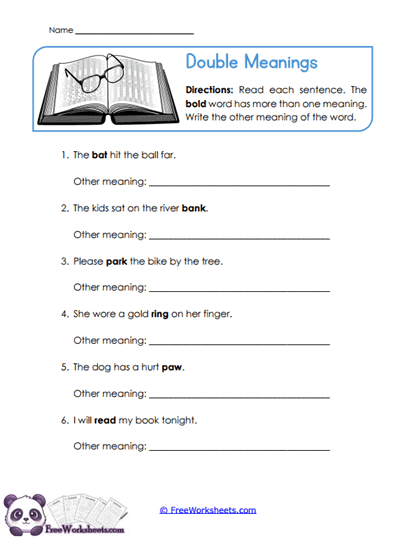
Double Meanings
What Kids Do:
Students examine six familiar multiple-meaning words, including bat, bank, park, ring, paw, and read. Each word appears in a sentence that demonstrates one particular meaning, and children must think of a different meaning for that same word. They write their alternative definitions on the provided lines, using their existing vocabulary knowledge to show how a single word can communicate more than one idea.
Target Skill:
This activity develops flexible vocabulary thinking and the ability to recognize multiple meanings for familiar words. Rather than simply identifying a definition from choices, 2nd grade students must independently recall another valid meaning, strengthening semantic awareness, word knowledge, and the understanding that sentence context determines how a word should be interpreted.
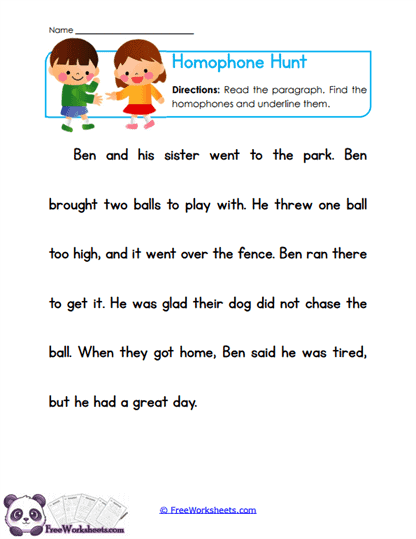
Homophone Hunt
What Kids Do:
Children read a short paragraph about Ben and his sister visiting a park, bringing two balls, throwing one too high, and running to retrieve it. As they read, they search for homophones that appear naturally within the story and underline the words they identify. Students can then name the matching sound-alike words, connecting examples such as two/too and one/won with their different spellings and meanings.
Target Skill:
This worksheet strengthens homophone recognition during connected reading rather than isolated word-pair exercises. Students practice identifying familiar sound-alike words, recalling alternative spellings, and considering how each spelling communicates a particular meaning. These skills support 2nd grade vocabulary development, spelling awareness, and careful reading comprehension.
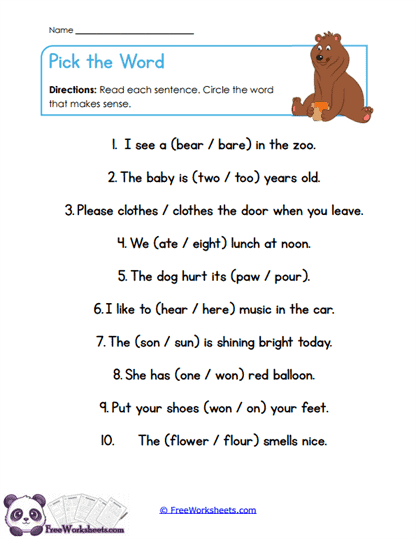
Homophone Picks
What Kids Do:
Students read ten sentences containing two homophone choices in parentheses. Word pairs include bear/bare, two/too, clothes/close, ate/eight, hear/here, son/sun, one/won, and flower/flour. Children examine the sentence context, compare the meanings of the two spellings, and circle the word that fits correctly. They can reread each completed sentence to check that the selected word communicates the intended meaning.
Target Skill:
This activity develops accurate homophone selection by requiring students to connect spelling with meaning. Because both choices may sound alike when spoken, 2nd grade readers must rely on context rather than pronunciation to determine the correct word. The repeated comparisons strengthen vocabulary discrimination, spelling accuracy, and sentence-level comprehension.
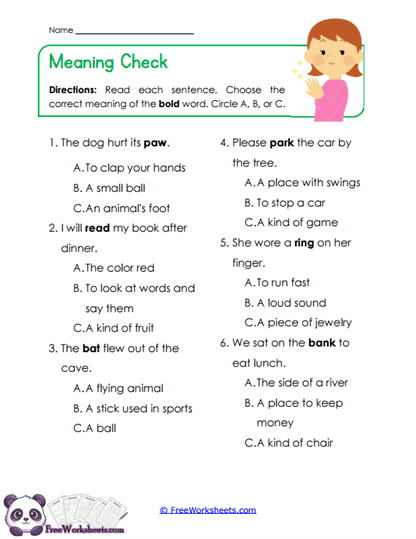
Meaning Check
What Kids Do:
Children examine six sentences containing bold vocabulary words such as paw, read, bat, park, ring, and bank. Each sentence is followed by three possible definitions, and students circle A, B, or C to identify the meaning that matches the word’s use. They consider surrounding details, such as whether park refers to stopping a vehicle or whether paw describes an animal’s foot, before making their selections.
Target Skill:
The worksheet strengthens contextual interpretation of homonyms and multiple-meaning words. Students learn to evaluate how a word functions within a particular sentence instead of automatically selecting its most familiar definition. This supports 2nd grade vocabulary flexibility, context clue recognition, and the ability to distinguish meanings during reading.
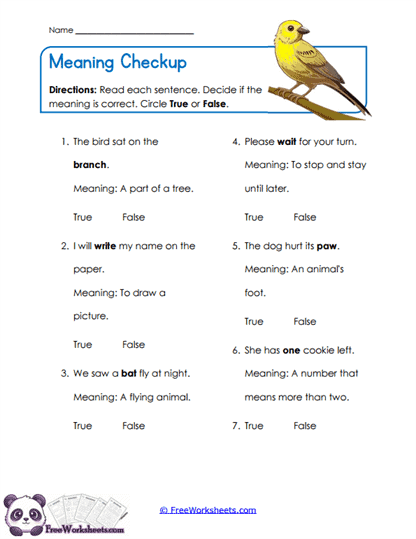
Meaning Checkup
What Kids Do:
Students read six sentences featuring words such as branch, write, bat, wait, paw, and one. Beneath each sentence, they examine a proposed meaning for the highlighted word and circle True or False to indicate whether the definition fits the context. Children must evaluate the relationship between the word and the situation described rather than assuming every familiar definition is appropriate.
Target Skill:
This activity builds vocabulary verification and careful reading skills by asking students to judge whether a definition accurately represents a word’s contextual meaning. The true-or-false format encourages 2nd grade students to compare word meanings with sentence evidence, strengthening comprehension, semantic reasoning, and awareness of words that may have multiple uses.
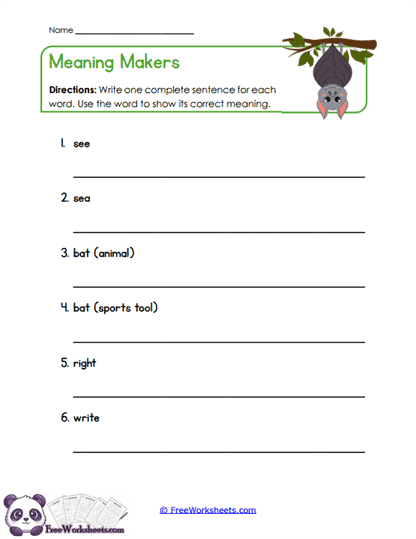
Meaning Makers
What Kids Do:
Children write original sentences using six target words or meanings, including see, sea, bat as an animal, bat as a sports tool, right, and write. They create a complete sentence for each entry, making sure the surrounding words clearly demonstrate the intended meaning. For the word bat, students write two separate sentences to show how identical spelling can represent different things.
Target Skill:
This worksheet develops the ability to demonstrate understanding of homophones and homonyms through independent writing. Students must choose meaningful context that makes each word’s definition clear to the reader, reinforcing 2nd grade vocabulary application, spelling accuracy, sentence construction, and awareness of how word meaning depends on surrounding language.
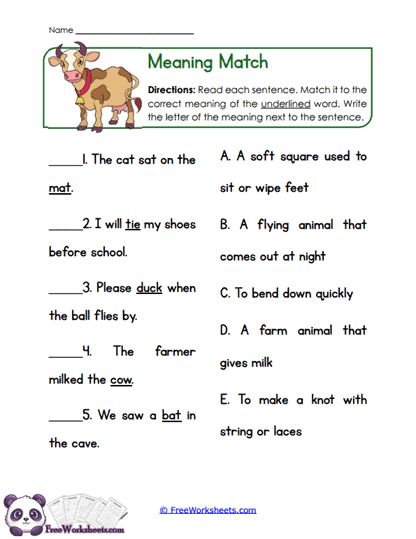
Meaning Match
What Kids Do:
Students read five sentences featuring underlined words such as mat, tie, duck, cow, and bat. They examine a separate list of child-friendly definitions and write the letter corresponding to the meaning that fits each sentence. Children use the situation described to determine the intended definition, paying attention to how familiar words may represent objects, actions, or other meanings in different contexts.
Target Skill:
This activity strengthens the ability to interpret words through sentence context and connect them with accurate definitions. By evaluating how a familiar word is used rather than assuming only one meaning is possible, 2nd grade students develop stronger semantic flexibility, vocabulary comprehension, and recognition of multiple-meaning word relationships.
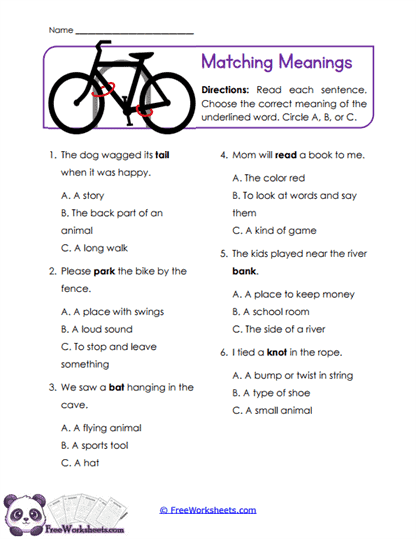
Meaning Matches
What Kids Do:
Children examine six sentences featuring underlined words such as tail, park, bat, read, bank, and knot. Each sentence provides context for the target word, followed by three possible definitions labeled A, B, and C. Students read the entire sentence, compare the meanings, and circle the option that best matches the word’s specific use, such as recognizing bank as the side of a river.
Target Skill:
This worksheet develops precise word-meaning identification by connecting vocabulary definitions with surrounding sentence clues. Students practice distinguishing between alternative interpretations of familiar words, strengthening 2nd grade reading comprehension, contextual reasoning, and the ability to interpret homonyms and multiple-meaning vocabulary accurately.
Sentence Choice
What Kids Do:
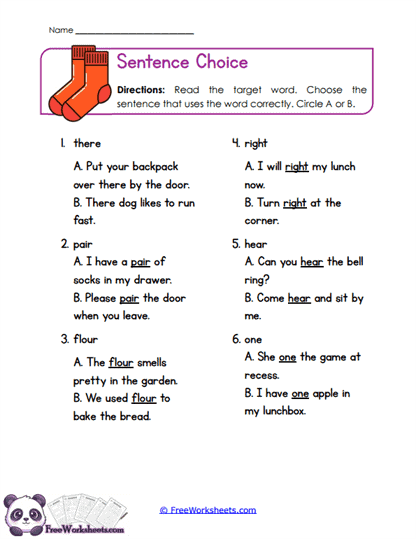
Students examine six target words, including there, pair, flour, right, hear, and one. For each word, they read two different sentences labeled A and B, then circle the letter of the sentence that uses the word correctly. Children consider whether the spelling matches the intended meaning, such as using pair to describe two socks or flour when discussing baking.
Target Skill:
The activity strengthens the ability to recognize correct homophone usage within complete sentences. Students learn to evaluate spelling and meaning together, rather than relying on pronunciation alone. This supports 2nd grade vocabulary knowledge, sentence comprehension, grammar awareness, and the development of more accurate word choices during writing and editing.
Sound Choices
What Kids Do:
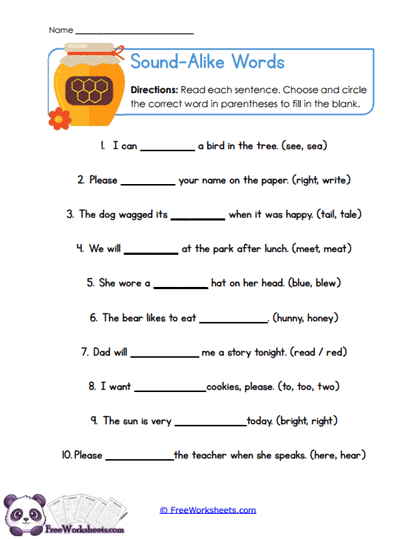
Children read ten fill-in-the-blank sentences containing homophone choices in parentheses. They work with familiar sound-alike words such as see/sea, right/write, tail/tale, meet/meat, blue/blew, hear/here, and to/too/two. Students circle the spelling that makes the sentence meaningful, using the surrounding words to determine which choice correctly communicates the intended idea.
Target Skill:
This worksheet reinforces the relationship between homophone spelling and vocabulary meaning. Students practice recognizing that words with identical pronunciations can represent different concepts, requiring careful interpretation of sentence clues. The activity strengthens 2nd grade spelling accuracy, contextual word selection, and comprehension of frequently confused vocabulary.
Sound Sorting
What Kids Do:
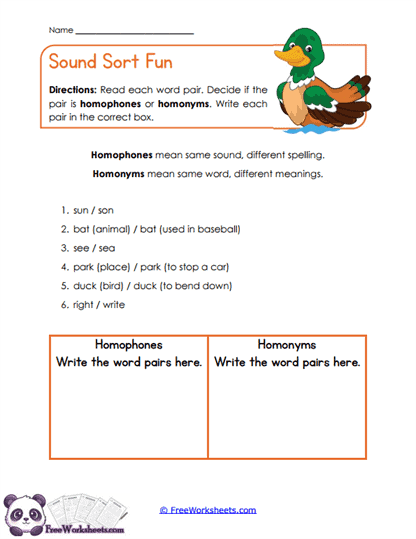
Students examine six examples of homophones and homonyms, including sun/son, see/sea, bat, park, duck, and right/write. After reviewing brief explanations of the two word relationships, they classify each example by writing it in either the Homophones or Homonyms box. Children compare whether words share the same sound with different spellings or use identical spellings to express different meanings.
Target Skill:
This sorting activity develops understanding of the differences between sound-based and meaning-based word relationships. Students practice recognizing homophone pairs and words with multiple meanings, strengthening 2nd grade vocabulary classification, spelling awareness, and the ability to explain how pronunciation, written form, and meaning interact.
Word Fixers
What Kids Do:
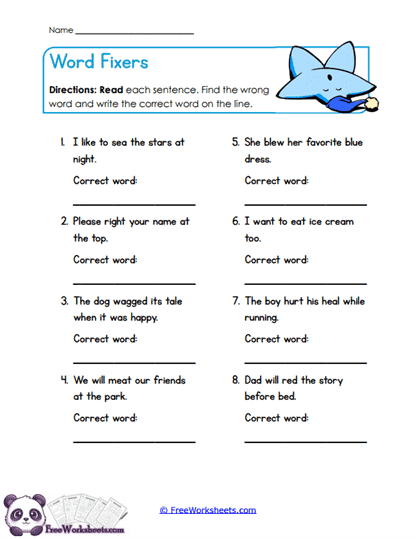
Children read eight sentences containing incorrectly used homophones, including examples such as “I like to sea the stars at night” and “The dog wagged its tale when it was happy.” They identify the word that does not fit the intended meaning and write the correct spelling on the provided line. The activity includes common pairs such as sea/see, right/write, tale/tail, meet/meat, and blew/blue.
Target Skill:
This worksheet develops vocabulary editing and proofreading skills by teaching students to recognize errors that may sound correct when read aloud. Students must evaluate sentence meaning, identify a mismatched homophone, and supply the appropriate spelling, supporting 2nd grade written language accuracy, reading comprehension, and more deliberate word selection.