
Place Value Worksheets
2nd grade math place value worksheets help students understand hundreds, tens, ones, digit values, expanded form, and three-digit number relationships. Free, ready-to-print worksheets in PDF format are designed for immediate classroom use, centers, guided practice, homework, or homeschool lessons. Students strengthen place-value reasoning, number representation, and comparison skills while developing abilities that support curriculum expectations.
About This Collection of Worksheets
Place value helps 2nd grade students understand that a digit’s position determines how much it represents. Students explore hundreds, tens, and ones while moving among standard form, expanded form, number words, base-ten models, and place-value clues. This understanding helps children read, build, break apart, compare, and order three-digit numbers with greater confidence.
The collection includes H-T-O charts, base-ten models, standard-to-expanded-form conversions, number-building clues, word-form matching, comparisons, ordering tasks, missing-digit puzzles, number riddles, and themed mixed review. Some worksheets focus on one representation, while others require students to switch between several forms of the same number. This variety helps students see that different representations can describe the same quantity.
Teachers can use these worksheets during place-value lessons, guided math, centers, homework, intervention, review, or informal assessment. Parents, tutors, and homeschool educators can support difficult tasks with base-ten blocks or a simple hundreds-tens-ones chart before returning to the printed activity. Because the collection includes both foundational models and reasoning challenges, it supports a progression from identifying place values to applying them in comparisons, ordering, and puzzles.
Paul’s Teacher Tip
Keep asking students two different questions: “What is the digit?” and “What is its value?” so they learn that the 4 in 348 is a digit but represents 40. When zeros appear, emphasize that the empty place still matters because it keeps the other digits in their correct positions. Use base-ten blocks or drawings before moving to expanded form if students are unsure why 506 means 500 + 6 rather than 50 + 6. During comparisons, have students start with the hundreds place and move right only when the digits are equal. Once students are confident, ask them to represent the same number in two or three different ways and explain how they know the forms are equivalent.
Worksheet Collection Skill Spotlights
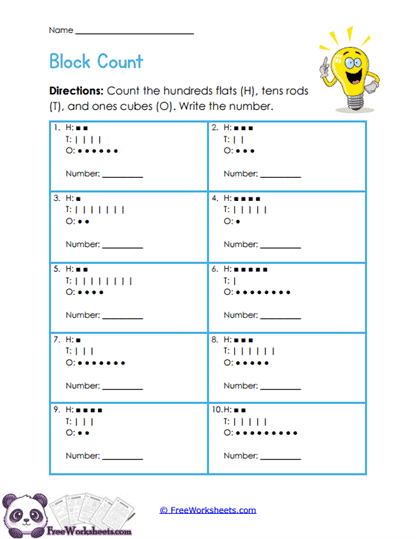
Base-Ten Decoder
What Kids Do:
Students examine ten visual models made from hundreds flats, tens rods, and ones cubes. They count each type of unit separately, combine the place-value quantities, and write the standard three-digit numeral represented by every model.
Target Skill:
This activity connects concrete base-ten representations with standard form. 2nd grade students strengthen understanding that hundreds, tens, and ones have different values and practice composing a complete number from visual place-value units within 1,000.
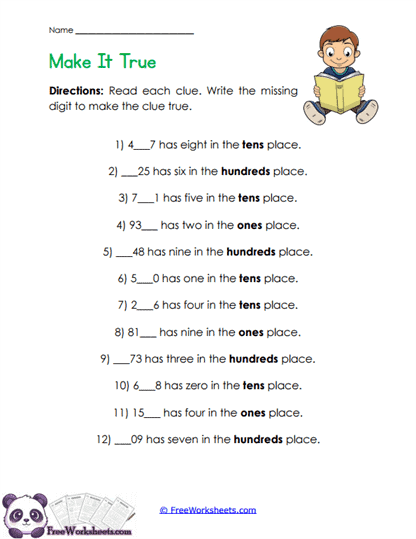
Digit Clue Fix
What Kids Do:
Students solve twelve partially completed three-digit numbers by reading clues about the hundreds, tens, or ones place. They determine which single digit belongs in each blank and then read the finished number to check that the clue is satisfied.
Target Skill:
The worksheet strengthens place-value vocabulary and precise digit placement. 2nd grade students practice distinguishing a place from a digit’s value, interpreting H-T-O language, and using positional clues to complete numbers accurately.
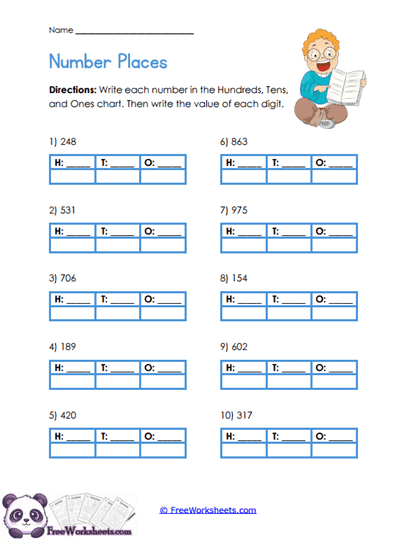
Digit Decomposer
What Kids Do:
Students work through ten three-digit numbers using charts labeled Hundreds, Tens, and Ones. For each numeral, they identify the digit in every place and then write the actual value represented by that digit, including examples with zeros.
Target Skill:
This activity develops the essential difference between a digit and its place value. 2nd grade students learn that a digit such as 2 can represent 200, 20, or 2 depending on position while strengthening decomposition and three-digit number sense.
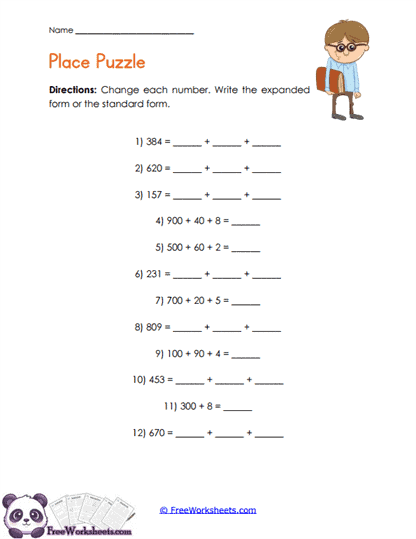
Form Flip
What Kids Do:
Students complete twelve conversions between standard and expanded form. Some problems begin with a three-digit numeral that must be broken into hundreds, tens, and ones, while others provide expanded parts that students combine into one standard number.
Target Skill:
The worksheet builds flexible representation and decomposition within 1,000. 2nd grade students practice connecting each digit with its value, composing numbers from place-value parts, and understanding that standard and expanded forms describe the same quantity.
Holiday Place Mix
What Kids Do:
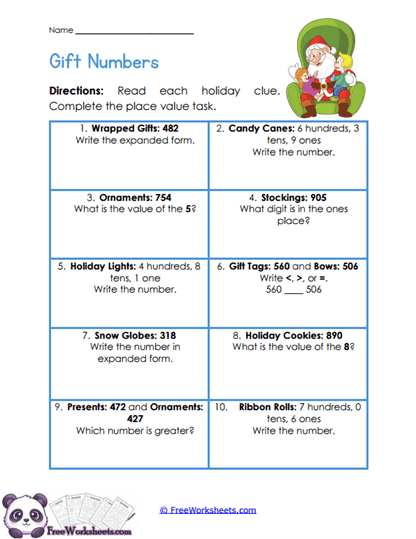
Students complete ten holiday-themed place-value tasks involving expanded form, digit values, number building, comparison symbols, and greater-number identification. The activity changes from one problem to the next, requiring careful reading before each response.
Target Skill:
This mixed review strengthens flexible use of several place-value representations. 2nd grade students practice moving among standard form, expanded form, digit value, H-T-O clues, and comparison while maintaining accuracy with three-digit numbers.
Mystery Number Lab
What Kids Do:
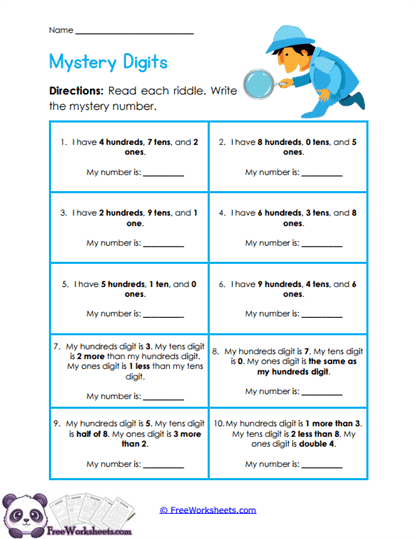
Students solve ten place-value riddles by interpreting clues about hundreds, tens, and ones. Early problems give direct place values, while later puzzles describe relationships between digits, requiring students to determine each position before writing the mystery number.
Target Skill:
This activity combines place value with logical reasoning and mathematical language. 2nd grade students practice building numbers from several clues, interpreting phrases such as more than or less than, and organizing digit relationships into a valid three-digit numeral.
Number Builder
What Kids Do:
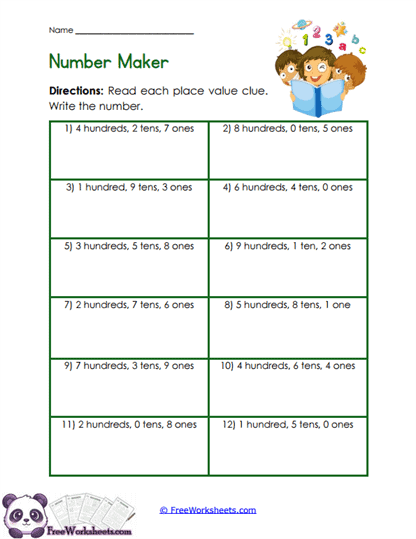
Students read twelve descriptions that state how many hundreds, tens, and ones make a number. They combine those clues to write each three-digit numeral, including examples where one place contains zero and must still be represented correctly.
Target Skill:
The worksheet strengthens number composition and understanding of zero as a placeholder. 2nd grade students practice translating place-value language into standard notation while keeping hundreds, tens, and ones in their correct positions.
Number Word Match
What Kids Do:
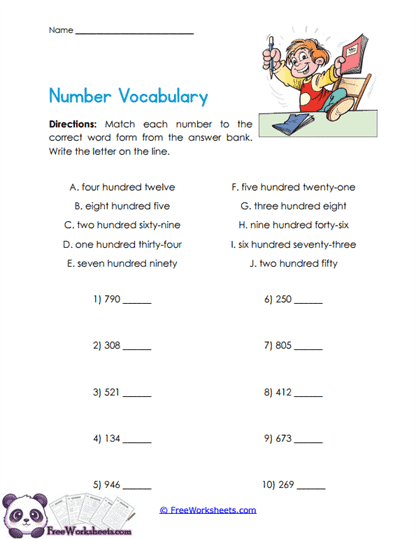
Students read ten three-digit numerals and match each one with its written number name from a lettered answer bank. They scan mixed choices, identify the exact word form, and record the corresponding letter beside each numeral.
Target Skill:
This activity connects standard notation with mathematical vocabulary and number-word reading. 2nd grade students strengthen their ability to interpret hundreds, tens, and ones in written language while recognizing equivalent numerical and word representations.
Order Builder
What Kids Do:
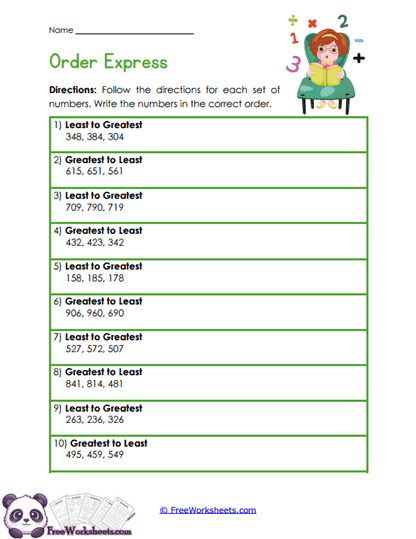
Students complete ten ordering problems with groups of three three-digit numbers. Depending on the directions, they rewrite each set from least to greatest or greatest to least while comparing hundreds, tens, and ones to determine the correct sequence.
Target Skill:
The worksheet applies place-value understanding to number ordering. 2nd grade students strengthen magnitude reasoning, sequencing, and comparison by deciding which place first determines the relative size of several numbers within the same set.
Pumpkin Place Clues
What Kids Do:
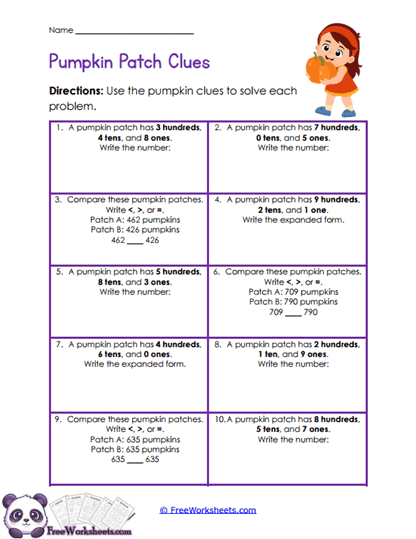
Students solve ten pumpkin-themed tasks that ask them to build numbers from hundreds-tens-ones clues, write expanded forms, and compare three-digit totals. Because the response type changes, they must identify what each problem asks before solving.
Target Skill:
This seasonal review develops flexible place-value reasoning across multiple representations. 2nd grade students practice number composition, decomposition, comparison, and careful interpretation of mathematical directions while working with values within 1,000.
School Supply Values
What Kids Do:
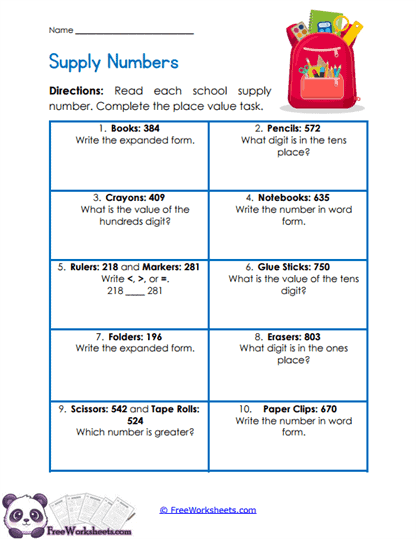
Students complete ten school-themed place-value questions involving expanded form, number words, digit identification, digit value, comparison symbols, and greatest-number choices. Familiar classroom objects provide context while the numerical tasks change across the page.
Target Skill:
This activity strengthens the ability to move among different place-value representations and question types. 2nd grade students practice distinguishing a digit from its value, reading three-digit numbers, comparing magnitudes, and interpreting place-value vocabulary accurately.
Value Showdown
What Kids Do:
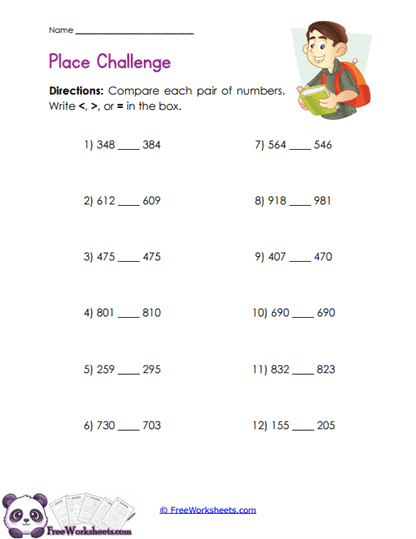
Students compare twelve pairs of three-digit numbers and write <, >, or = between them. They examine the hundreds first, then the tens and ones when necessary, including close pairs and equal values that require careful place-value comparison.
Target Skill:
The worksheet develops comparison fluency grounded in place-value reasoning. 2nd grade students learn to compare numbers systematically from the greatest place to the least, recognize equality, and use comparison symbols accurately with values within 1,000.