
Skip Counting And Number Patterns Worksheets
2nd grade math skip counting and number patterns worksheets help students extend sequences, identify rules, and count by equal intervals. Free, ready-to-print worksheets in PDF format are designed for immediate classroom use, centers, guided practice, homework, or homeschool lessons. Students strengthen skip-counting fluency, pattern recognition, and mental addition while developing skills that support curriculum expectations.
About This Collection of Worksheets
Skip counting and number patterns help 2nd grade students recognize that numbers can increase in predictable ways. Students practice counting forward by 2s, 5s, 10s, and 100s while learning to notice the repeated change from one number to the next. Understanding these patterns supports stronger number sense and gives children an early foundation for repeated addition and multiplication.
The collection includes missing-number sequences, rule identification, number-line paths, hundreds-chart coloring, rule matching, error analysis, and themed pattern practice. Some worksheets clearly state the skip-counting interval, while others require students to examine the numbers and determine the rule independently. These varied formats help students move from guided counting to deeper pattern reasoning.
Teachers can use these worksheets during number-sense lessons, centers, morning work, homework, intervention, or fluency review. Parents, tutors, and homeschool educators can reinforce the patterns through clapping, tapping, number lines, or oral counting before moving to written practice. Because the collection combines sequence completion, rule analysis, and error correction, it helps students apply skip-counting knowledge in several different ways.
Paul’s Teacher Tip
Have students say the counting rule aloud before they begin each sequence, such as “add 5 each time.” When a pattern is difficult, write +2, +5, +10, or +100 between neighboring terms so the repeated change becomes visible. Encourage students to check at least two pairs of numbers before deciding what an unlabeled rule is. For missing-number patterns, have them read the complete sequence aloud after filling the blanks because an incorrect value often sounds out of place. Once students are fluent, ask them to create their own pattern and challenge a classmate to identify the rule.
Worksheet Collection Skill Spotlights
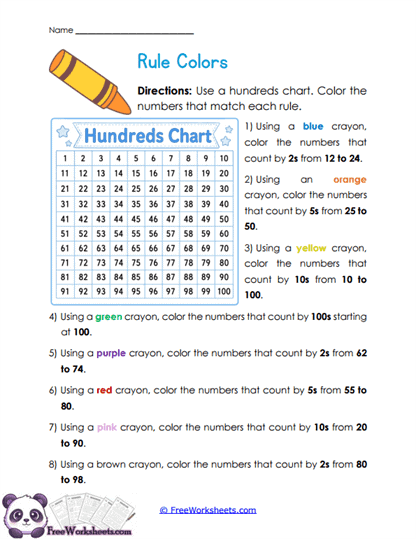
Chart Color Rules
What Kids Do:
Students follow eight color-coded directions on a hundreds chart, locating numbers that fit skip-counting rules by 2s, 5s, 10s, and 100s. They begin at the stated value, continue through the given range, and color only the numbers that belong to each sequence.
Target Skill:
This activity strengthens visual pattern recognition and hundreds-chart fluency. 2nd grade students see how repeated numerical changes form predictable paths across a grid while practicing accurate skip counting, direction-following, and number-location skills.
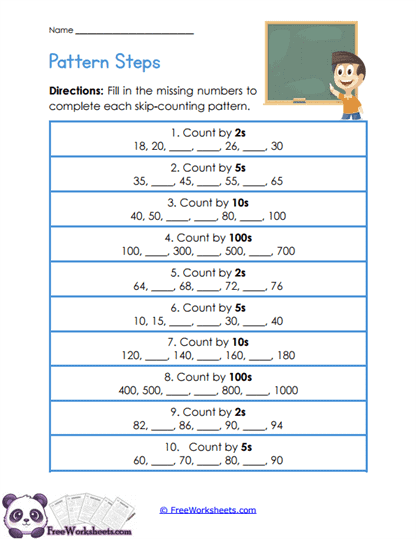
Counting Steps
What Kids Do:
Students complete ten partially filled number sequences in which the counting rule is already provided. They count forward by 2s, 5s, 10s, or 100s and write the missing values in the correct spaces while maintaining the same interval across each row.
Target Skill:
The worksheet builds foundational skip-counting fluency and repeated-addition thinking. 2nd grade students practice maintaining a consistent numerical change, extending sequences accurately, and recognizing how equal jumps create predictable number patterns.
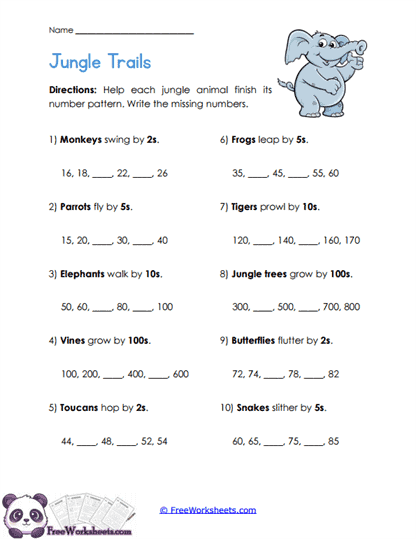
Jungle Number Trails
What Kids Do:
Students solve ten jungle-themed patterns featuring monkeys, parrots, elephants, vines, toucans, frogs, tigers, trees, butterflies, and snakes. They read the stated skip-counting rule and fill missing values throughout each sequence.
Target Skill:
This activity reinforces flexible counting by 2s, 5s, 10s, and 100s across changing number ranges. 2nd grade students strengthen sequence completion, repeated addition, attention to rules, and accurate movement between two- and three-digit values.
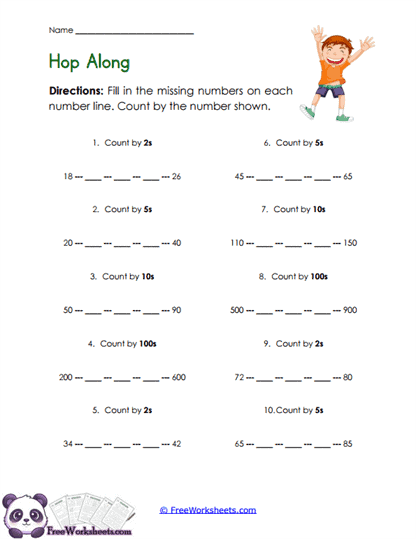
Number Line Hops
What Kids Do:
Students complete ten number-line style paths with given starting and ending values. Each problem tells them whether to count by 2s, 5s, 10s, or 100s, and they write the missing values along the repeated jumps between the endpoints.
Target Skill:
The visual format connects skip counting with movement along a number line. 2nd grade students strengthen repeated-addition reasoning, mental calculation, and number-line understanding by seeing each counting interval as an equal jump forward.
Pattern Predictor
What Kids Do:
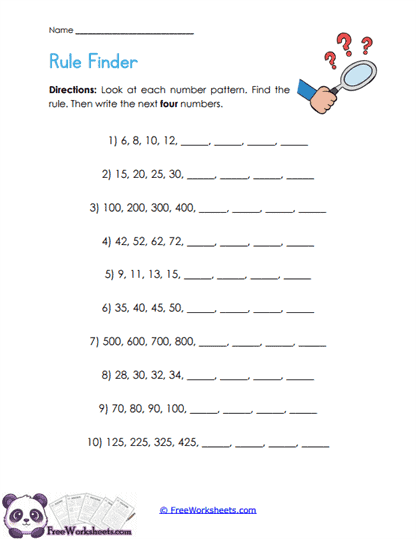
Students examine ten number sequences without being told the rule. They compare neighboring values, determine whether the pattern increases by 2, 5, 10, or 100, and then write the next four numbers to extend each sequence correctly.
Target Skill:
This worksheet develops independent pattern analysis rather than rule-following alone. 2nd grade students practice identifying repeated differences, using mental subtraction or comparison to detect a rule, and extending numerical patterns with increasing confidence.
Pattern Repair
What Kids Do:
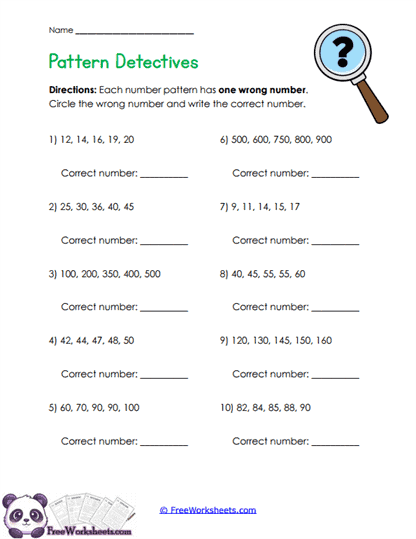
Students inspect ten completed skip-counting sequences that each contain one incorrect value. They identify the rule, circle the number that breaks the pattern, and write the correct replacement so the sequence follows the same interval throughout.
Target Skill:
The activity strengthens error analysis and mathematical self-checking. 2nd grade students practice recognizing consistent changes, detecting when a number violates a rule, and repairing sequences using skip-counting knowledge rather than simply filling empty spaces.
Pet Parade Patterns
What Kids Do:
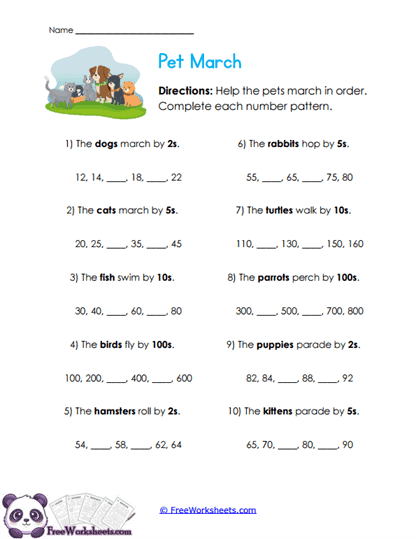
Students complete ten pet-themed sequences involving dogs, cats, fish, birds, hamsters, rabbits, turtles, parrots, puppies, and kittens. Each item provides a counting interval, and students fill in the missing numbers while following that rule.
Target Skill:
This worksheet builds fluency with repeated counts by 2s, 5s, 10s, and 100s. 2nd grade students practice maintaining a stated interval across partially completed sequences and shifting accurately between different rules from one problem to the next.
Reef Counting Trails
What Kids Do:
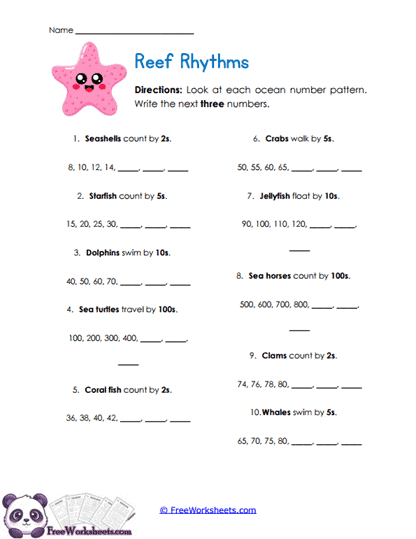
Students extend ten ocean-themed sequences featuring shells, starfish, dolphins, sea turtles, coral fish, crabs, jellyfish, sea horses, clams, and whales. They use the stated counting rule to write the next three numbers in each pattern.
Target Skill:
The activity develops forward sequence extension and mental addition. 2nd grade students reinforce skip-counting patterns by 2s, 5s, 10s, and 100s while learning to continue a repeated numerical change beyond the values already shown.
Rule Match
What Kids Do:
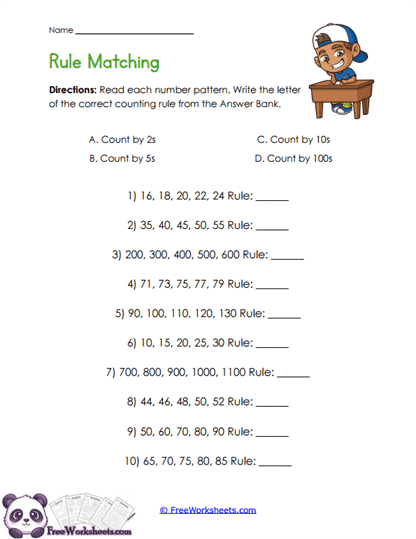
Students study ten completed number patterns and compare them with an answer bank containing count-by-2s, count-by-5s, count-by-10s, and count-by-100s rules. They determine the repeated change and record the letter of the matching rule.
Target Skill:
This worksheet strengthens pattern-rule identification and mathematical vocabulary. 2nd grade students practice focusing on the difference between neighboring terms rather than the size of the numbers, helping them recognize repeated-addition structures accurately.
Rule Reader
What Kids Do:
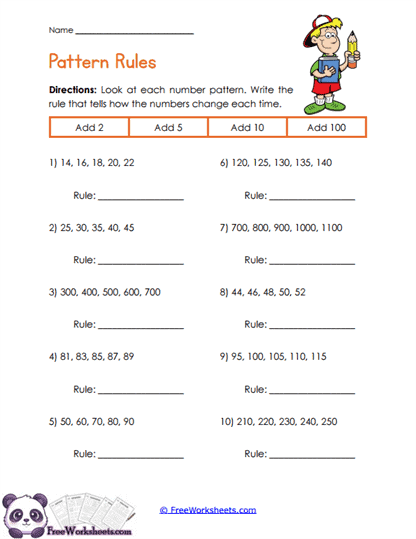
Students examine ten fully written number sequences and decide whether each one follows an Add 2, Add 5, Add 10, or Add 100 rule. They compare consecutive values and write the correct rule on the line beside each pattern.
Target Skill:
The activity helps students describe numerical patterns with precise mathematical language. 2nd grade learners strengthen rule recognition, mental comparison, repeated-addition reasoning, and the ability to explain how a sequence changes from term to term.
Sequence Fill-In
What Kids Do:
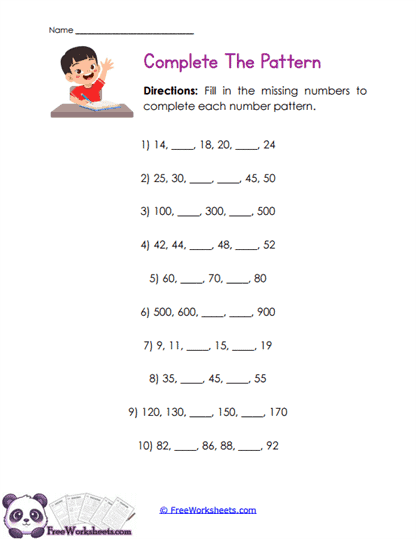
Students complete ten partially missing number patterns without being given the counting interval. They use the visible values to infer whether the rule is +2, +5, +10, or +100, then fill blanks that appear in different positions throughout each sequence.
Target Skill:
This worksheet combines rule detection with missing-number reasoning. 2nd grade students practice analyzing known terms, maintaining a repeated change across gaps, and using mental addition to reconstruct a complete and mathematically consistent sequence.
Space Sequence Mission
What Kids Do:
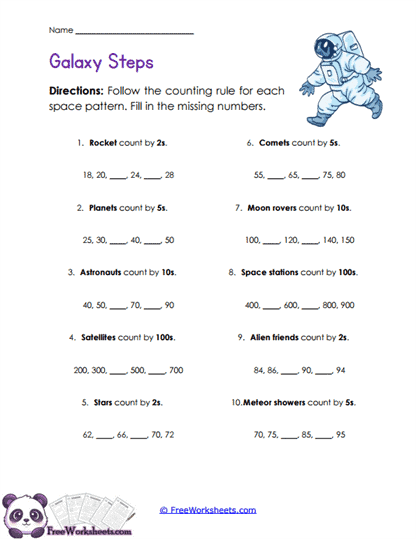
Students complete ten space-themed patterns involving rockets, planets, astronauts, satellites, stars, comets, moon rovers, space stations, aliens, and meteor showers. They follow the stated rule and fill missing values that appear throughout each sequence.
Target Skill:
The worksheet strengthens skip-counting fluency and internal sequence reasoning. 2nd grade students practice using counts by 2s, 5s, 10s, and 100s to determine missing values while checking that each answer fits the numbers both before and after it.