
Subtracting Two-digit Numbers Worksheets
2nd grade math subtracting two-digit numbers worksheets help students use place value, find differences, and solve subtraction problems with flexible strategies. Free, ready-to-print worksheets in PDF format are designed for immediate classroom use, centers, guided practice, homework, or homeschool lessons. Students strengthen subtraction fluency, place-value reasoning, and problem solving while developing skills that support curriculum expectations.
About This Collection of Worksheets
Subtracting two-digit numbers helps 2nd grade students understand how tens and ones work together when one quantity is taken away from another. Students learn that subtraction can be solved in several ways, including breaking numbers apart, using base-ten models, making backward jumps, or working in vertical form. Seeing these methods side by side helps children build both understanding and confidence.
The collection includes place-value breakdowns, base-ten models, decomposition strategies, open number-line jumps, vertical subtraction, answer matching, comparison activities, error checking, and real-world word problems. Some worksheets provide visual or step-by-step support, while others focus on independent computation and applying subtraction to familiar situations. The different formats give students repeated practice without relying on one routine.
Teachers can use these worksheets during subtraction lessons, guided math, centers, homework, intervention, review, or informal assessment. Parents, tutors, and homeschool educators can begin with visual models or break-apart strategies before moving toward more independent written computation. Because the collection combines reasoning, fluency, checking, and application, it supports a steady progression toward stronger two-digit subtraction skills.
Paul’s Teacher Tip
Before students use a written subtraction method, ask them to identify the tens and ones in both numbers. Encourage language such as “subtract tens from tens and ones from ones” so place value stays central to the process. When using number lines, remind students that subtraction means moving backward toward smaller numbers. Have students estimate whether an answer seems reasonable before accepting it, especially during independent work. If an error appears repeatedly, return to base-ten blocks or a break-apart strategy to show where the thinking went off track.
Worksheet Collection Skill Spotlights
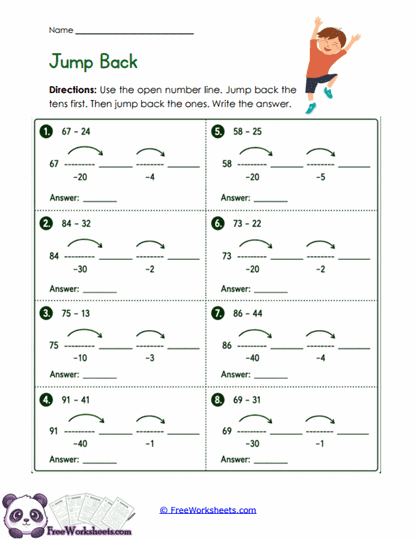
Backward Jumps
What Kids Do:
Students solve eight two-digit subtraction problems by starting with the larger number and making two backward jumps. They subtract the tens part first, record the intermediate landing number, subtract the ones part next, and then write the final difference.
Target Skill:
This activity strengthens open-number-line reasoning and mental subtraction. 2nd grade students practice decomposing the number being subtracted, moving backward by tens and ones, and keeping track of intermediate values while connecting subtraction with decreasing number magnitude.
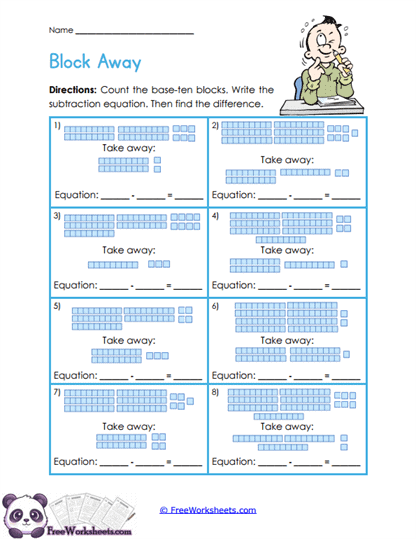
Base-Ten Takeaway
What Kids Do:
Students examine eight visual subtraction models made from tens rods and ones cubes. They count the starting quantity, identify the amount labeled to be taken away, write the matching subtraction equation, and calculate how much remains after the removal.
Target Skill:
The worksheet builds conceptual understanding of subtraction through base-ten representations. 2nd grade students strengthen place-value knowledge, equation writing, and the take-away meaning of subtraction before relying only on symbolic two-digit computation.
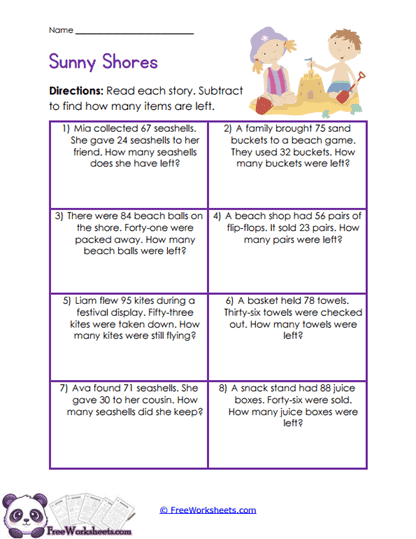
Beach Day Differences
What Kids Do:
Students read eight beach-themed subtraction stories about seashells, buckets, beach balls, flip-flops, kites, towels, juice boxes, and other summer items. They identify the starting amount, subtract the quantity removed, and record how many remain.
Target Skill:
This activity develops real-world subtraction reasoning and mathematical reading. 2nd grade students practice recognizing take-away situations, ordering quantities correctly in an equation, and applying two-digit subtraction to familiar contexts without regrouping.
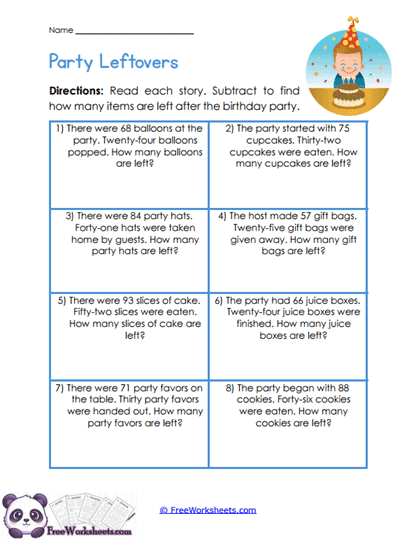
Birthday Leftovers
What Kids Do:
Students solve eight birthday-themed word problems involving balloons, cupcakes, party hats, gift bags, cake slices, juice boxes, party favors, and cookies. They determine the original amount, subtract what was used or removed, and write the remaining quantity.
Target Skill:
The worksheet strengthens subtraction application in everyday situations. 2nd grade students practice translating take-away language into equations, identifying what is left after a change, and using accurate two-digit computation while reading short story problems.
Break Apart Subtraction
What Kids Do:
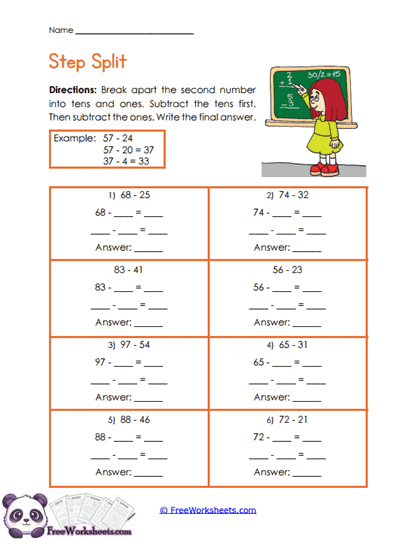
Students solve eight guided subtraction problems by splitting the second number into tens and ones. They subtract the tens part from the starting number, write the intermediate result, subtract the remaining ones, and then record the final difference.
Target Skill:
This strategy develops decomposition and mental subtraction. 2nd grade students strengthen place-value reasoning by understanding a two-digit subtrahend as separate tens and ones and using those parts to make a larger subtraction problem easier to manage.
Difference Face-Off
What Kids Do:
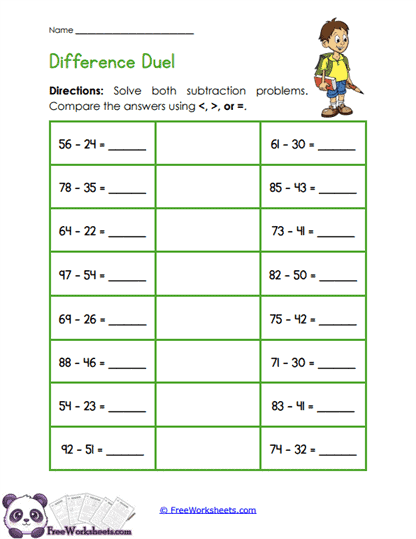
Students solve eight pairs of two-digit subtraction equations presented side by side. They calculate both differences, write each result, and then place <, >, or = between the answers to show how the two differences compare.
Target Skill:
The worksheet combines subtraction fluency with comparison reasoning. 2nd grade students practice accurate computation, number magnitude, and correct symbol use while learning that they must solve both expressions before deciding which resulting difference is greater.
Difference Match-Up
What Kids Do:
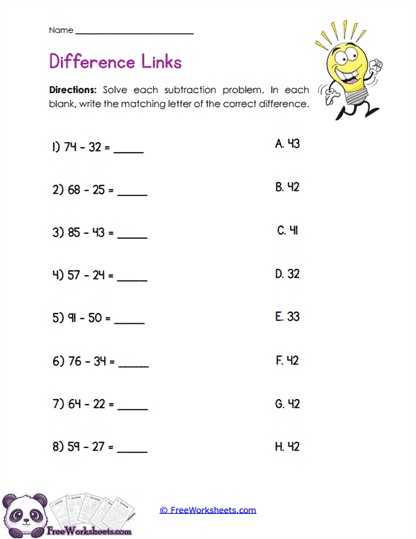
Students calculate eight two-digit subtraction problems and then search a lettered answer bank for each exact difference. They record the numerical result and match it to the correct letter, using the available choices as a checking step after solving.
Target Skill:
This activity strengthens subtraction fluency and answer verification. 2nd grade students practice computing differences accurately, scanning for exact numerical matches, and developing self-checking habits instead of choosing an answer simply because it appears close.
Place Value Differences
What Kids Do:
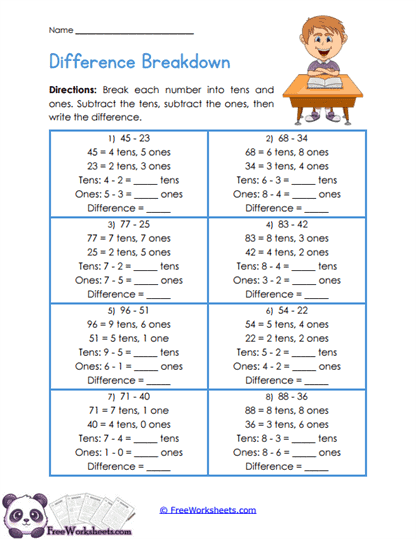
Students work through eight subtraction problems by separating each two-digit number into tens and ones. They subtract corresponding place-value parts, record the tens and ones differences, and combine those parts to write the final answer.
Target Skill:
The worksheet reinforces place-value structure as the basis of subtraction. 2nd grade students practice understanding the value of each digit, keeping tens and ones organized, and using decomposition to explain how a two-digit difference is formed.
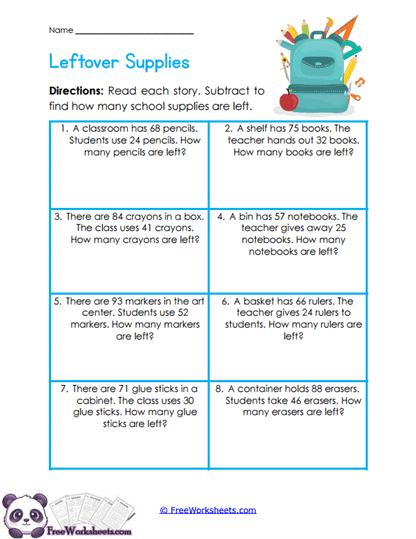
School Supply Leftovers
What Kids Do:
Students solve eight school-themed stories involving pencils, books, crayons, notebooks, markers, rulers, glue sticks, and erasers. They identify how many items were available at first, subtract those used or removed, and find the amount left.
Target Skill:
This activity strengthens subtraction in practical take-away situations. 2nd grade students practice reading for mathematical meaning, identifying the minuend and subtrahend from context, and applying two-digit subtraction accurately to familiar classroom examples.
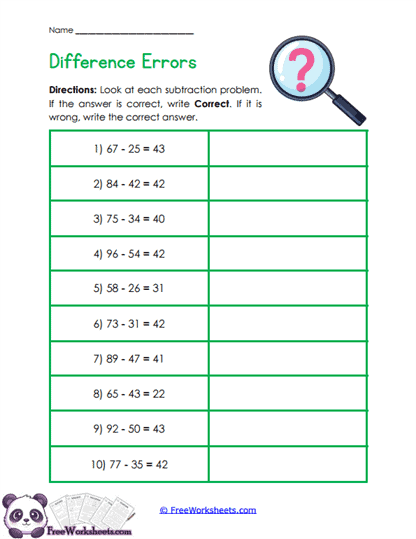
Subtraction Inspector
What Kids Do:
Students examine ten completed two-digit subtraction equations and check whether each printed answer is correct. They recalculate each problem independently and write a corrected difference whenever the original result does not match their own work.
Target Skill:
The worksheet develops error analysis and self-correction. 2nd grade students strengthen subtraction accuracy, place-value reasoning, and checking habits by evaluating completed work instead of assuming a printed result is automatically correct.
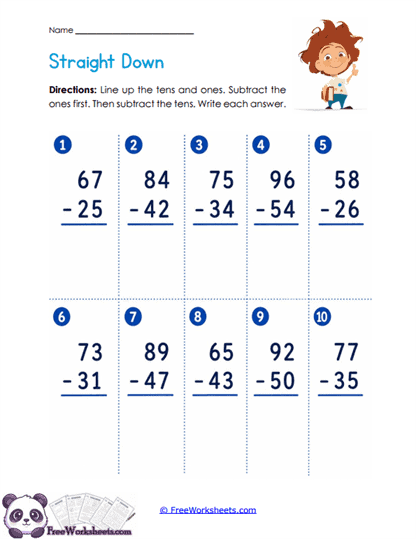
Vertical Differences
What Kids Do:
Students solve ten two-digit subtraction problems arranged in standard vertical form. They work from the ones column to the tens column, keep each place aligned, and record the difference beneath the line for every equation.
Target Skill:
This activity develops fluency with vertical subtraction without regrouping. 2nd grade students practice place-value alignment, one-digit subtraction facts, and orderly written computation while preparing for later problems that require regrouping across places.
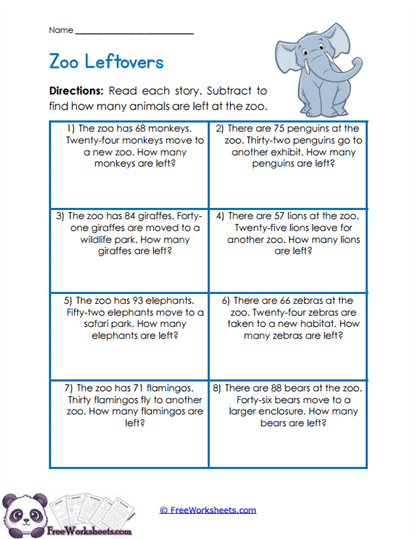
Zoo Takeaways
What Kids Do:
Students read eight zoo-themed stories involving monkeys, penguins, giraffes, lions, elephants, zebras, flamingos, and bears. They identify the original animal group, subtract the number that leaves or moves away, and write how many animals remain.
Target Skill:
The worksheet builds subtraction problem-solving skills in a clear take-away context. 2nd grade students practice connecting story language with subtraction equations, preserving the correct order of quantities, and applying two-digit differences to real-world-style situations.