
About This Worksheet
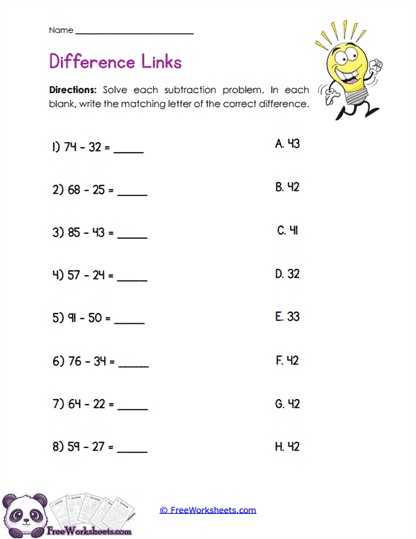
Difference Match-Up is a second grade subtraction activity that combines computation with answer matching. Students solve each two-digit subtraction problem and then locate the correct difference in a lettered answer list. They write the matching letter beside the equation. For example, if 74 − 32 equals 42, students find the answer choice showing 42 and record its letter. This gives children a built-in way to check their subtraction while adding a matching challenge.
Curriculum and Grade Alignment
This worksheet is made for second grade learners who are building fluency with two-digit subtraction without regrouping. The main goal is to help students solve accurately and connect each equation with its correct difference. Before using this page, your child should be comfortable subtracting tens and ones in two-digit numbers. The next step is solving similar problems without an answer bank and checking with addition or another subtraction strategy. This activity supports computation fluency, number matching, and self-checking.
Student Tasks
Students will solve eight subtraction equations, including 74 − 32, 68 − 25, 85 − 43, 57 − 24, 91 − 50, 76 − 34, 64 − 22, and 59 − 27. After calculating each difference, they scan the answer choices and identify the matching value. Students then write the corresponding letter in the blank. Because several answer choices may look similar, careful calculation matters. This builds subtraction accuracy, visual scanning, and answer verification.
Common Challenges and Misconceptions
Some students may guess from the answer list instead of solving first. Others may find the correct difference but copy the wrong letter. A child may also make a small subtraction error and then choose the closest-looking answer. Encourage your child to write the numerical difference before searching the answer bank. This keeps computation separate from matching.
Implementation Guidance
Teachers can use this worksheet as independent review after students have practiced two-digit subtraction in several forms. It works well as a math center because the answer list provides a self-checking element. Parents can cover the answer choices while the child solves all eight problems, then uncover them for matching. If a difference is not available, have the child recheck the original subtraction. This encourages productive error correction.
Details and Features
This worksheet includes eight two-digit subtraction equations and a lettered answer bank. Each problem has space for the calculated difference and the matching letter. The clean two-column design makes scanning easy. The printable supports subtraction fluency, answer matching, number recognition, and self-checking.