
Adding With Regrouping Strategies Worksheets
2nd grade math adding with regrouping strategies worksheets help students compose new tens, use place value, and solve two-digit addition in flexible ways. Free, ready-to-print worksheets in PDF format are designed for immediate classroom use, centers, guided practice, homework, or homeschool lessons. Students strengthen place-value reasoning, mental addition, and regrouping fluency while developing skills that support curriculum expectations.
About This Collection of Worksheets
Adding with regrouping strategies helps 2nd grade students understand why 10 ones can be exchanged for 1 ten during addition. Rather than treating regrouping as a carrying rule to memorize, students explore the idea through models, place-value charts, expanded form, friendly tens, number jumps, and vertical equations. Seeing the same concept represented in different ways helps students connect written procedures with the place-value reasoning behind them.
The collection includes both visual and symbolic practice with regrouping. Students combine base-ten blocks, trade ones for tens in charts, bridge to the next multiple of 10, split addends by place value, make tens-and-ones jumps, solve stacked equations, analyze incorrect work, check completed sums, and apply regrouping in story problems. Some pages provide detailed step-by-step support, while others ask students to choose and apply strategies more independently.
Teachers can use these worksheets during whole-class instruction, guided math, intervention, centers, homework, review, or informal assessment. Parents, tutors, and homeschool educators can begin with visual models when students need concrete support and move toward expanded form or vertical addition as understanding grows. Because the collection focuses on both strategy and accuracy, it helps students develop a stronger foundation for larger-number addition, subtraction with regrouping, and later multi-digit computation.

Paul’s Teacher Tip
When students regroup, consistently use the language “10 ones become 1 new ten” so the written step stays connected to place value. Begin with blocks or drawings before moving to charts and the standard vertical method, especially for students who are tempted to carry a 1 without knowing what it represents. Encourage students to estimate the sum first so they can recognize answers that are far too high or too low. When introducing make-a-ten strategies, ask how many are needed to reach the next multiple of 10 before breaking apart the second addend. Once students are accurate, have them solve selected problems with two different methods and explain how both strategies show the same regrouping idea.
Worksheet Collection Skill Spotlights
Apple Harvest
What Kids Do:
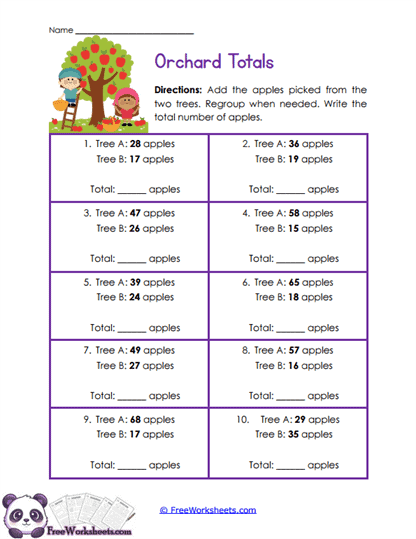
Students solve ten orchard-themed addition problems by combining the numbers of apples picked from two trees. They add each pair of two-digit quantities, regroup when the ones total 10 or more, and write the combined number of apples on the answer line.
Target Skill:
This activity gives 2nd grade students repeated contextual practice with two-digit regrouping. Students strengthen place-value alignment, addition fluency, and composing a new ten while applying the same computation process to a familiar real-world setting.
Bridge to Ten
What Kids Do:
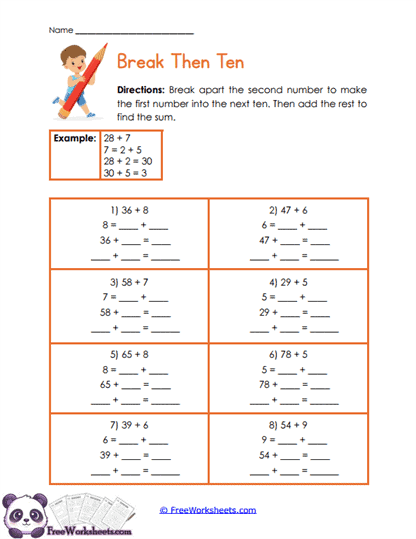
Students solve eight addition problems by breaking apart the second addend so the first step reaches the next multiple of 10. They record how much is needed to make the friendly ten, add the remaining part, and use the guided blanks to show each stage.
Target Skill:
This worksheet develops flexible mental addition and number decomposition. 2nd grade students learn to use friendly tens as efficient landmarks, strengthening number sense and regrouping understanding without relying only on the standard written algorithm.
Collection Stories
What Kids Do:
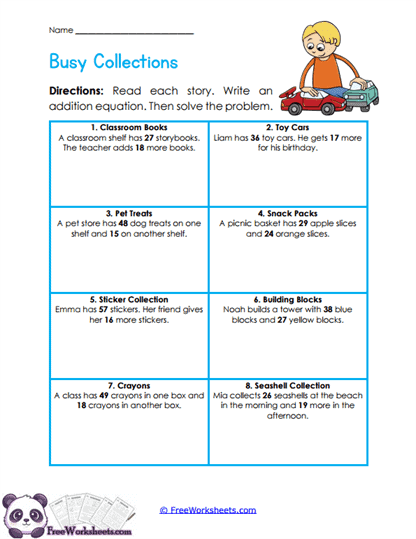
Students read eight short stories about collections such as books, toy cars, treats, snacks, stickers, blocks, crayons, and seashells. They identify the two amounts being joined, write an addition equation, and solve each problem using regrouping when necessary.
Target Skill:
The activity connects two-digit regrouping with mathematical reading and equation writing. 2nd grade students practice recognizing joining situations, extracting relevant quantities, and applying an addition strategy accurately within meaningful one-step problems.
Column Regroup
What Kids Do:
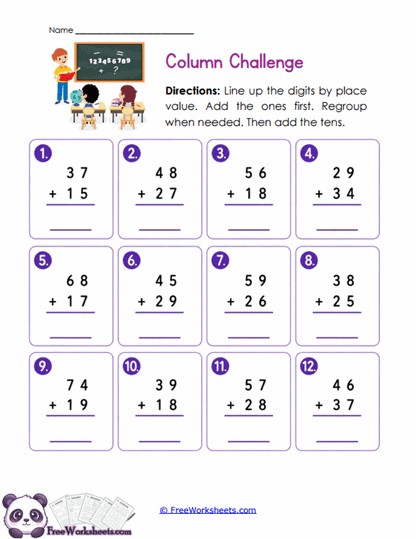
Students solve twelve vertically aligned two-digit addition problems. They begin with the ones column, compose a new ten when the ones total 10 or more, record the regrouped ten above the tens place, and finish each sum beneath the equation.
Target Skill:
This worksheet strengthens the standard regrouping algorithm while reinforcing place-value alignment. 2nd grade students practice keeping ones under ones and tens under tens, recording regrouped values correctly, and solving two-digit addition efficiently and accurately.
Expanded Path
What Kids Do:
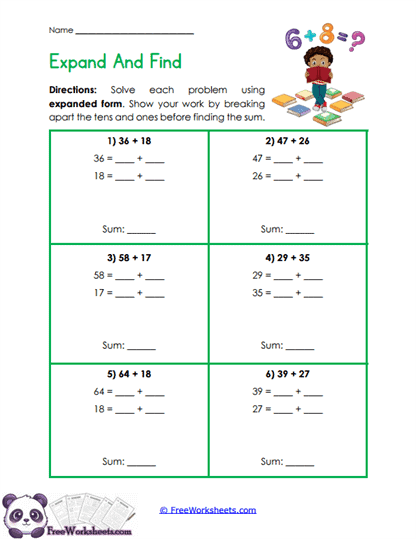
Students work through six two-digit addition problems by rewriting both addends in expanded form. They add tens and ones separately, regroup when the ones total reaches 10 or more, and combine the resulting partial sums to find the final answer.
Target Skill:
The worksheet develops regrouping through decomposition and partial-sum reasoning. 2nd grade students see how each digit represents a place-value amount and how a two-digit ones total can be reorganized into a new ten and leftover ones.
Holiday Combos
What Kids Do:
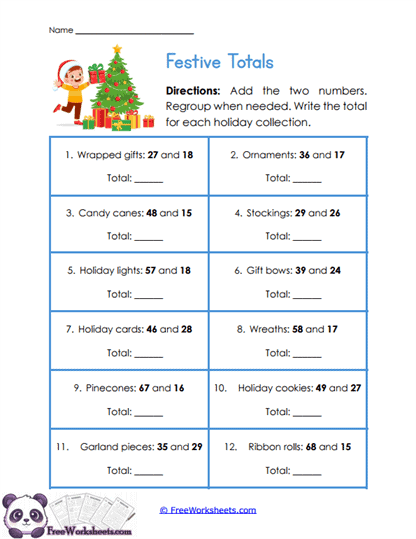
Students solve twelve holiday-themed problems involving quantities such as gifts, ornaments, candy canes, stockings, lights, bows, cards, wreaths, cookies, garland, and ribbon. They add each pair of two-digit values and record the total.
Target Skill:
This activity builds regrouping fluency through repeated computation in a seasonal context. 2nd grade students practice composing a new ten, maintaining place-value accuracy, and choosing an efficient addition method while working through a consistent set of problems.
Jump Strategy
What Kids Do:
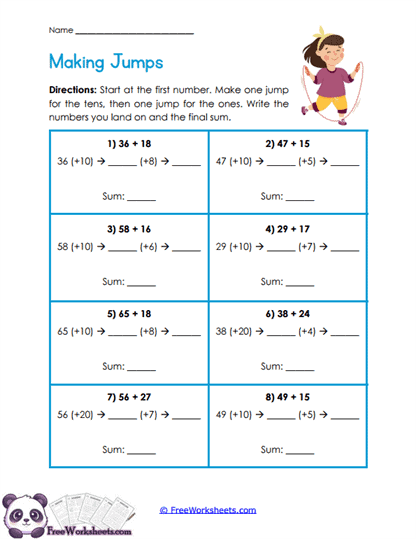
Students solve eight two-digit addition problems by splitting the second addend into a tens jump and an ones jump. They record the number reached after the larger jump, add the remaining ones, and then write the final sum.
Target Skill:
This worksheet strengthens open-number-line thinking and mental addition. 2nd grade students practice decomposing an addend by place value, adding multiples of 10 efficiently, and tracking intermediate totals as they move through a regrouping problem in smaller steps.
Place Value Split
What Kids Do:
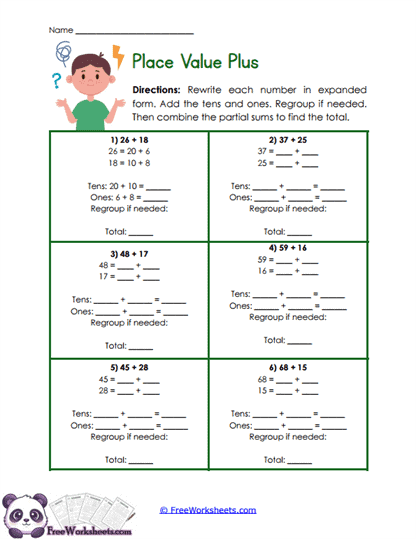
Students solve six regrouping problems by rewriting both addends as tens plus ones. They add the place-value parts separately, show how a ones total of 10 or more creates another ten, and then combine the partial sums into the final answer.
Target Skill:
The activity builds a clear conceptual link between expanded form and regrouping. 2nd grade students strengthen decomposition, place-value reasoning, and addition accuracy while seeing exactly where the extra ten comes from during a regrouping problem.
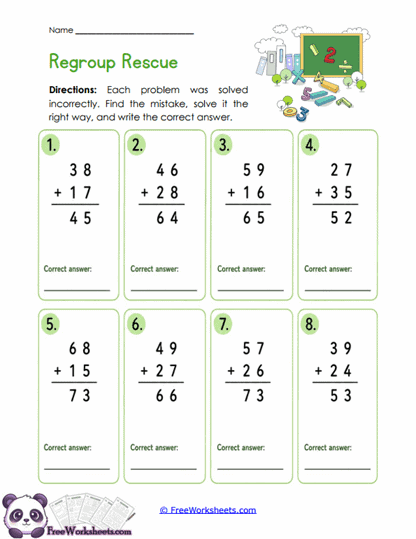
Regroup Repair
What Kids Do:
Students inspect eight vertical addition problems that contain incorrect sums. They recalculate the ones and tens, identify where the regrouping process went wrong, and write the corrected answer on the line provided for each problem.
Target Skill:
This worksheet develops error analysis and mathematical self-checking. 2nd grade students learn to diagnose common regrouping mistakes, such as forgetting the new ten or handling the ones incorrectly, while strengthening their own computation habits and place-value reasoning.
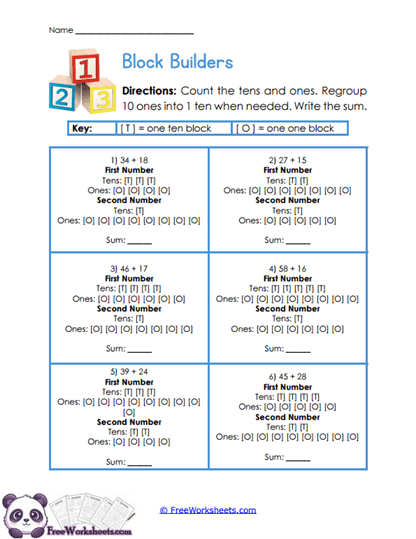
Regrouping Blocks
What Kids Do:
Students examine six addition problems represented with tens blocks and individual ones. They combine the ones, group every set of 10 into a new ten, add the remaining tens and ones, and record the completed two-digit sum.
Target Skill:
The visual models make composing a new ten concrete for 2nd grade students. Learners strengthen understanding of the relationship between 10 ones and 1 ten, providing a conceptual foundation for later work with place-value charts and vertical regrouping.
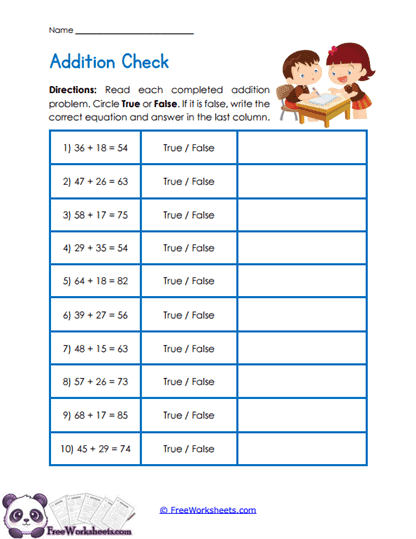
Regrouping Check
What Kids Do:
Students evaluate ten completed two-digit addition equations and decide whether each shown total is correct. They circle True or False and calculate a corrected answer whenever the printed sum contains an error.
Target Skill:
This activity strengthens computation accuracy and verification. 2nd grade students practice independently solving regrouping problems, comparing results, spotting incorrect totals, and developing the habit of checking mathematical work rather than accepting an answer automatically.
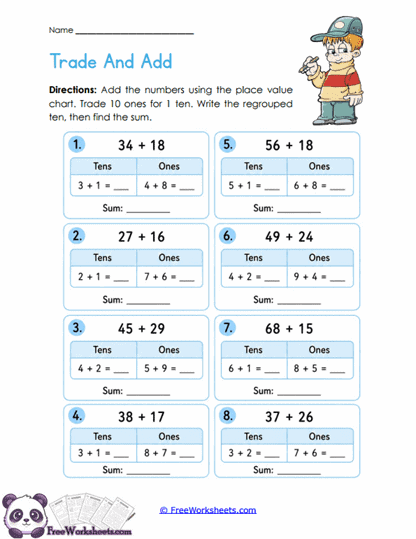
Trade the Ten
What Kids Do:
Students solve eight guided problems using labeled tens-and-ones charts. They add the ones, identify when 10 ones must be traded for 1 ten, record the regrouped value, add the tens, and complete the final sum.
Target Skill:
The chart format helps 2nd grade students connect concrete base-ten models with written regrouping. Learners strengthen place-value organization and understand that the carried 1 represents a new ten rather than an isolated digit added by a memorized rule.