
Subtracting With Regrouping Strategies Worksheets
2nd grade math subtracting with regrouping strategies worksheets help students trade tens for ones, decompose numbers, and solve two-digit subtraction accurately. Free, ready-to-print worksheets in PDF format are designed for immediate classroom use, centers, guided practice, homework, or homeschool lessons. Students strengthen place-value reasoning, regrouping fluency, and subtraction strategies while developing skills that support curriculum expectations.
About This Collection of Worksheets
Subtracting with regrouping strategies helps 2nd grade students understand what happens when there are not enough ones to subtract directly. Students learn that 1 ten can be exchanged for 10 ones without changing the total value of the number. By working with models, charts, expanded form, decomposition, and vertical equations, children can understand why regrouping works instead of treating it as a step to memorize.
The collection includes base-ten models, tens-and-ones charts, expanded-form exchanges, break-apart strategies, regrouping decisions, standard vertical subtraction, error analysis, and themed word problems. Some worksheets provide strong visual or step-by-step support, while others ask students to recognize when regrouping is needed and apply the process more independently. These different formats help connect conceptual understanding with accurate computation.
Teachers can use these worksheets during subtraction lessons, guided math, intervention, centers, homework, review, or informal assessment. Parents, tutors, and homeschool educators can begin with manipulatives or place-value drawings before moving to written strategies and vertical subtraction. Because the collection progresses from concrete exchanges to independent computation and story problems, it supports growing confidence with two-digit subtraction that requires regrouping.
Paul’s Teacher Tip
Before students regroup, have them compare the ones digits and ask, “Do I have enough ones to subtract?” When the answer is no, use the language “1 ten becomes 10 ones” so the trade stays connected to place value. Remind students that the number’s total value does not change when it is renamed, such as changing 52 into 4 tens and 12 ones. If students make repeated errors, return to base-ten blocks or a tens-and-ones chart before practicing the written algorithm again. Once the process is secure, ask students to solve selected problems with two different strategies and explain how both methods produce the same difference.
Worksheet Collection Skill Spotlights
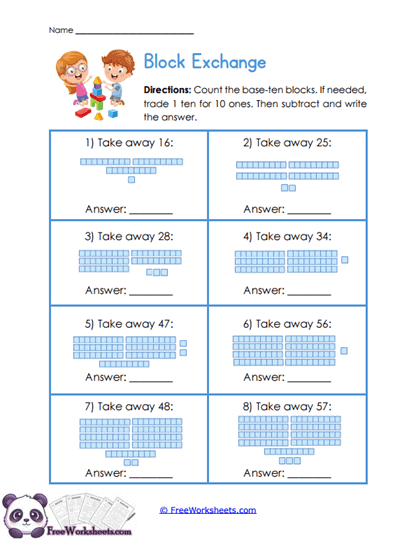
Base-Ten Exchange
What Kids Do:
Students solve eight visual subtraction problems using tens rods and ones cubes. They identify the starting amount, determine what must be removed, exchange 1 ten for 10 ones when there are not enough ones, and then subtract to find the remaining value.
Target Skill:
This activity makes regrouping concrete for 2nd grade students by showing the physical exchange behind the written process. Learners strengthen base-ten understanding, place-value equivalence, and subtraction reasoning while seeing that trading a ten changes the representation but not the total amount.
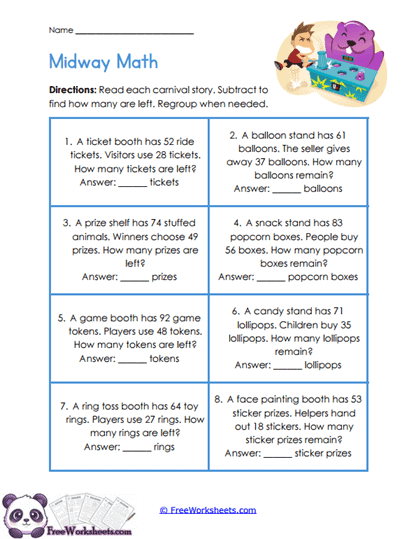
Carnival Takeaways
What Kids Do:
Students read eight carnival-themed stories involving ride tickets, balloons, prizes, popcorn, game tokens, lollipops, rings, and stickers. They identify the starting quantity, subtract the amount used or removed, regroup when needed, and write how many items remain.
Target Skill:
The worksheet applies subtraction with regrouping to meaningful take-away situations. 2nd grade students strengthen equation writing, place-value reasoning, and computation fluency while interpreting story language and deciding how to organize a two-digit subtraction problem accurately.
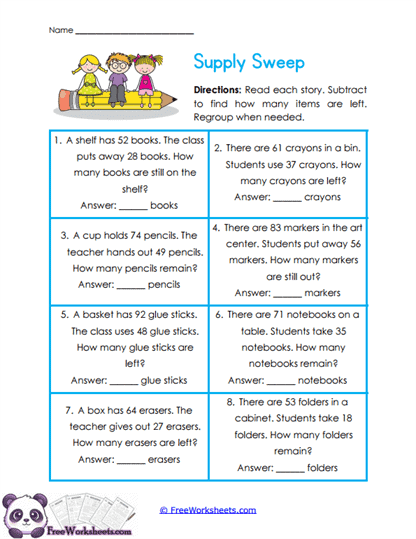
Classroom Remainders
What Kids Do:
Students solve eight classroom-themed subtraction stories involving books, crayons, pencils, markers, glue sticks, notebooks, erasers, and folders. They find the starting amount, subtract what was used or removed, and regroup from the tens place when the ones require an exchange.
Target Skill:
This activity connects regrouping with familiar real-world situations. 2nd grade students practice translating story information into subtraction equations, identifying when a place-value trade is necessary, and finding accurate remainders while strengthening mathematical reading.
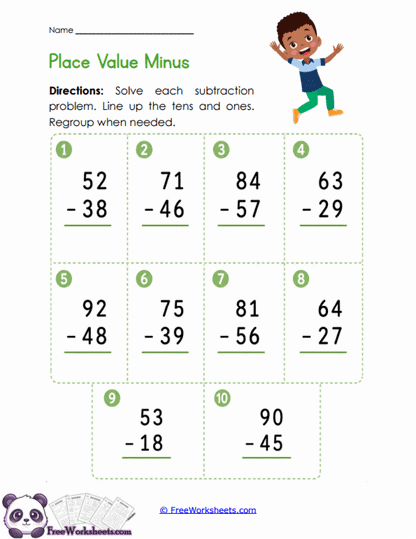
Column Regroup
What Kids Do:
Students solve ten vertically aligned two-digit subtraction problems. They compare the ones digits, trade 1 ten for 10 ones when necessary, subtract the regrouped ones, adjust the tens, and record the final difference below each equation.
Target Skill:
This worksheet develops fluency with the standard subtraction algorithm while keeping place value central. 2nd grade students practice correct column alignment, regrouping from tens to ones, and maintaining accurate values throughout each step of written computation.
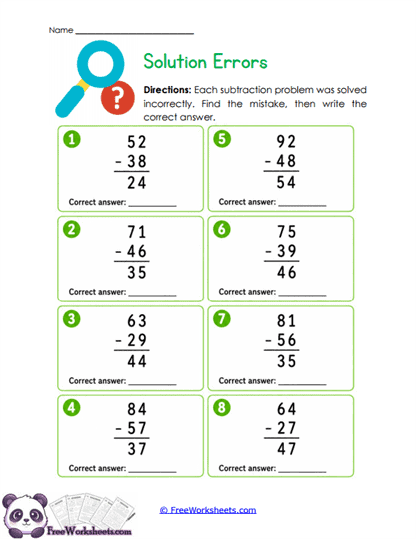
Error Detective
What Kids Do:
Students inspect eight incorrectly solved regrouping problems and determine where the subtraction went wrong. They recalculate each equation, check the ones and tens, identify the likely regrouping mistake, and write the correct difference on the provided line.
Target Skill:
The activity strengthens error analysis and mathematical self-checking. 2nd grade students learn to recognize common regrouping mistakes, such as failing to trade a ten or adjusting only one place, while reinforcing accurate place-value reasoning and subtraction procedures.
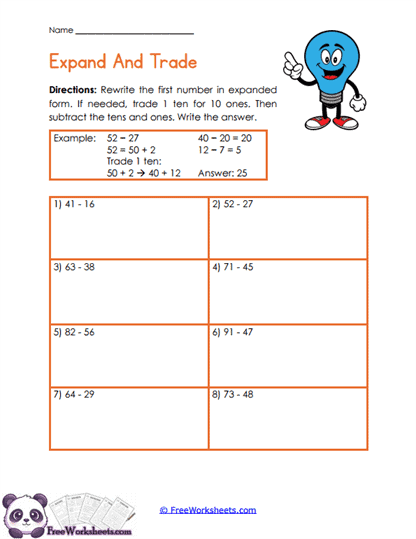
Expanded Exchange
What Kids Do:
Students solve eight subtraction problems by rewriting the first number in expanded form and renaming it when regrouping is required. They trade one ten for 10 ones, subtract the place-value parts, and combine the remaining values to find each difference.
Target Skill:
This worksheet connects regrouping with decomposition and equivalent forms. 2nd grade students see why a number such as 52 can become 40 + 12 without changing its value, building deeper understanding of the place-value logic behind subtraction with regrouping.
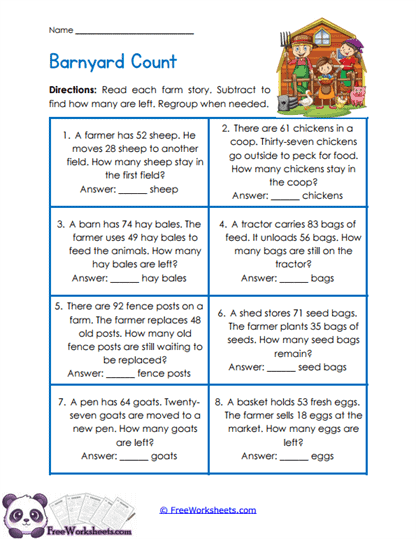
Farmyard Leftovers
What Kids Do:
Students read eight farm-themed stories about sheep, chickens, hay, feed, fence posts, seeds, goats, and eggs. They identify the starting quantity, subtract the amount moved, used, planted, or sold, and regroup when necessary to determine what remains.
Target Skill:
The worksheet strengthens real-world application of two-digit subtraction with regrouping. 2nd grade students practice identifying take-away situations, writing subtraction equations in the correct order, and using place-value strategies to find accurate differences within context.
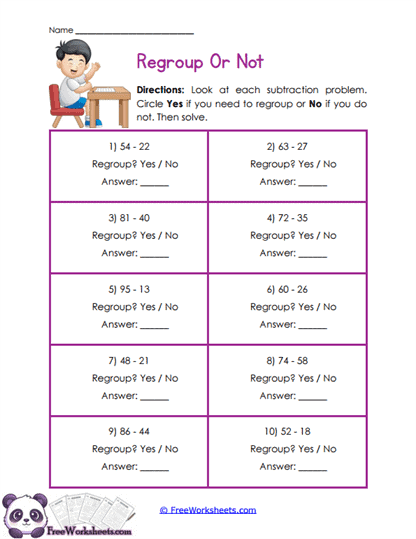
Regrouping Decision
What Kids Do:
Students examine ten two-digit subtraction problems and first decide whether each one requires regrouping. They circle Yes or No by comparing the ones digits, then solve the equation and record the difference after making a trade when needed.
Target Skill:
This activity develops strategy recognition before computation begins. 2nd grade students learn to inspect the ones place, determine when the top digit is too small to subtract directly, and distinguish regrouping problems from those that can be solved without an exchange.
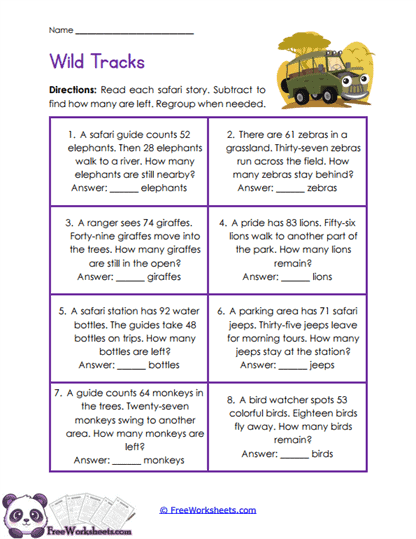
Safari Subtraction
What Kids Do:
Students solve eight safari-themed stories involving elephants, zebras, giraffes, lions, water bottles, jeeps, monkeys, and birds. They find the starting amount, subtract the quantity that leaves or is used, and complete regrouping when the ones place requires it.
Target Skill:
This activity builds subtraction fluency through contextual problem solving. 2nd grade students strengthen place-value regrouping, equation setup, and mathematical reading while applying the same subtraction process to varied real-world-style situations.
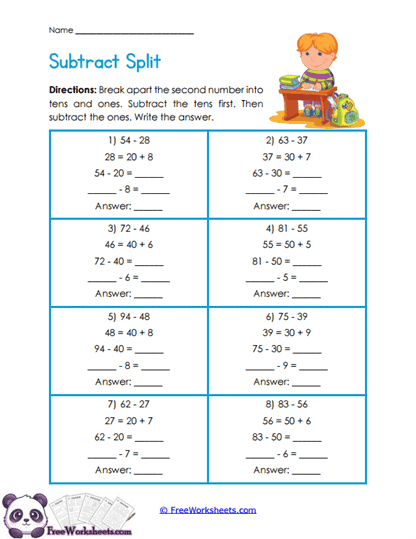
Split and Subtract
What Kids Do:
Students complete eight two-digit subtraction problems by breaking the second number into tens and ones. They subtract the tens part first, carry the intermediate result into the next step, subtract the remaining ones, and then write the final difference.
Target Skill:
The worksheet develops decomposition as a flexible subtraction strategy. 2nd grade students practice understanding a two-digit subtrahend as separate place-value parts and using those parts to solve regrouping problems without depending only on the standard vertical algorithm.
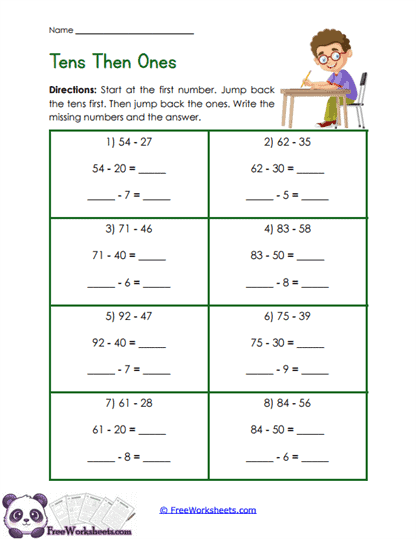
Tens Then Ones
What Kids Do:
Students solve eight guided subtraction problems by removing the tens part of the second number first and then subtracting the ones from the new amount. They record the intermediate value and use it as the starting point for the second subtraction step.
Target Skill:
This activity strengthens mental subtraction and place-value decomposition. 2nd grade students practice breaking larger calculations into manageable steps, maintaining an intermediate result, and using tens-and-ones reasoning to solve problems that involve regrouping.
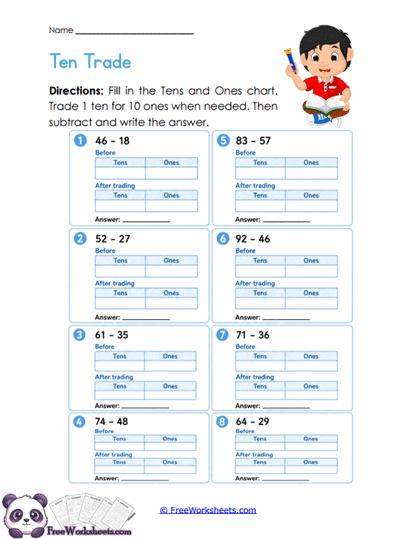
Tens Trade
What Kids Do:
Students use before-and-after tens-and-ones charts to solve eight regrouping problems. They record the original place values, exchange 1 ten for 10 ones, show the renamed number in the chart, and then subtract to find the difference.
Target Skill:
The chart format helps 2nd grade students understand regrouping as an equivalent place-value exchange. Learners practice seeing that a number such as 46 can be represented as 4 tens and 6 ones or 3 tens and 16 ones while keeping the same total value.