
About This Worksheet
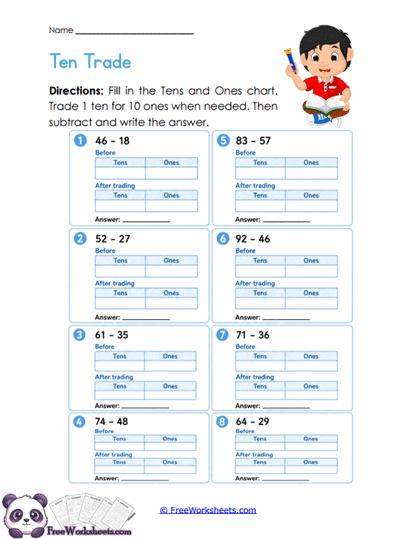
Tens Trade is a second grade place-value activity that guides students through regrouping inside a tens-and-ones chart. Each problem gives a two-digit subtraction equation and provides spaces to show the number before and after trading. Students move 1 ten into the ones place as 10 ones when needed, then subtract and write the answer. For example, 46 − 18 requires changing 4 tens and 6 ones into 3 tens and 16 ones before subtracting. This helps children understand exactly what changes during regrouping.
Curriculum and Grade Alignment
This worksheet is intended for second grade learners who are moving from concrete base-ten blocks to written place-value representations. The main goal is to help students record how a number changes when 1 ten is exchanged for 10 ones. Before beginning, your child should understand tens and ones and know that the value of the number stays the same during a trade. The next step is applying the same process in vertical subtraction. This activity supports place-value reasoning, regrouping, and subtraction fluency.
Student Tasks
Students will solve eight two-digit subtraction problems using before-and-after place-value charts. They write the tens and ones before regrouping, trade a ten when necessary, show the new place-value amounts, and then calculate the difference. Problems include 46 − 18, 52 − 27, 61 − 35, 74 − 48, 83 − 57, 92 − 46, 71 − 36, and 64 − 29. This builds structured regrouping practice and clear place-value thinking.
Common Challenges and Misconceptions
Some students may reduce the tens by 1 but forget to add 10 to the ones. Others may add 10 ones without decreasing the tens. A child may also think that regrouping changes the total value of the number. Encourage your child to check that the “before” and “after trading” forms still represent the same number. This makes the exchange easier to understand.
Implementation Guidance
Teachers can use this worksheet after students have practiced regrouping with physical blocks. It works well as a bridge into written subtraction because the charts make the trade explicit. Parents can ask the child to say the number before and after trading, such as “46 is still 46, but now it is 3 tens and 16 ones.” This verbal explanation reinforces equivalence. If needed, draw a quick place-value chart beside the problem.
Details and Features
This worksheet includes eight regrouping problems with labeled Tens and Ones charts for before and after trading. Each problem has a separate answer line beneath the chart. The guided format makes the exchange process easy to follow. The printable supports place-value charts, regrouping, equivalence, and two-digit subtraction.