
Comparing And Ordering Numbers Worksheets
2nd grade math comparing and ordering numbers worksheets help students compare values, use symbols, arrange numbers, and reason with place value. Free, ready-to-print worksheets in PDF format are designed for immediate classroom use, centers, guided practice, homework, or homeschool lessons. Students strengthen place-value understanding, comparison fluency, and number sequencing while developing skills that support curriculum expectations.
About This Collection of Worksheets
Comparing and ordering numbers helps 2nd grade students understand how values relate by size and position. Students learn to use greater than, less than, and equal to symbols, identify the largest or smallest values, and arrange numbers from least to greatest or greatest to least. Working with both two- and three-digit numbers also strengthens the idea that hundreds should be compared first, followed by tens and ones when needed.
The collection includes direct comparisons, ordering lists, greatest-and-least searches, place-value charts, number-line activities, true-or-false statements, open-ended inequalities, and themed sorting tasks. Some worksheets focus on one skill at a time, while others mix comparison symbols, ordering, and magnitude reasoning on the same page. These different formats help students apply place-value thinking rather than depend on one repeated routine.
Teachers can use these worksheets during number-sense lessons, guided math, centers, homework, review, or informal assessment. Parents, tutors, and homeschool educators can use number cards, place-value charts, or simple number lines to support students before moving to written practice. Because the collection includes direct comparisons, multi-number ordering, number lines, and open-ended reasoning, it gives students several ways to build confidence with number magnitude.
Paul’s Teacher Tip
Teach students to compare numbers from left to right, beginning with the greatest place value. If the hundreds are different, there is no need to compare the tens or ones; if the hundreds match, move one place to the right. For comparison symbols, have students first say the relationship in words before writing <, >, or =. During ordering activities, encourage students to find and cross off the smallest or largest remaining number one at a time. Once students are confident, ask them to explain which digit determined a close comparison instead of only giving the final answer.
Worksheet Collection Skill Spotlights
Comparison Judge
What Kids Do:
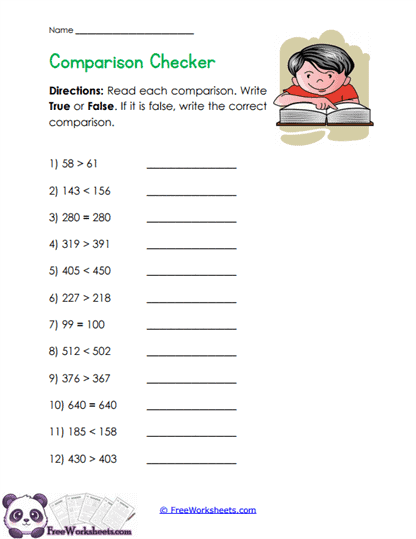
Students examine twelve completed comparison statements containing two- and three-digit numbers connected by <, >, or =. They decide whether each relationship is true or false and, when it is incorrect, rewrite the comparison using the proper symbol.
Target Skill:
This activity strengthens comparison-symbol fluency and mathematical checking. 2nd grade students practice using hundreds, tens, and ones to evaluate number relationships, recognize equal values, and correct inaccurate statements instead of simply filling in a missing sign.
Greatest First
What Kids Do:
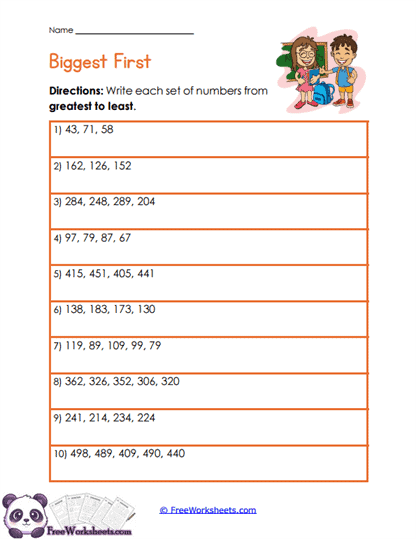
Students work through ten sets of mixed two- and three-digit numbers and rewrite each group from greatest to least. They identify the largest value first, continue comparing the remaining numbers, and record the complete descending sequence.
Target Skill:
The worksheet builds flexible number ordering and place-value reasoning. 2nd grade students practice comparing several values at once, maintaining descending order, and using hundreds, tens, and ones to distinguish numbers that may contain similar digits.
Greatest Number Hunt
What Kids Do:
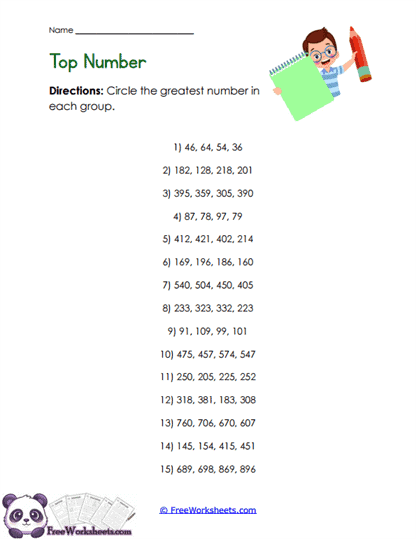
Students scan fifteen groups of two- and three-digit numbers and circle the greatest value in each set. They compare every number before making a choice, including groups where the values share the same hundreds or tens digits.
Target Skill:
This activity develops quick and accurate recognition of number magnitude. 2nd grade students strengthen place-value comparison by starting with the greatest place and moving right only when necessary to determine which value is largest.
Holiday Number Order
What Kids Do:
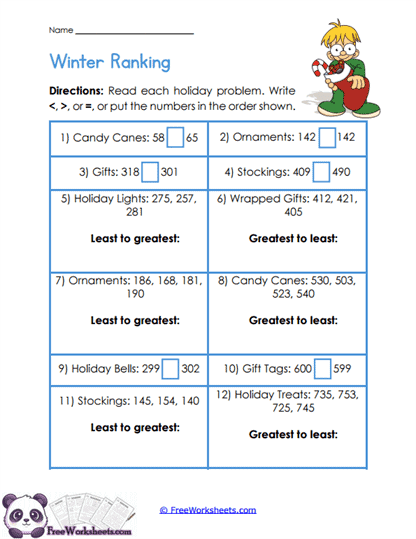
Students complete twelve holiday-themed comparison and ordering problems. Some boxes ask them to write <, >, or = between two numbers, while others require them to arrange three or four values from least to greatest or greatest to least.
Target Skill:
The mixed format strengthens both comparison-symbol fluency and sequencing. 2nd grade students practice switching between direct comparisons and multi-number ordering while using place value consistently and following changing mathematical directions carefully.
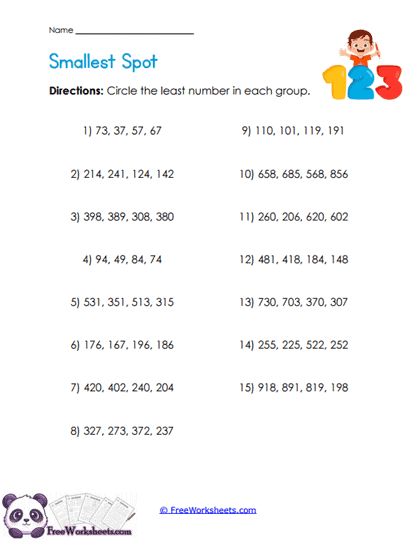
Least Number Search
What Kids Do:
Students examine fifteen groups of two- and three-digit values and circle the least number in each set. Many groups use similar digits in different positions, requiring students to inspect the hundreds, tens, and ones instead of choosing by appearance.
Target Skill:
This worksheet strengthens identification of the smallest value within a group. 2nd grade students develop number sense and place-value accuracy while learning that the position of a digit, not just the digit itself, determines the size of a number.
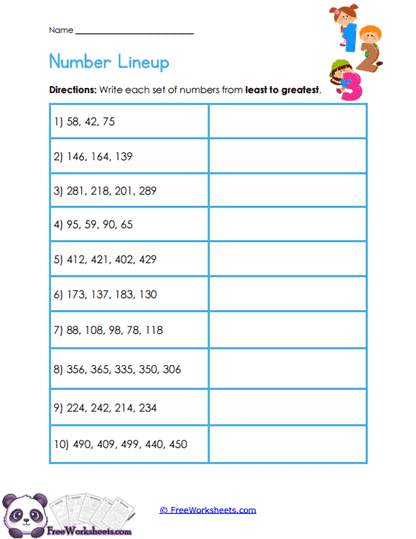
Least to Greatest Lineup
What Kids Do:
Students complete ten ordering problems containing sets of three to five numbers. They identify the smallest value, continue comparing the remaining numbers, and rewrite the entire group from least to greatest in the provided space.
Target Skill:
The activity builds ascending-order fluency and multi-number comparison. 2nd grade students practice sequencing several values, organizing close middle numbers, and applying place-value reasoning consistently across both two- and three-digit sets.
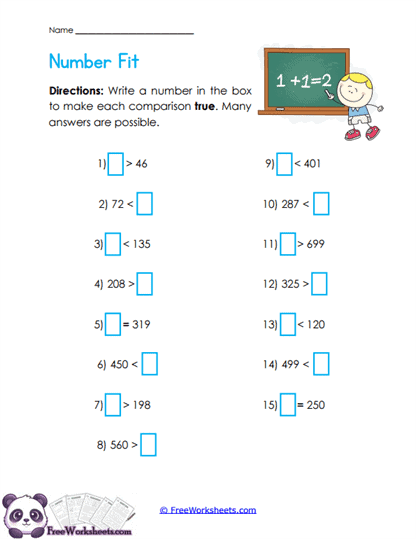
Number Choice
What Kids Do:
Students complete fifteen open-ended comparison statements by writing a number that makes each one true. They generate values for relationships such as ___ > 46, 72 < ___, ___ < 135, or ___ = 250, with many inequalities allowing more than one valid response.
Target Skill:
This worksheet develops flexible inequality reasoning beyond fixed-answer comparisons. 2nd grade students strengthen number magnitude, symbol understanding, and open-ended thinking by recognizing that greater-than and less-than statements can describe whole ranges of possible values.
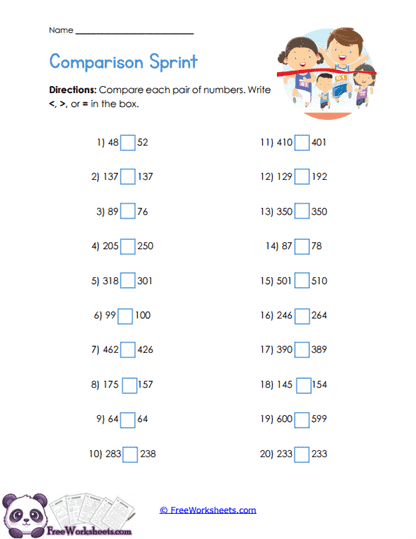
Number Showdown
What Kids Do:
Students solve twenty direct comparisons involving pairs of two- and three-digit numbers. They determine which value is greater or whether the two are equal, then write <, >, or = in the box between the numbers.
Target Skill:
The worksheet provides focused practice with comparison symbols and place value. 2nd grade students build accuracy by comparing the highest place first, checking lower places only when necessary, and recognizing equal-number cases as well as greater-than and less-than relationships.
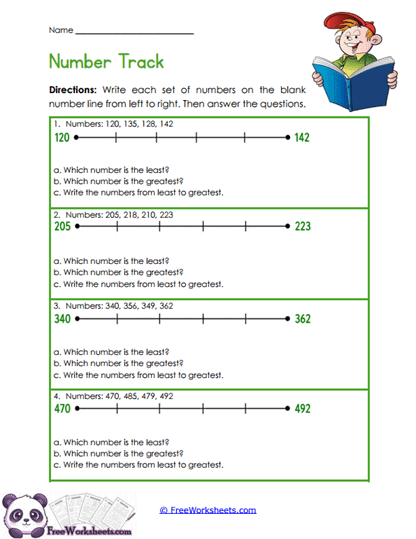
Number Track
What Kids Do:
Students complete four number-line activities involving three-digit values. They place given numbers at the correct positions, identify the least and greatest values, and then write the complete set in order from least to greatest.
Target Skill:
This activity connects numerical comparison with visual position on a number line. 2nd grade students strengthen magnitude, ordering, and place-value reasoning while learning that smaller values appear farther left and larger values appear farther right.
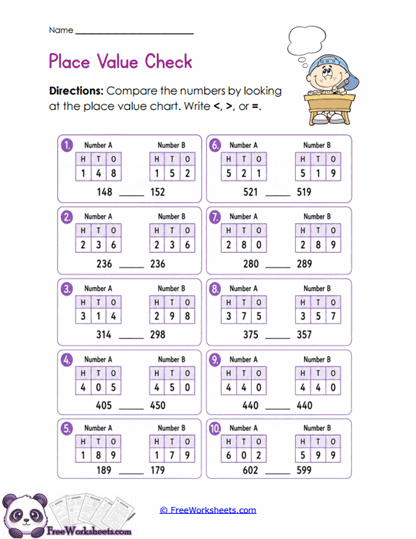
Place Value Comparator
What Kids Do:
Students compare ten pairs of three-digit numbers shown in hundreds-tens-ones charts. They inspect each place from left to right, identify where the values first differ, and write <, >, or = between the standard numerals.
Target Skill:
The chart format makes the logic of comparison visible. 2nd grade students strengthen systematic place-value reasoning by learning to compare hundreds first, then tens, then ones only when needed, rather than judging numbers by overall appearance.
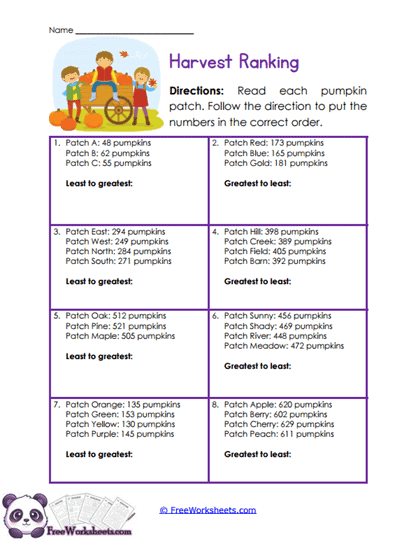
Pumpkin Order
What Kids Do:
Students solve eight pumpkin-themed ordering problems containing three or four values. Each box tells them to arrange the quantities either from least to greatest or greatest to least, requiring careful attention to both direction and place value.
Target Skill:
The worksheet reinforces three-digit ordering in both ascending and descending forms. 2nd grade students practice switching directions, comparing close values, and using hundreds, tens, and ones to organize number sets accurately.
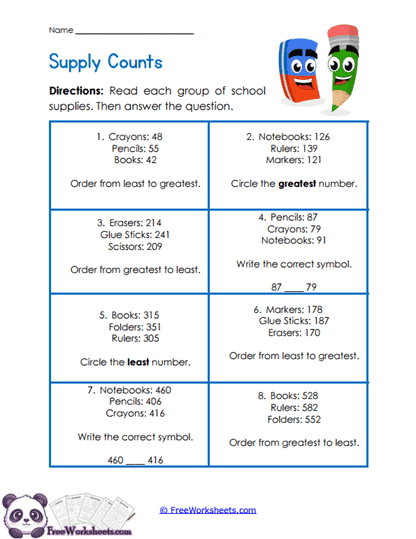
School Supply Sort
What Kids Do:
Students complete eight school-supply-themed tasks that mix number ordering, greatest-or-least selection, and symbol comparisons. They work with quantities connected to crayons, pencils, notebooks, rulers, glue sticks, markers, books, and folders.
Target Skill:
This mixed review strengthens comparison, ordering, and direction-following on one page. 2nd grade students practice using place value across several task types while recognizing words such as least and greatest and applying <, >, and = correctly.