
About This Worksheet
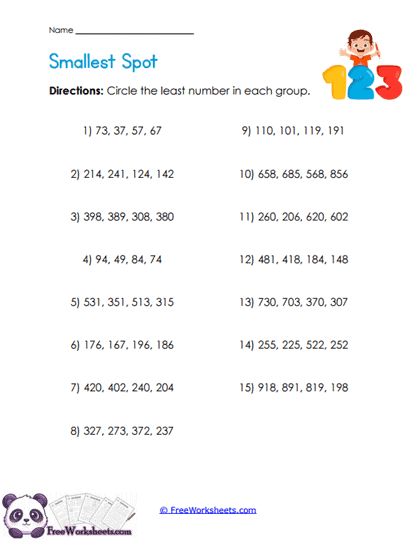
Least Number Search is a second grade comparison activity that helps students identify the smallest number in each group. Every problem lists several two- or three-digit values, and children circle the least one. For example, in a set such as 73, 37, 57, and 67, students choose 37. The groups include values with similar digits arranged in different places, so students need to pay close attention to place value. This helps children understand that the position of a digit matters when deciding which number is smallest.
Curriculum and Grade Alignment
This worksheet is intended for second grade learners who are practicing comparison within the hundreds. The main goal is to help students identify the least value among several numbers. Before beginning, your child should understand how hundreds, tens, and ones determine a number’s size. The next step is arranging entire groups from least to greatest. This activity supports place-value reasoning, number magnitude, and comparison fluency.
Student Tasks
Students will solve fifteen least-number problems. They read each group, compare all the values, and circle the smallest one. The sets include numbers such as 214, 241, 124, and 142 as well as larger three-digit values. Some problems are designed so the digits look similar, making careful comparison especially important. This builds number sense, visual attention, and accurate use of place value.
Common Challenges and Misconceptions
Some students may choose the number with the smallest ones digit even when its hundreds digit makes it much larger. Others may confuse the meaning of least with greatest. A child may also rush when several values contain the same digits in a different order. Encourage your child to say “smallest first” and compare the hundreds place before looking at the rest. When the hundreds are equal, move to tens and then ones.
Implementation Guidance
Teachers can use this worksheet alongside greatest-number practice so students learn to switch between the two directions. It works well for independent practice after place-value comparison has been introduced. Parents can ask the child to cross out obviously larger numbers first, leaving the smallest candidates to compare more closely. If needed, use a place-value chart to line up difficult values. This provides a clear visual support.
Details and Features
This worksheet includes fifteen number groups arranged in two columns. Each group contains several two- or three-digit values and asks students to circle the least one. The page uses a clean, uncluttered format that keeps focus on comparison. The varied groups provide repeated practice with close place-value decisions. The printable supports least-number identification, place value, comparison, and number sense.