
Adding Two-digit Numbers Worksheets
2nd grade math adding two-digit numbers worksheets help students combine tens and ones, regroup accurately, and solve addition problems with confidence. Free, ready-to-print worksheets in PDF format are designed for immediate classroom use, centers, guided practice, homework, or homeschool lessons. Students strengthen place-value reasoning, addition fluency, and problem solving while developing skills that support curriculum expectations.
-
Addition Dash
-
Addition Grid
-
Answer Links
-
-
Answer Search
-
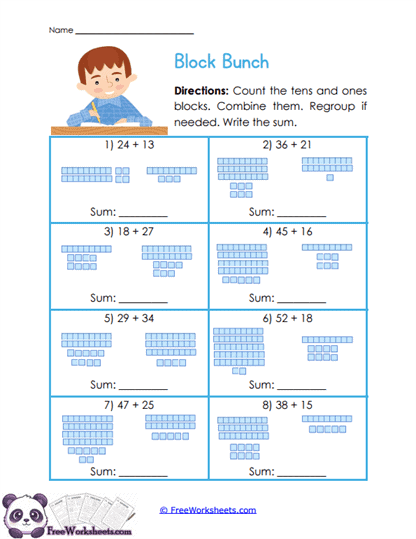
Block Bundles
-
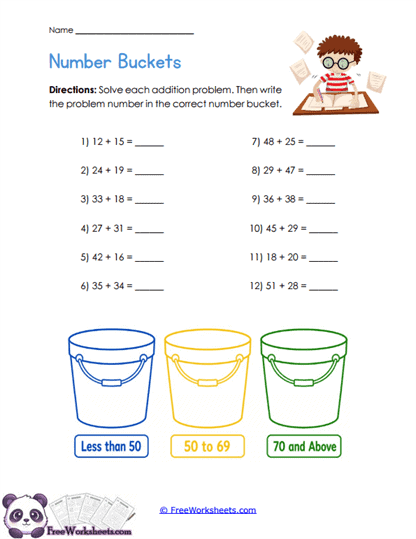
Bucket Numbers
-
Camp Additions
-
Camp Totals
-
Candy Counts
-
Color Totals
-
Column Sums
-
Expanded Sums
-
Missing Addends
-
Number Leaps
-
Pair Builder
-
Place Pairs
-
Shopping Sums
-
Story Sums
-
Sum Checker
-
Sum Detectives
-
Sum Showdown
-
Sum Sprint
-
Truth Check
-
Winter Totals
About This Collection of Worksheets
Adding two-digit numbers helps 2nd grade students understand how tens and ones work together when quantities are combined. Students use place-value knowledge to add corresponding digits, compose a new ten when necessary, and recognize why regrouping works rather than simply memorizing a procedure. These skills provide an important foundation for larger-number operations and more advanced problem solving.
The collection presents two-digit addition through a wide range of formats and strategies. Students use base-ten blocks, place-value charts, expanded form, number-line jumps, vertical addition, missing addends, answer matching, true-or-false checks, error analysis, comparison activities, number grids, sorting tasks, computation practice, and themed word problems. This variety gives students opportunities to build conceptual understanding while also developing speed and accuracy.
Teachers can use these worksheets during whole-class instruction, guided math, centers, spiral review, intervention, homework, or informal assessment. Parents, tutors, and homeschool educators can select strategy-based pages when students need visual support and move toward straightforward computation as confidence grows. Because the collection includes both regrouping and non-regrouping problems, reasoning tasks, and real-world applications, it supports a broad progression of 2nd grade addition skills.

Paul’s Teacher Tip
Before teaching the standard algorithm, make sure students can explain a two-digit number as tens and ones and show it with a place-value model. When regrouping appears, use language such as “10 ones become 1 new ten” so the written step stays connected to its mathematical meaning. Encourage students to estimate a sum before calculating so they have a quick way to notice answers that are unreasonable. If a student repeatedly makes the same mistake, compare the written work with base-ten blocks, expanded form, or an open number line to identify where the reasoning breaks down. Once students are accurate with a strategy, ask them to solve selected problems a second way and explain why both methods produce the same total.
Worksheet Collection Skill Spotlights
Addition Dash
What Kids Do:
Students solve twelve two-digit addition equations arranged in a spacious two-column format. They add ones and tens, regroup when a ones total reaches 10 or more, and record each sum independently without pictures, answer choices, or other strategy prompts.
Target Skill:
This activity develops computation fluency after students have learned the place-value reasoning behind two-digit addition. 2nd grade students practice accurate regrouping, maintaining tens-and-ones alignment, and solving mixed addition problems efficiently without depending on visual supports.
Addition Grid
What Kids Do:
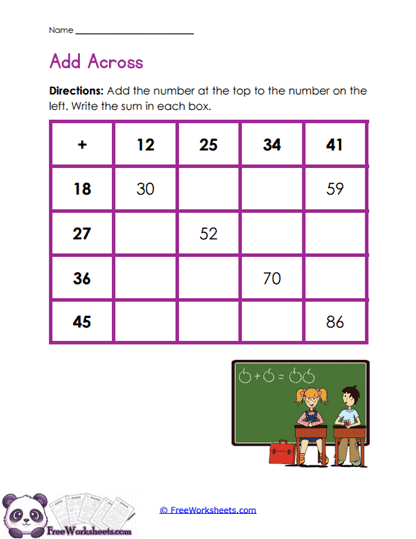
Students use a four-by-four table with two-digit numbers across the top and down the side. They add the row number and column number that meet at each empty square, use several completed examples as models, and continue until all sums in the grid are filled.
Target Skill:
The grid strengthens addition fluency while introducing an organized table-reading format. 2nd grade students practice tracking rows and columns, maintaining place-value accuracy, and observing how sums change as one addend increases across or down the chart.
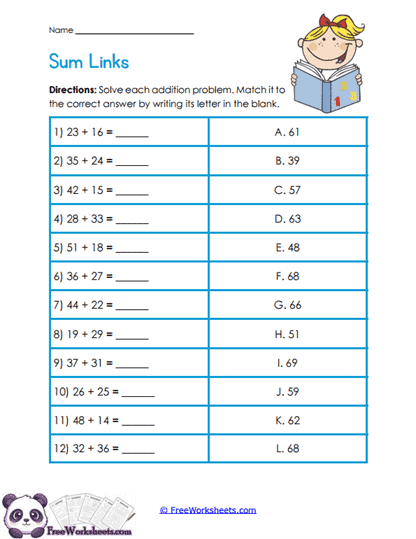
Answer Links
What Kids Do:
Students solve twelve two-digit addition equations and then search a lettered answer bank for each exact total. After calculating a sum, they identify the matching number in the list and record the corresponding letter beside the original problem.
Target Skill:
This worksheet combines computation with careful answer verification. 2nd grade students strengthen addition accuracy, visual scanning, and self-checking habits while learning that a result must match an answer exactly rather than merely appear close or reasonable.
Answer Search
What Kids Do:
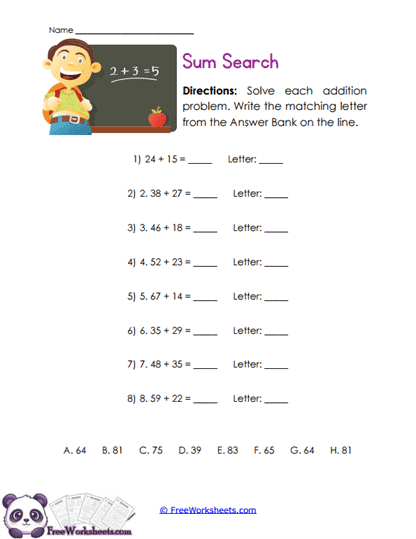
Students calculate eight two-digit sums and use a mixed answer bank to locate each matching total. Every answer in the bank has a letter, so students record the corresponding letter beside the problem after confirming that the numerical result is correct.
Target Skill:
The matching format reinforces two-digit addition while encouraging students to verify their calculations. 2nd grade learners practice computation, exact number comparison, and error checking as they connect each independently solved sum with the correct entry in the answer bank.
Block Bundles
What Kids Do:
Students examine base-ten block models representing two addends in each of eight problems. They count tens rods and ones cubes, combine the quantities, regroup 10 ones into a new ten when necessary, and write the final two-digit sum.
Target Skill:
This activity develops concrete understanding of regrouping and place value. 2nd grade students see why a new ten is composed when ones reach 10, strengthening the conceptual foundation needed for expanded form, place-value charts, and standard vertical addition.
Bucket Numbers
What Kids Do:
Students solve twelve two-digit addition problems and then classify each answer by placing the problem number into one of three buckets: less than 50, 50 to 69, or 70 and above. Every item requires both computation and a number-range decision.
Target Skill:
The worksheet connects addition with comparison and place-value reasoning. 2nd grade students practice finding accurate sums, interpreting numerical ranges, and deciding where boundary values belong while strengthening their overall sense of number magnitude within 100.
Camp Additions
What Kids Do:
Students read eight camping-themed addition stories involving backpacks, fish, marshmallows, rocks, trail signs, sticks, flashlights, and litter. They identify the two quantities being combined, write a matching equation, and calculate the total for each situation.
Target Skill:
This activity develops the ability to translate a real-world joining situation into a two-digit addition equation. 2nd grade students strengthen mathematical reading, operation selection, equation writing, and accurate computation while applying addition to familiar story contexts.
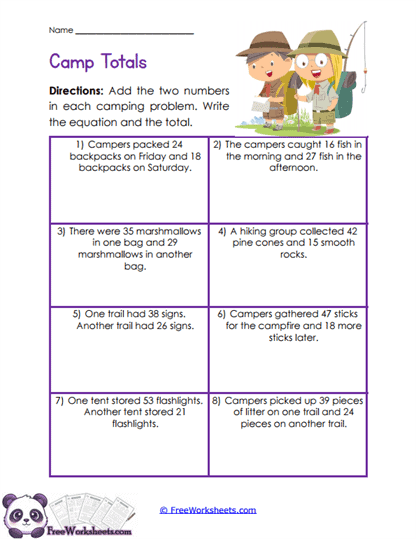
Camp Totals
What Kids Do:
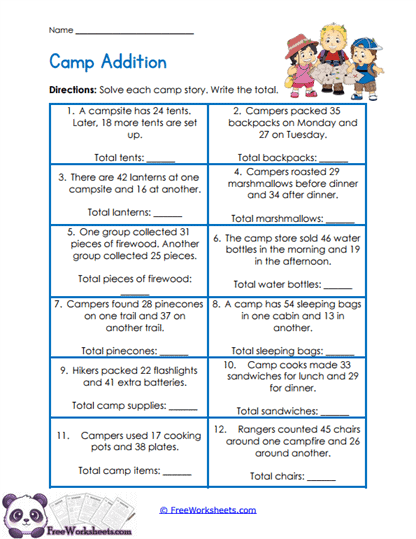
Students solve twelve camping-themed word problems involving two quantities, such as tents, lanterns, water bottles, pinecones, sleeping bags, sandwiches, or chairs. They identify the amounts being joined and write the total after completing the required addition.
Target Skill:
The worksheet strengthens one-step problem solving with two-digit quantities. 2nd grade students practice recognizing joining situations, extracting relevant numbers from text, and applying regrouping or non-regrouping strategies within meaningful real-world contexts.
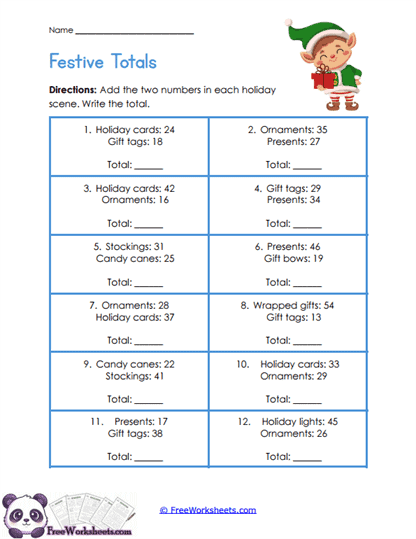
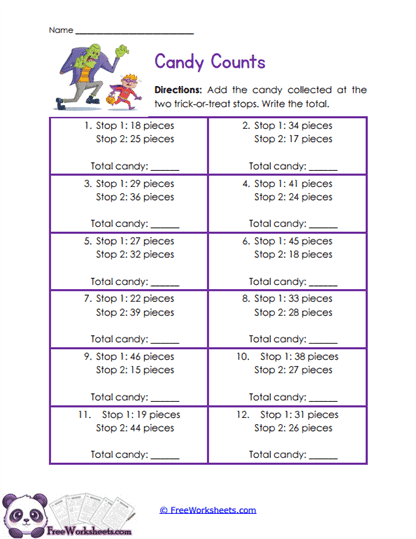
Candy Counts
What Kids Do:
Students complete twelve themed problems that show candy collected at two different stops. They add the two two-digit amounts in each box and write the combined total, working through a mixture of problems that do and do not require regrouping.
Target Skill:
This page develops addition fluency within a simple real-world setting. 2nd grade students practice combining two quantities, composing a new ten when necessary, and using estimation or number sense to judge whether each candy total is reasonable.
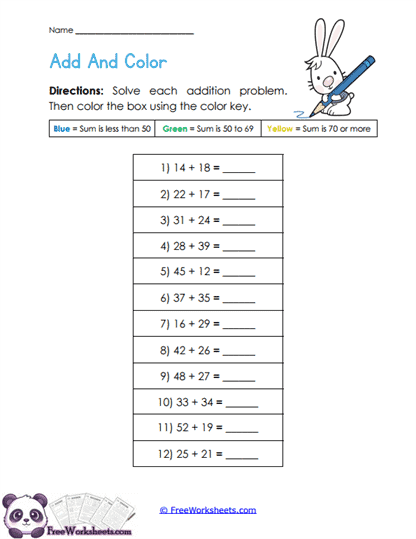
Color Totals
What Kids Do:
Students solve twelve two-digit addition problems and then use a three-part color key based on the size of each sum. They color each problem according to whether its answer is below 50, from 50 to 69, or 70 and above.
Target Skill:
This activity blends computation with number comparison and classification. 2nd grade students strengthen addition accuracy, range awareness, and careful reading of boundary values while using each calculated sum to make a second mathematical decision.
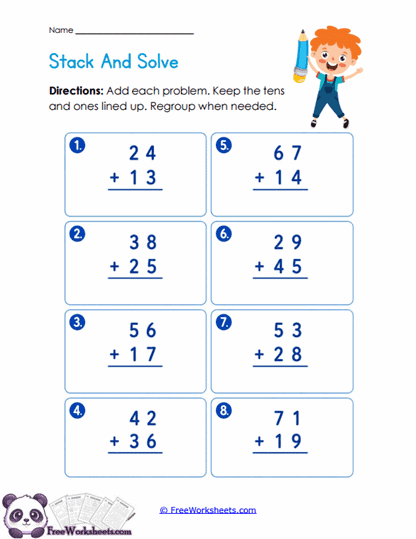
Column Sums
What Kids Do:
Students solve eight vertically arranged two-digit addition problems with the ones and tens columns already aligned. They add the ones first, regroup a new ten when needed, add the tens, and write each final sum beneath the stacked equation.
Target Skill:
The worksheet develops accurate use of the standard vertical addition process. 2nd grade students practice place-value alignment, regrouping, and orderly written computation while connecting the algorithm to their understanding of tens and ones.
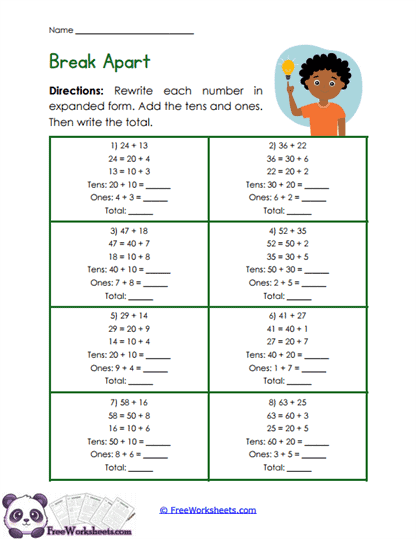
Expanded Sums
What Kids Do:
Students break each two-digit addend into tens and ones, add the tens, add the ones, and combine the partial sums. They work through eight problems using expanded forms such as 40 + 7 to represent the place-value structure of each number.
Target Skill:
This strategy page strengthens decomposition and place-value understanding. 2nd grade students learn to connect each digit with its actual value and use partial sums to explain why two-digit addition works, including cases where the ones create another ten.
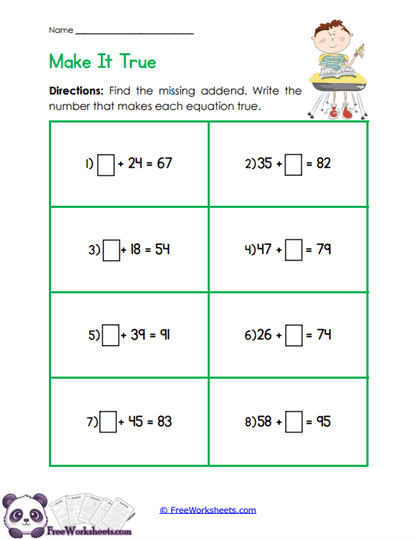
Missing Addends
What Kids Do:
Students solve eight equations containing a missing two-digit addend. They use the known addend and total to determine the unknown value, record it in the box, and can substitute the answer back into the equation to confirm that the relationship is true.
Target Skill:
The activity strengthens equation sense and the connection between addition and subtraction. 2nd grade students practice reasoning backward from a total, finding unknown parts, and understanding that a missing addend can appear in more than one position within an equation.
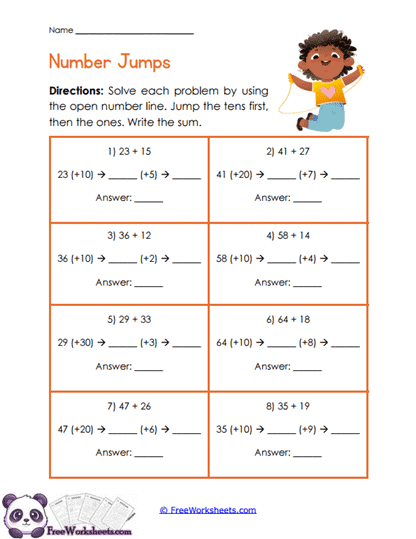
Number Leaps
What Kids Do:
Students solve eight addition problems by decomposing the second addend into tens and ones. They make a larger tens jump from the first number, record the intermediate total, add the remaining ones, and then write the final sum.
Target Skill:
This worksheet develops open-number-line and mental-math reasoning. 2nd grade students practice decomposing numbers by place value, adding multiples of 10 efficiently, and keeping track of intermediate totals as they build a two-digit sum in manageable steps.
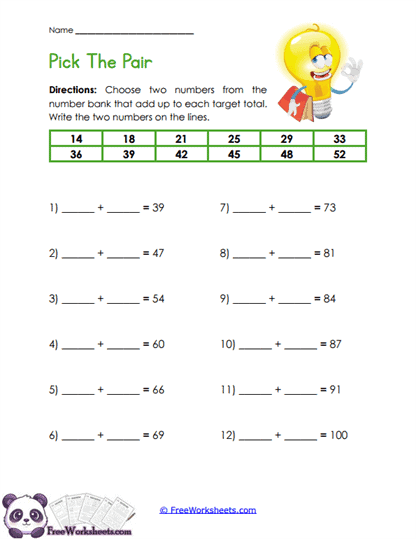
Pair Builder
What Kids Do:
Students use a bank of two-digit numbers to find two addends that combine to make each of twelve target totals. They select possible partners, write them in the blank equation, and add the pair to check that it reaches the required sum.
Target Skill:
This activity strengthens flexible number relationships and missing-part reasoning. 2nd grade students work backward from a total, evaluate possible combinations, and use addition to verify choices rather than following the usual routine of starting with two given addends.
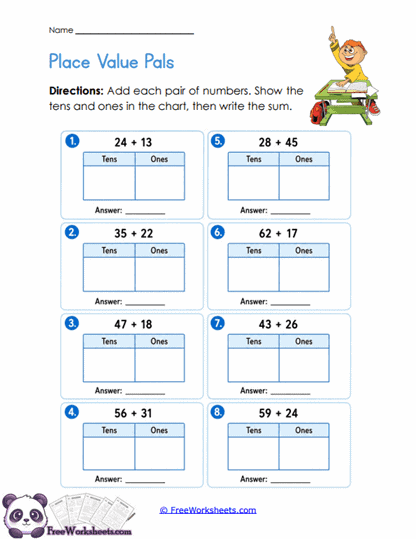
Place Pairs
What Kids Do:
Students solve eight addition problems by organizing both addends in tens-and-ones charts. They separate the place values, combine corresponding parts, regroup when the ones create another ten, and record the completed sum on the answer line.
Target Skill:
The worksheet builds place-value understanding as the foundation for two-digit addition. 2nd grade students practice keeping tens and ones organized, interpreting each digit by value, and understanding how regrouping changes the amount recorded in each place.
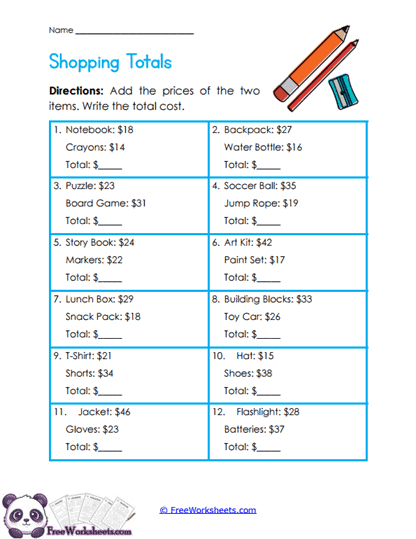
Shopping Sums
What Kids Do:
Students examine twelve pairs of familiar items with whole-dollar prices and add the two amounts to find each total cost. They work with school supplies, clothing, toys, sports items, and other purchases while recording the combined price.
Target Skill:
This activity applies two-digit addition to early financial math. 2nd grade students strengthen regrouping, place-value alignment, and estimation while learning that ordinary whole-dollar prices can be combined using the same addition strategies used with other two-digit numbers.
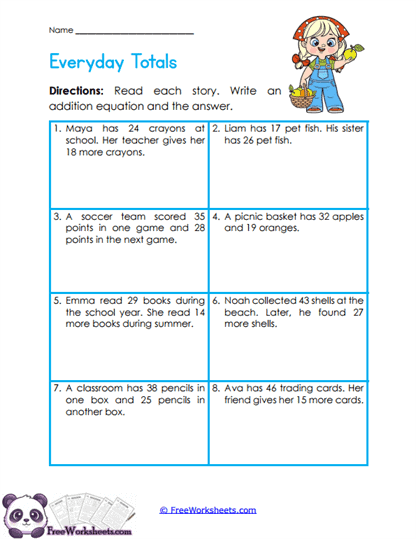
Story Sums
What Kids Do:
Students read eight short real-world stories about crayons, fish, sports points, fruit, books, shells, pencils, and reading cards. They identify the two quantities being combined, write an addition equation, and calculate the requested total.
Target Skill:
This worksheet strengthens mathematical reading and one-step problem solving. 2nd grade students practice recognizing joining situations, translating words into equations, and applying accurate two-digit addition rather than simply calculating from equations that are already set up.
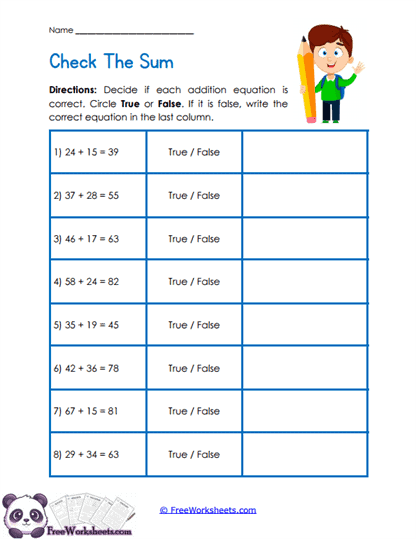
Sum Checker
What Kids Do:
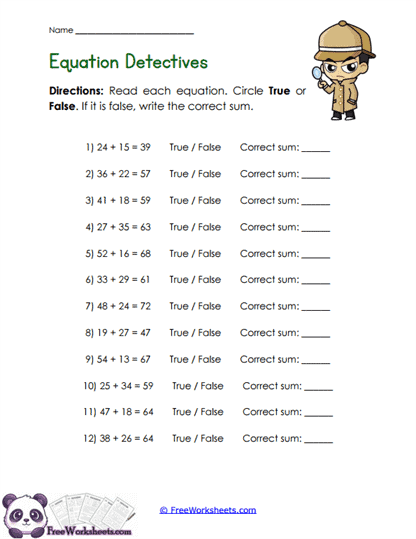
Students inspect eight completed two-digit addition equations and determine whether each stated total is correct. They circle True or False, and whenever an equation is false, they calculate and record the corrected sum in the final column.
Target Skill:
The activity develops addition accuracy and self-checking habits. 2nd grade students practice verifying completed work, identifying incorrect totals, and correcting errors while paying close attention to place value and regrouping.
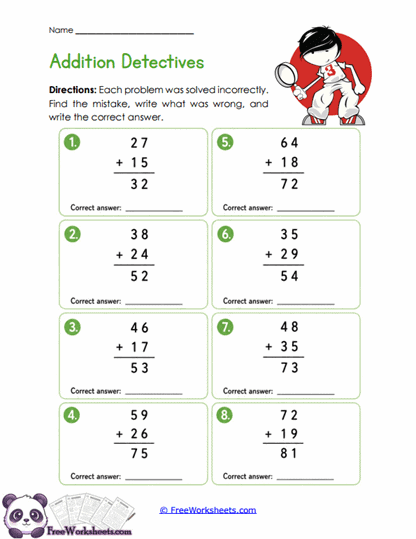
Sum Detectives
What Kids Do:
Students examine eight addition problems that already contain incorrect answers. They work through the tens and ones to locate what went wrong, solve each equation correctly, and record the repaired total on the provided answer line.
Target Skill:
This worksheet develops error analysis rather than routine computation alone. 2nd grade students strengthen place-value reasoning, regrouping awareness, and mathematical explanation by determining why a completed solution fails and replacing it with an accurate result.
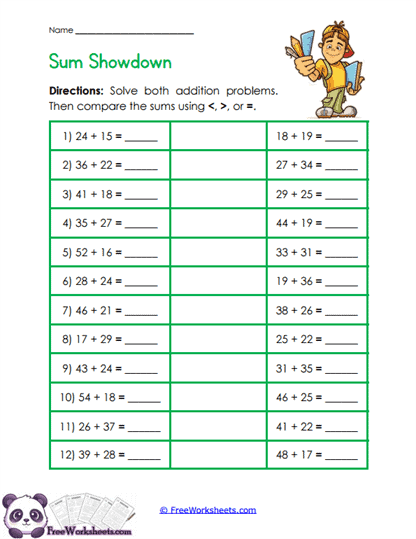
Sum Showdown
What Kids Do:
Students solve twelve pairs of two-digit addition equations presented side by side. After finding both totals, they compare the answers and write the appropriate greater-than, less-than, or equal-to symbol between them.
Target Skill:
The activity combines computation and comparison in every row. 2nd grade students strengthen addition fluency, number magnitude understanding, and correct use of comparison symbols while learning to compare completed sums rather than the original addends.
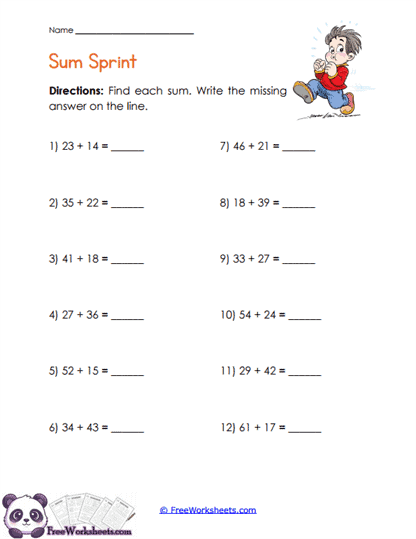
Sum Sprint
What Kids Do:
Students solve twelve straightforward two-digit addition equations in a clean two-column layout. They calculate each sum independently, regroup where necessary, and write the answer beside the equation without using visual models or answer banks.
Target Skill:
This worksheet builds independent computation fluency after students understand the underlying strategies. 2nd grade learners practice accuracy, efficient regrouping, and place-value organization while gaining confidence solving two-digit additions with fewer supports.
Truth Check
What Kids Do:
Students evaluate twelve completed addition statements by solving each equation and comparing their result with the printed total. They circle True or False and write the correct sum whenever they determine that the statement is inaccurate.
Target Skill:
The worksheet reinforces calculation and mathematical verification. 2nd grade students practice judging whether an answer is correct, identifying regrouping or place-value errors, and developing the habit of checking mathematical work instead of accepting a stated result automatically.
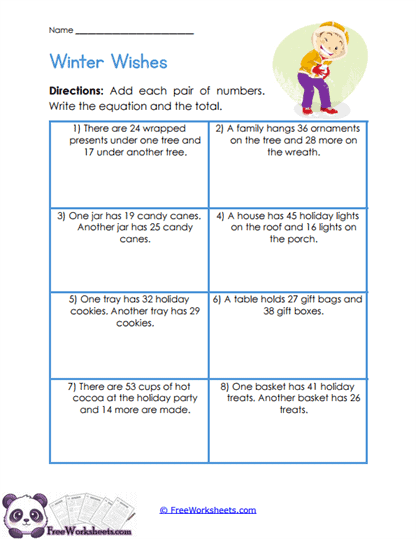
Winter Totals
What Kids Do:
Students read eight winter-themed stories involving presents, ornaments, candy canes, lights, cookies, gift bags, cocoa, and treats. They identify the two quantities being joined, write the corresponding addition equation, and solve for the total.
Target Skill:
This activity applies two-digit addition within engaging seasonal contexts. 2nd grade students strengthen reading comprehension, equation writing, regrouping, and real-world problem solving while explaining how two separate amounts combine into one total.