
2nd Grade Math Review Worksheets
2nd grade math review worksheets help students revisit operations, place value, measurement, geometry, money, time, data, and problem solving. Free, ready-to-print worksheets in PDF format are designed for immediate classroom use, centers, morning work, homework, or homeschool lessons. Students strengthen computation, number sense, and flexible problem solving while developing skills that support curriculum expectations.
About This Collection of Worksheets
Mixed math review helps 2nd grade students revisit important concepts while practicing how to recognize which strategy fits each problem. Instead of working through one repeated skill, students move among addition, subtraction, place value, money, time, measurement, geometry, number patterns, comparisons, data, and word problems. This variety encourages students to recall prior learning and apply it independently in changing situations.
The collection includes direct computation, error analysis, true-or-false checks, category sorting, answer-bank matching, comparisons, picture graphs, tally charts, seasonal activities, and real-world word problems. Some worksheets ask students to solve straightforward questions, while others require them to classify a problem, correct a mistake, interpret information, or compare values represented in different forms. These varied formats provide a broader look at mathematical understanding than a single-skill practice page.
Teachers can use these worksheets for morning work, centers, spiral review, homework, test preparation, intervention, or informal assessment. Parents, tutors, and homeschool educators can use individual pages to identify which skills are secure and which topics need more focused practice. Because students must switch between many types of math, the collection also helps build independence, attention to directions, and confidence applying familiar skills in new contexts.
Paul’s Teacher Tip
Encourage students to name the math skill before they begin each problem on a mixed-review page. A quick statement such as “This is subtraction,” “I need to read the graph,” or “This is a money problem” helps them choose an appropriate strategy instead of carrying over the method from the previous question. When students make mistakes, sort the errors by topic so you can see whether there is a pattern rather than treating every missed problem the same way. For comparison or true-or-false tasks, ask students to solve or interpret both sides before making a judgment. After students finish a page, have them choose one problem from two or three different skill areas and explain how they knew what to do.
Worksheet Collection Skill Spotlights
Answer Network
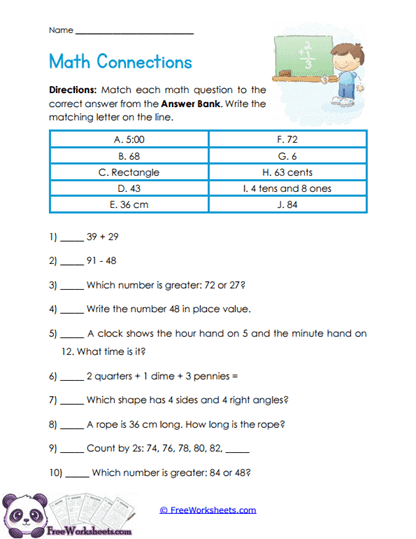
What Kids Do:
Students solve ten mixed math questions covering two-digit addition and subtraction, number comparison, place value, time, money, geometry, measurement, skip counting, and number order. After finding each answer, they search a lettered answer bank and record the letter that matches the exact result.
Target Skill:
This activity strengthens flexible skill selection and answer verification across several 2nd grade topics. Students practice deciding which math process each question requires, solving accurately, and matching their result to a provided choice without relying on the answer bank as a guessing tool.
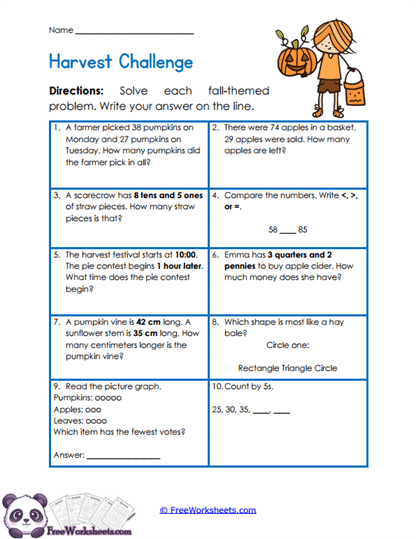
Autumn Math Mix
What Kids Do:
Students complete ten fall-themed problems involving addition, subtraction, place value, comparison, time, money, measurement, geometry, picture graphs, and skip counting. They move from one type of question to another while recording numbers, symbols, and other short responses.
Target Skill:
The worksheet develops broad 2nd grade math recall and the ability to shift strategies between unrelated topics. Students strengthen computation, number sense, data interpretation, measurement, and mathematical vocabulary while practicing careful reading of each new direction.
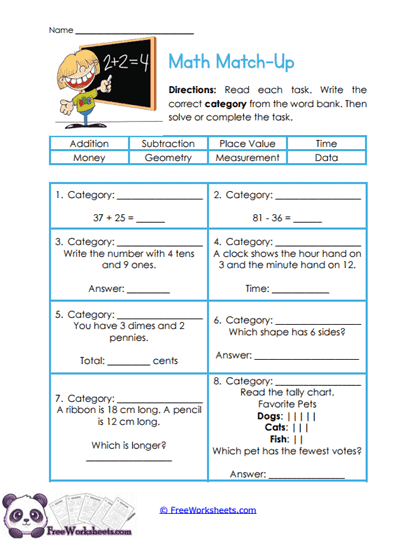
Category Circuit
What Kids Do:
Students work through eight mixed problems and first identify which category each one belongs to, using options such as addition, subtraction, place value, time, money, geometry, measurement, and data. They then solve or answer the mathematical task after naming its topic.
Target Skill:
This activity strengthens mathematical vocabulary and concept recognition along with computation. 2nd grade students learn to identify the structure of a problem before solving it, helping them connect individual questions with broader math topics and choose strategies more deliberately.
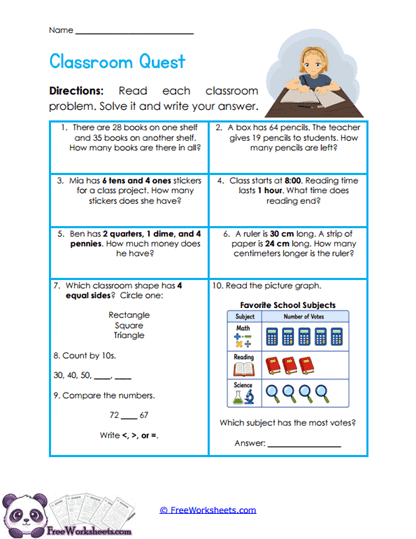
Classroom Mission
What Kids Do:
Students solve ten school-themed problems involving books, pencils, stickers, clocks, coins, length, shapes, counting patterns, number comparison, and a picture graph. They identify the needed skill in each classroom situation and record the appropriate numerical, symbolic, or written response.
Target Skill:
The mixed classroom setting strengthens skill transfer and independent strategy choice. 2nd grade students practice applying operations, place value, time, money, measurement, geometry, patterns, comparisons, and data skills without being told which mathematical topic appears next.
Compare Quest
What Kids Do:
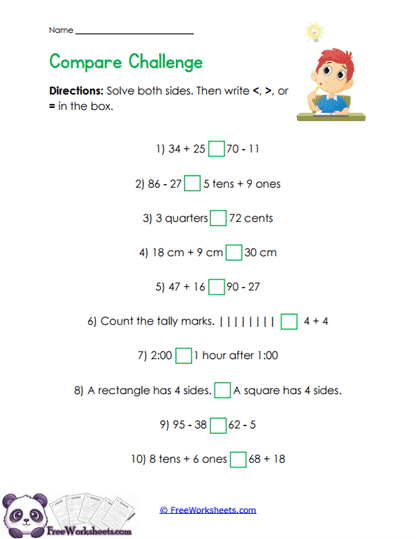
Students evaluate both sides of ten comparison statements that may involve addition, subtraction, coins, measurement, time, tally marks, geometry facts, or place-value forms. After finding the value represented on each side, they write greater than, less than, or equal to.
Target Skill:
This worksheet develops comparison reasoning across multiple mathematical representations. 2nd grade students strengthen computation, number magnitude understanding, unit interpretation, and symbol fluency while learning that very different-looking expressions can still be compared by their values.
Error Lab
What Kids Do:
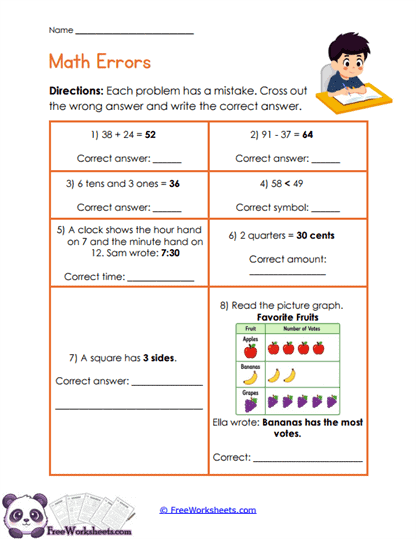
Students inspect eight incorrect mathematical statements involving addition, subtraction, place value, comparison symbols, time, money, geometry, and picture graphs. They determine what is wrong, cross out or replace the inaccurate information, and write the correct answer or statement.
Target Skill:
The activity builds error analysis and self-correction rather than routine calculation alone. 2nd grade students practice checking mathematical claims, locating mistakes across different topics, and explaining or recording accurate replacements, strengthening reasoning and attention to detail.
Everyday Equations
What Kids Do:
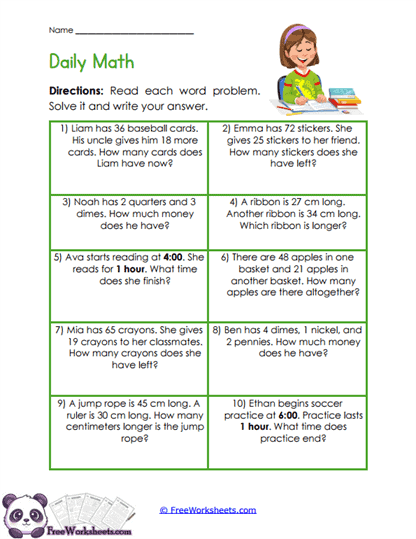
Students solve ten short real-world problems involving addition, subtraction, coin values, ribbon lengths, elapsed time, apples, crayons, jump ropes, money, and soccer practice. They read each situation, determine what is being asked, and write the correct numerical answer.
Target Skill:
This worksheet strengthens practical problem solving and mathematical reading. 2nd grade students practice identifying whether a situation involves joining, taking away, comparing, measuring, finding money, or working with time, then selecting and applying an appropriate strategy.
Fact Inspector
What Kids Do:
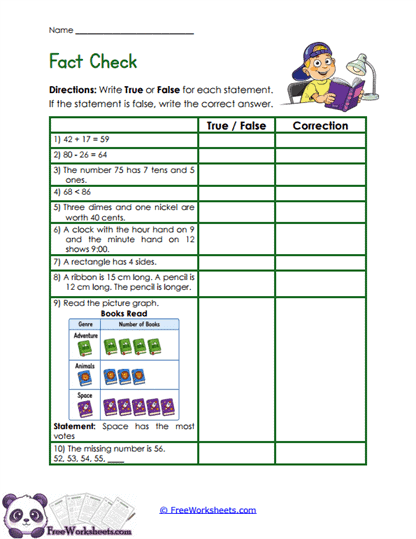
Students review ten completed statements from several math topics and decide whether each one is true or false. They check operations, place value, money, time, geometry, measurement, data, and number patterns, then write the correct information whenever a statement is inaccurate.
Target Skill:
The worksheet develops verification and mathematical reasoning across a broad 2nd grade skill set. Students learn to prove whether a statement is correct instead of judging by appearance, strengthening computation, conceptual knowledge, error detection, and self-checking habits.
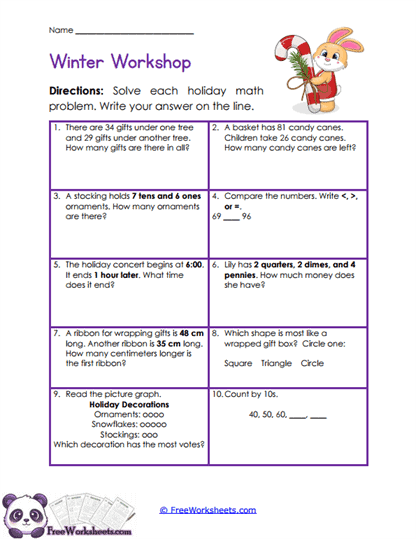
Holiday Math Roundup
What Kids Do:
Students complete ten winter and holiday-themed review problems covering addition, subtraction, place value, comparison, elapsed time, money, measurement, geometry, picture graphs, and counting patterns. Each problem requires a different type of mathematical response.
Target Skill:
This activity reinforces broad 2nd grade fluency while requiring students to shift between skills independently. Learners strengthen operations, number sense, measurement, geometry, data, and time concepts while practicing how to identify the strategy needed for each new question.
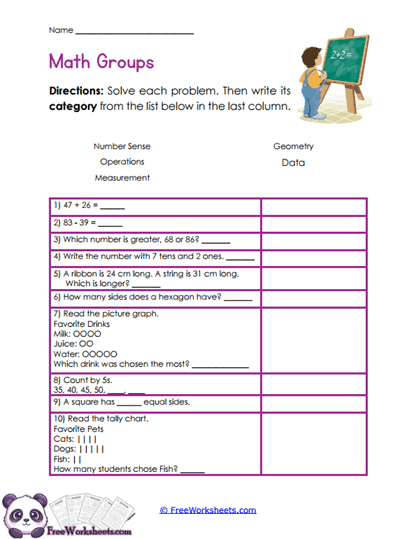
Math Sort
What Kids Do:
Students solve ten mixed problems and classify each one under Number Sense, Operations, Measurement, Geometry, or Data. They work with addition, subtraction, comparisons, place value, lengths, shape properties, counting patterns, picture graphs, and tally charts before recording the correct category.
Target Skill:
The sorting format strengthens conceptual organization and mathematical vocabulary. 2nd grade students practice distinguishing broader areas of mathematics, such as separating operations from number sense or data from measurement, while also solving the underlying questions accurately.
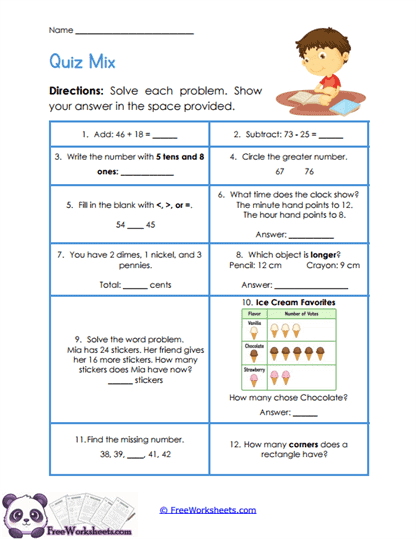
Skill Sampler
What Kids Do:
Students complete twelve varied questions involving addition, subtraction, tens and ones, comparisons, coins, clocks, measurement, a word problem, a picture graph, a number pattern, and geometry. Response types change throughout the page, requiring students to read each direction carefully.
Target Skill:
This broad review strengthens flexible application of major 2nd grade math concepts. Students practice computation, place value, money, time, measurement, data interpretation, patterns, geometry, and problem solving while learning to choose a new strategy as the topic changes.
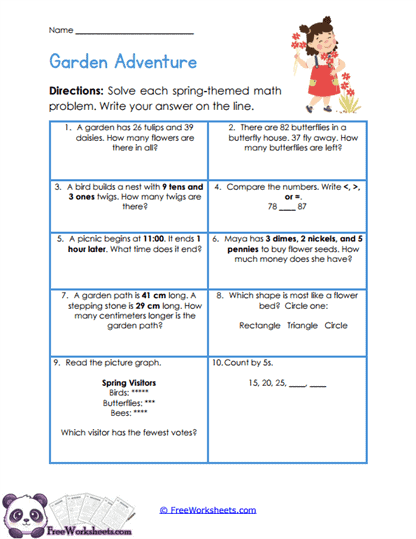
Spring Math Adventure
What Kids Do:
Students solve ten spring-themed questions involving flowers, butterflies, birds, picnics, coins, measurement, shapes, graphs, elapsed time, and number patterns. They add, subtract, build numbers from tens and ones, compare values, interpret data, and complete several other short math tasks.
Target Skill:
The worksheet develops skill transfer across a wide range of 2nd grade topics. Students strengthen operations, place value, comparison, money, time, measurement, geometry, data, and counting patterns while practicing independent decision-making on a mixed review page.