
About This Worksheet
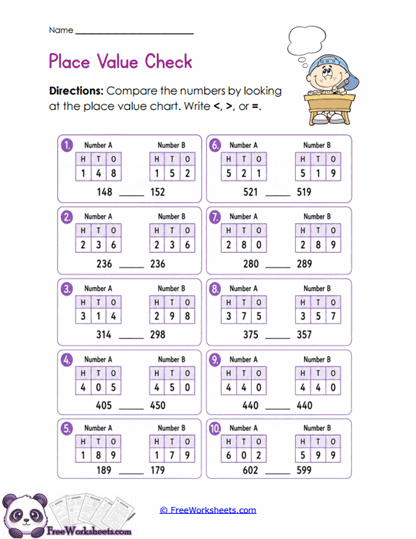
Place Value Comparator is a second grade worksheet that helps students compare three-digit numbers by looking directly at their hundreds, tens, and ones. Each problem shows two numbers in place-value charts labeled H, T, and O. Students study the digits in each place and then write <, >, or = between the two values. For example, when comparing 521 and 519, students first see that both numbers have 5 hundreds, then compare the tens. This makes the reasoning behind number comparison clear and visible.
Curriculum and Grade Alignment
This worksheet is made for second grade learners who are strengthening comparison skills with three-digit numbers. The main goal is to help students use place value systematically instead of comparing numbers by appearance. Before using this page, your child should be able to identify the hundreds, tens, and ones in a number. The next step is comparing three-digit numbers without a place-value chart and explaining which digit determines the result. This activity supports place-value understanding, comparison-symbol fluency, and mathematical reasoning.
Student Tasks
Students will complete ten comparisons. Each problem shows Number A and Number B in separate H-T-O charts, followed by the standard numerals and a blank for the comparison symbol. Students compare the hundreds first, then tens, then ones when needed. Some pairs are equal, while others differ in only one place. This builds careful comparison, symbol use, and place-value reasoning.
Common Challenges and Misconceptions
Some students may look at all three digits at once and feel overwhelmed instead of comparing one place at a time. Others may reverse the comparison symbol after correctly identifying the larger number. A child may also continue checking tens and ones even after the hundreds place already determines the answer. Encourage your child to stop as soon as one place is different. Reading the completed comparison aloud can help check the symbol.
Implementation Guidance
Teachers can use this worksheet when students need a more visual bridge between place-value lessons and standard number comparison. It works well in guided groups because students can point to the exact place that decides the comparison. Parents can cover the standard numerals and compare using only the H-T-O charts first. Then reveal the numerals and show that the same reasoning applies without the chart. This helps the skill transfer to ordinary number writing.
Details and Features
This worksheet includes ten comparison problems using paired hundreds-tens-ones charts. Each problem also shows the full numerals and provides a blank for <, >, or =. The purple boxes keep place values clearly separated. Several problems use equal or closely related numbers to encourage careful thinking. The printable supports three-digit comparison, place value, symbol fluency, and number sense.