
About This Worksheet
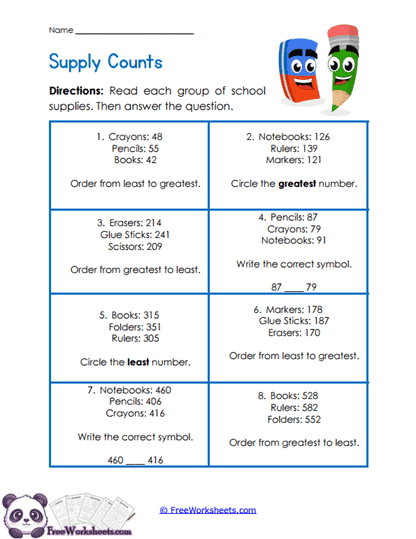
School Supply Sort is a second grade comparison and ordering activity that uses familiar classroom supplies to make number work more meaningful. Each problem gives a small group of two- or three-digit quantities connected to items such as crayons, pencils, notebooks, rulers, glue sticks, markers, books, and folders. Students may order the numbers from least to greatest or greatest to least, circle the greatest or least number, or write the correct comparison symbol. This variety helps children practice several comparison skills without changing the overall topic. The school-supply theme keeps the numbers connected to an everyday setting.
Curriculum and Grade Alignment
This worksheet is made for second grade learners who are practicing comparison and ordering within the hundreds. The main goal is to help students use place value to compare several numbers and follow different directions for arranging them. Before using this page, your child should be able to identify hundreds, tens, and ones and compare two numbers accurately. The next step is solving mixed comparison tasks without a themed context or with larger number sets. This activity supports place-value reasoning, ordering, symbol use, and number sense.
Student Tasks
On this worksheet, students will complete eight school-supply problems. They order groups from least to greatest or greatest to least, circle the greatest or least value, and complete comparisons such as 87 ___ 79 or 460 ___ 416. The number groups include values in the tens and hundreds. Because the directions change from box to box, students must read each task carefully before solving. This builds comparison fluency, ordering, and attention to mathematical language.
Common Challenges and Misconceptions
Some students may continue ordering in the same direction from one box to the next without noticing that the directions changed. Others may compare three-digit numbers by the tens or ones before checking the hundreds. A child may also reverse the comparison symbol even when they know which number is larger. Encourage your child to underline words such as least, greatest, and circle before starting. Comparing from the highest place value first will help with close numbers.
Implementation Guidance
Teachers can use this worksheet after students have practiced each comparison skill separately. It works well as mixed review because students need to switch among ordering, circling, and symbol-writing tasks. Parents can ask the child to read the direction aloud before working each box. If a set is difficult, write the numbers in a place-value chart or arrange them vertically. This keeps the focus on value rather than appearance.
Details and Features
This worksheet includes eight classroom-themed comparison and ordering problems in a large grid. Tasks use two- and three-digit numbers and vary between ordering, greatest or least selection, and symbol comparisons. The school-supply context adds variety while the math remains clear. Large boxes provide room for complete ordered lists. The printable supports number comparison, sequencing, place value, and direction-following.