
Compound Words Worksheets
Combining two familiar words can produce a new word with a meaning of its own, such as raincoat or toothbrush. These grade 2 compound words worksheets have children connect word beginnings and endings, separate compounds into their original parts, and repair incorrectly spelled words. Some activities also challenge learners to distinguish real compounds from invented combinations. The free printable PDFs move from supported matching toward sentence-level application. Demonstrate how two word cards fit together, then discuss the meaning of the complete word.
About This Collection of Worksheets
Understanding compound words helps young learners recognize how familiar words combine to form new vocabulary with distinct meanings. These 2nd grade compound words worksheets introduce students to common closed compounds such as sunshine, playground, toothbrush, and raincoat, showing how two smaller words work together as one. By examining the individual parts of each compound word, children develop stronger word recognition, spelling awareness, and vocabulary knowledge. This understanding also supports decoding and reading comprehension as students encounter longer, more complex words in everyday texts.
The collection includes a variety of activities designed to help students identify, construct, analyze, and use compound words. Children match word beginnings with endings, separate compound words into their individual parts, and determine whether combinations form real words or silly ones. Other worksheets focus on correcting misspelled compounds, identifying words hidden within sentences and paragraphs, matching compound words with definitions, and selecting vocabulary that completes sentences meaningfully. Students also practice writing original sentences using compound words, allowing them to apply their understanding beyond isolated word recognition.
Teachers can use these printable worksheets during vocabulary instruction, phonics review, spelling lessons, literacy centers, or independent reading activities. Parents, tutors, and homeschool educators can reinforce the concepts by encouraging children to identify compound words in books, explain how their parts contribute to meaning, and practice writing them correctly. The collection offers a progression from supported matching and multiple-choice exercises to open-ended word analysis and sentence writing. This variety helps educators provide targeted practice for students developing foundational word-building skills while offering meaningful extensions for learners ready to apply compound vocabulary independently.
Paul’s Teacher Tip
Introduce compound words by writing two familiar words on separate cards, such as sun and shine, and physically moving them together to demonstrate how they create sunshine. Ask students to explain what each smaller word means before discussing the meaning of the complete compound, since the combined meaning may be more specific than either part alone. When children struggle to recognize compounds, encourage them to look for two complete words rather than simply dividing a long word into syllables. For spelling practice, emphasize that the closed compound words in these worksheets are written without spaces or hyphens, even though they contain two recognizable words. Extend the lesson by challenging students to find compound words in their independent reading books, separate them into meaningful parts, and use them in original sentences.
Worksheet Collection Skill Spotlights
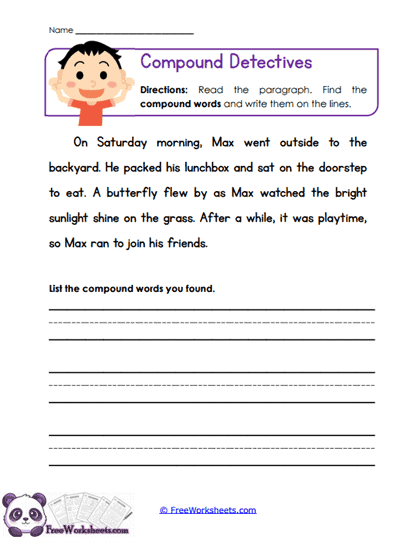
Compound Detectives
What Kids Do:
Students read a short paragraph about Max spending time in his backyard, carrying a lunchbox, sitting on the doorstep, watching a butterfly, noticing sunlight, and enjoying playtime. As they read, they search for compound words embedded in the passage and write each one on the provided lines. Children can examine the words they find and identify the two smaller words that form each compound.
Target Skill:
This activity strengthens the ability to recognize compound words within connected reading rather than isolated vocabulary lists. Students practice analyzing word structure, identifying meaningful word parts, and transferring their knowledge of compound formation into authentic reading situations, supporting 2nd grade vocabulary development, word recognition, and spelling awareness.
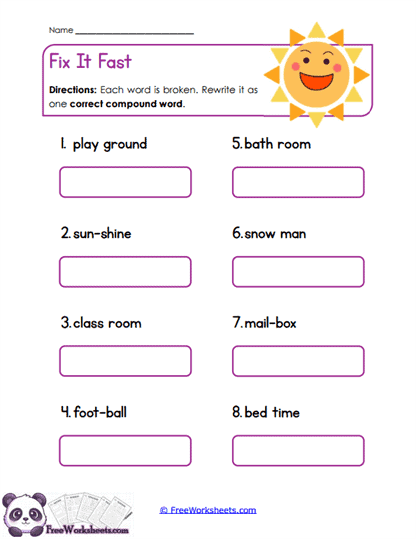
Compound Repair
What Kids Do:
Children examine eight incorrectly written compound words, including examples such as play ground, sun-shine, class room, foot-ball, bath room, snow man, mail-box, and bed time. Some words contain unnecessary spaces, while others use incorrect hyphens. Students identify the error in each example and rewrite the compound word correctly as a single word in the provided box.
Target Skill:
This worksheet develops proofreading accuracy and an understanding of closed compound word spelling conventions. By correcting improperly separated or hyphenated words, 2nd grade students reinforce the principle that many familiar compound words are written as one continuous unit, strengthening visual word recognition, spelling fluency, and structural word analysis.
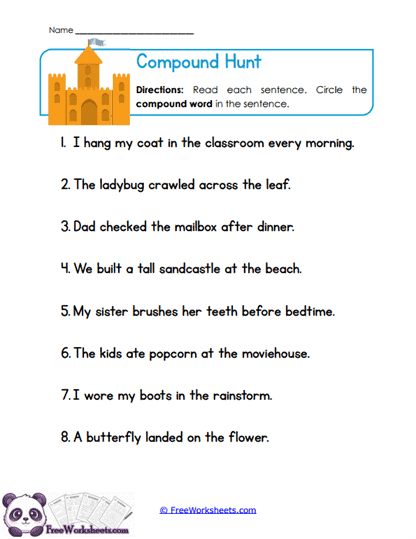
Compound Search
What Kids Do:
Students read eight short sentences featuring familiar compound words connected to everyday situations. Each sentence contains a compound word, such as classroom, ladybug, mailbox, sandcastle, bedtime, moviehouse, rainstorm, or butterfly. Children read each complete sentence, locate the compound word, and circle it before considering the two smaller words that make up the larger vocabulary term.
Target Skill:
The activity strengthens compound word recognition during sentence-level reading. Students learn to distinguish genuine compounds from other longer words by identifying two meaningful components, supporting 2nd grade vocabulary analysis, spelling awareness, and the ability to recognize familiar word structures while reading connected text.
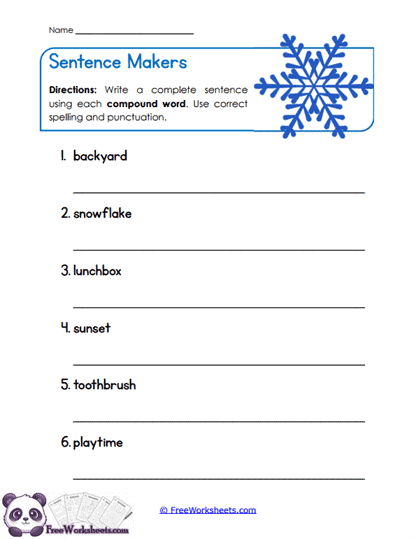
Compound Sentences
What Kids Do:
Children receive six familiar compound words, including backyard, snowflake, lunchbox, sunset, toothbrush, and playtime. They read each word and write an original sentence that uses it correctly. Students must develop a complete thought, incorporate the compound naturally, and use appropriate capitalization and ending punctuation. The open-ended format encourages individual expression while keeping the focus on vocabulary meaning.
Target Skill:
This worksheet moves compound word understanding from recognition into independent written expression. Students strengthen 2nd grade vocabulary application by demonstrating that they understand what each compound means and can use it appropriately in context. The activity also reinforces sentence structure, grammar, spelling accuracy, and the ability to communicate complete ideas.
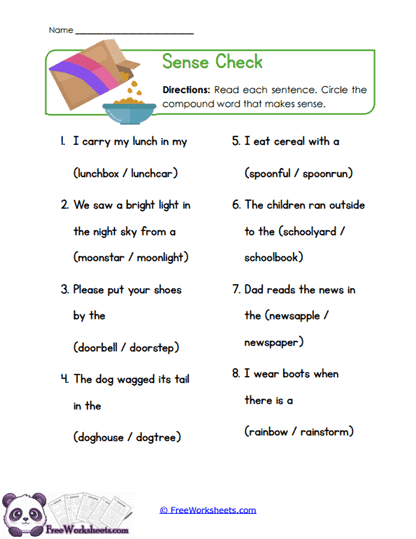
Meaning Choices
What Kids Do:
Students read eight sentences containing two possible compound word choices in parentheses. Examples include comparisons such as lunchbox or lunchcar, moonlight or moonstar, and rainstorm or rainbow. Children consider the meaning of the entire sentence and circle the compound that fits best. After selecting an answer, they can reread the completed sentence to confirm that the vocabulary choice makes sense.
Target Skill:
This activity develops contextual vocabulary understanding and careful word selection. Students learn that recognizing familiar word parts is not enough to determine whether a compound fits a sentence. By considering both the combined meaning and surrounding language, 2nd grade readers strengthen comprehension, semantic reasoning, and the ability to select vocabulary appropriate to a specific context.
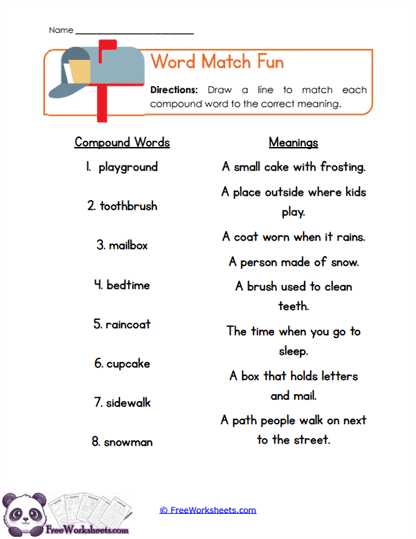
Meaning Match
What Kids Do:
Children examine eight common compound words, including playground, toothbrush, mailbox, bedtime, raincoat, cupcake, sidewalk, and snowman. They read the definitions provided in a separate column and draw lines connecting each compound with its correct meaning. For example, they connect toothbrush with a brush used to clean teeth and mailbox with a box that holds letters and mail.
Target Skill:
The worksheet strengthens the connection between compound word structure and vocabulary meaning. Students practice using the meanings of two smaller words to understand the complete compound, developing 2nd grade word analysis and comprehension skills while recognizing that the combined word represents a specific object, place, activity, or concept.
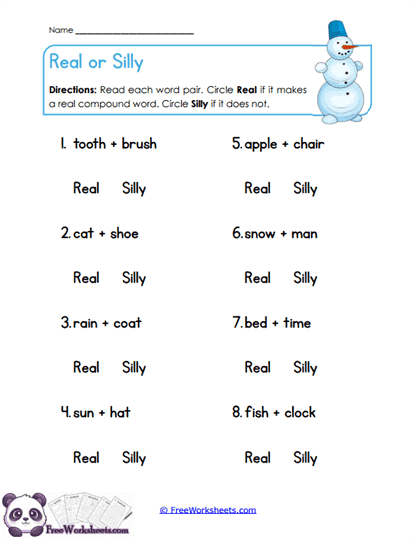
Real Compounds
What Kids Do:
Students read eight pairs of smaller words and decide whether each combination forms a recognizable compound word or a silly, unfamiliar expression. Familiar examples include tooth + brush, rain + coat, and snow + man, alongside combinations that do not create common compound words. For each pair, children mentally join the words, consider the resulting meaning, and circle either Real or Silly.
Target Skill:
This worksheet develops the ability to distinguish meaningful compound formations from arbitrary word combinations. Students strengthen vocabulary judgment and word awareness by evaluating whether two recognizable words create an established compound with a coherent meaning, supporting 2nd grade language development and more accurate recognition of common word-building patterns.
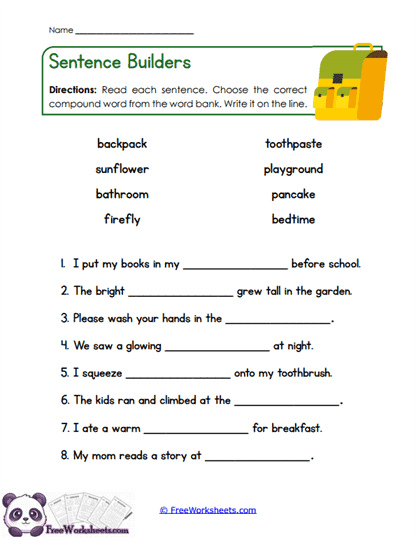
Sentence Compounds
What Kids Do:
Children use a word bank containing eight compound words, including backpack, sunflower, bathroom, firefly, toothpaste, playground, pancake, and bedtime. They read eight incomplete sentences and select the compound word that best completes each one. Students write their choices on the provided lines, using contextual clues to determine which word makes each sentence meaningful and grammatically appropriate.
Target Skill:
This activity reinforces the ability to understand and apply compound vocabulary within complete sentences. Students combine word meaning with contextual reasoning, strengthening 2nd grade reading comprehension, vocabulary selection, and spelling accuracy while learning to recognize how compound words function naturally in everyday language.
Spelling Choices
What Kids Do:
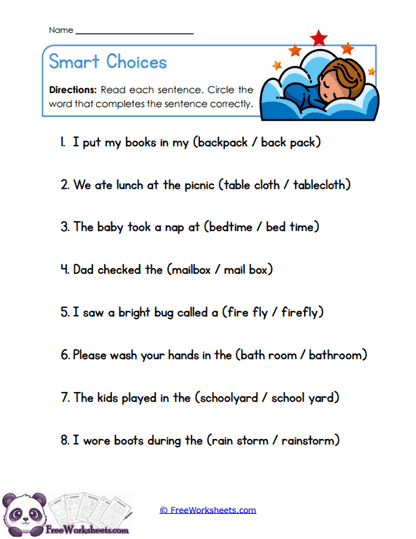
Students read eight sentences presenting two possible spellings of a familiar compound word. Examples include backpack versus back pack, tablecloth versus table cloth, mailbox versus mail box, and rainstorm versus rain storm. Children compare the written forms, circle the correctly spelled option, and reread the sentence to reinforce recognition of the compound as one complete word.
Target Skill:
This worksheet strengthens visual spelling recognition and knowledge of closed compound word conventions. Students practice identifying the standard written form of familiar compounds and distinguishing it from incorrectly spaced alternatives, supporting 2nd grade spelling development, proofreading skills, and accurate word recognition during reading and writing.
Word Builders
What Kids Do:
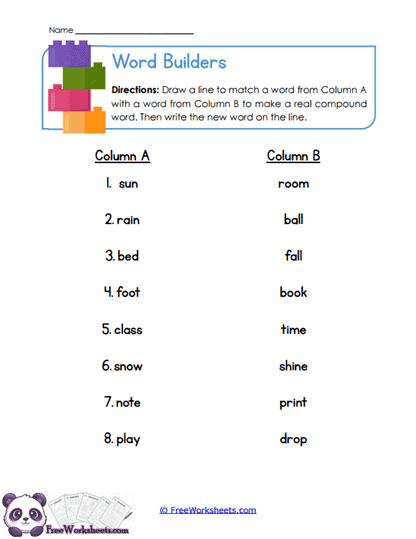
Children work with two columns of smaller words, including beginnings such as sun, rain, bed, foot, class, snow, note, and play. They examine possible endings, draw lines connecting the parts that form real compound words, and write each completed word on the provided line. The activity requires students to consider both familiar word combinations and the meaning of the resulting compound.
Target Skill:
This worksheet builds foundational compound word formation skills by teaching students how two complete words combine into one meaningful vocabulary term. Through matching and writing, 2nd grade students strengthen structural word awareness, spelling accuracy, and the ability to recognize familiar patterns that help them decode and understand compound words independently.
Word Parts
What Kids Do:
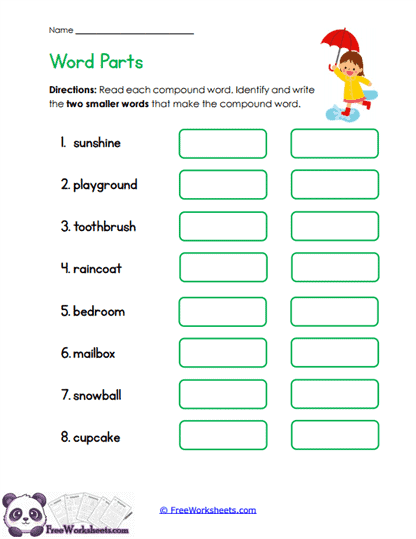
Students examine eight familiar compound words, including sunshine, playground, toothbrush, raincoat, bedroom, mailbox, snowball, and cupcake. For each word, they determine where the compound separates into two meaningful smaller words and write those components in individual boxes. For example, they divide sunshine into sun and shine, demonstrating an understanding of how the complete word is constructed.
Target Skill:
This activity develops the ability to analyze compound words by identifying their meaningful components. Rather than treating longer vocabulary words as indivisible units, 2nd grade students learn to recognize familiar smaller words within them, strengthening decoding strategies, vocabulary comprehension, structural analysis, and spelling knowledge.
Word Puzzles
What Kids Do:
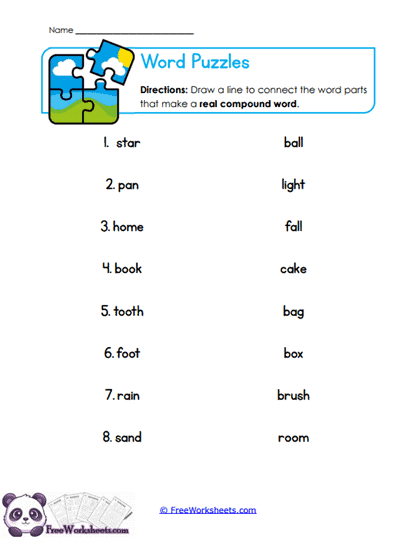
Children examine two sets of word parts arranged in separate columns. Beginnings include star, pan, home, book, tooth, foot, rain, and sand, while endings include light, cake, room, bag, brush, ball, fall, and box. Students draw lines connecting beginnings and endings to form recognizable compound words, using familiar vocabulary and word meanings to determine the correct matches.
Target Skill:
This puzzle-style activity strengthens the ability to construct compound words through meaning-based word-part matching. Students develop flexible word recognition and semantic reasoning as they test possible combinations and identify established vocabulary, supporting 2nd grade expectations for understanding word formation, recognizing compound structures, and expanding familiar word knowledge.