
Categories Worksheets
Organizing vocabulary into meaningful groups requires children to recognize shared characteristics rather than simply notice familiar words. These grade 2 categories worksheets have learners sort vocabulary into labeled groups, solve riddles about word categories, and identify the item that does not belong. Other activities ask children to generate category names or add their own examples. The free printable PDFs provide structured choices for beginners and open-ended challenges for more independent learners. Encourage children to explain what connects the words before deciding where each belongs.
About This Collection of Worksheets
Learning to organize words into categories helps young readers understand how vocabulary is connected through shared meanings, characteristics, and uses. These 2nd grade vocabulary categories worksheets teach students to recognize relationships between familiar words and identify broader groups such as animals, foods, clothing, places, actions, and school supplies. Rather than memorizing individual definitions, children learn to compare word meanings, recognize common features, and explain why certain words belong together. These foundational language skills support reading comprehension, word retrieval, and the ability to communicate ideas more precisely.
This collection provides a variety of engaging activities that gradually build category recognition and classification skills. Students sort words into labeled groups, identify the word that does not belong, complete category lists, and name groups based on shared characteristics. Other worksheets challenge children to solve category riddles, replace incorrectly grouped words, organize vocabulary by everyday settings, or create meaningful sentences using words from the same category. The activities range from straightforward sorting and multiple-choice tasks to open-ended vocabulary generation, providing opportunities to practice both recognizing and applying word relationships.
Teachers can incorporate these printable worksheets into vocabulary lessons, literacy centers, small-group instruction, or independent reading activities. Parents, tutors, and homeschool educators can reinforce the same skills by encouraging children to name additional category members and explain the reasoning behind their choices. Some worksheets provide category labels and examples for students who need more structure, while others require learners to generate category names or vocabulary words independently. This flexibility makes the collection useful for introducing semantic relationships, reviewing previously taught vocabulary, and helping students develop more organized word knowledge.
Paul’s Teacher Tip
Before introducing category worksheets, demonstrate how familiar objects can be grouped by asking students what they have in common, such as why an apple, banana, and orange belong together. Encourage children to describe the shared characteristic before naming the category, since this helps prevent guessing based on superficial similarities. When students encounter an odd-one-out activity, have them identify the category shared by the other words before selecting the item that does not belong. For children who need additional support, use picture cards or real classroom objects to make abstract word relationships more concrete. Extend the learning by asking students to create their own categories, add new examples, or explain why a word might fit more than one group depending on the context.
Worksheet Collection Skill Spotlights
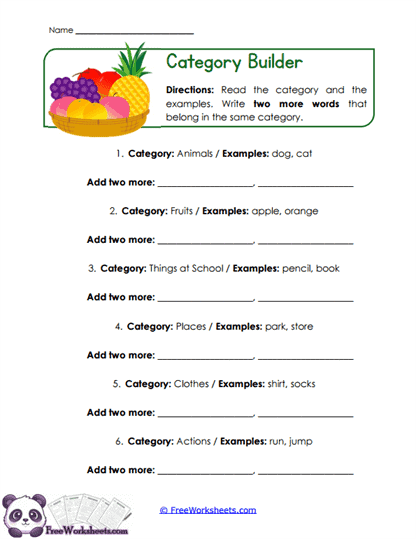
Category Builder
What Kids Do:
Students work with six familiar categories, including animals, fruits, things at school, places, clothes, and actions. Each category provides two example words to establish the group, and children write two additional words that belong. They use the category heading and starter examples to brainstorm appropriate vocabulary, checking that their new choices share the same general meaning or characteristic as the original words.
Target Skill:
This activity strengthens vocabulary recall, semantic classification, and the ability to generate related words independently. By expanding established groups rather than simply identifying their members, 2nd grade students develop a deeper understanding of category relationships and practice retrieving vocabulary that fits a specific meaning-based classification.
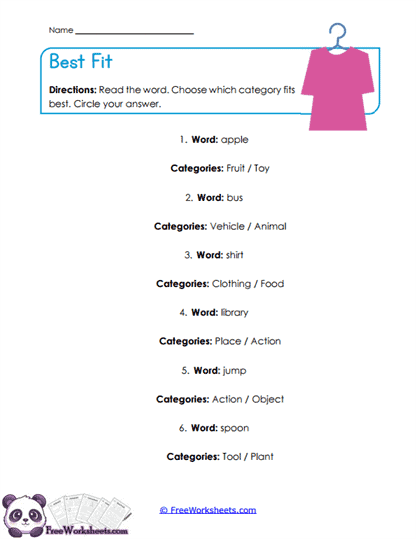
Category Choices
What Kids Do:
Children examine six familiar vocabulary words, including apple, bus, shirt, library, jump, and spoon. Each word appears with two possible category labels, and students circle the option that best describes its meaning. They consider whether each word represents a type of food, transportation, clothing, place, action, or object, using the alternatives to guide their decision.
Target Skill:
The worksheet develops accurate word classification by teaching students to connect individual vocabulary words with broader meaning-based groups. This supports 2nd grade vocabulary expectations by strengthening word knowledge, category recognition, and the ability to distinguish between closely presented classification choices.
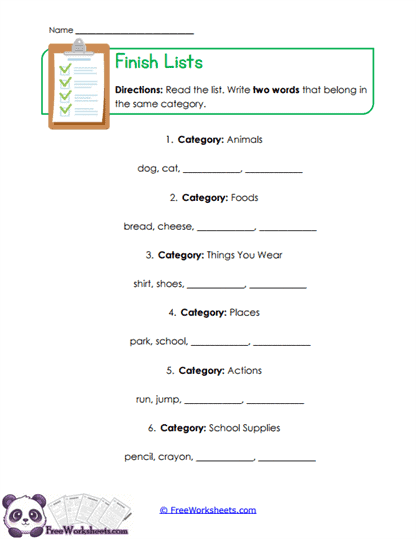
Category Lists
What Kids Do:
Students complete six everyday vocabulary categories, including animals, foods, things you wear, places, actions, and school supplies. Each category begins with two familiar example words, and children contribute two additional examples of their own. The open-response format encourages them to recall relevant vocabulary, avoid repeating the starter words, and consider whether their additions genuinely belong in each group.
Target Skill:
This worksheet builds vocabulary fluency and semantic organization through independent word generation. Rather than choosing from predetermined answers, 2nd grade students retrieve words from memory and connect them to established meaning groups, supporting expressive vocabulary development and flexible understanding of how related words are organized.
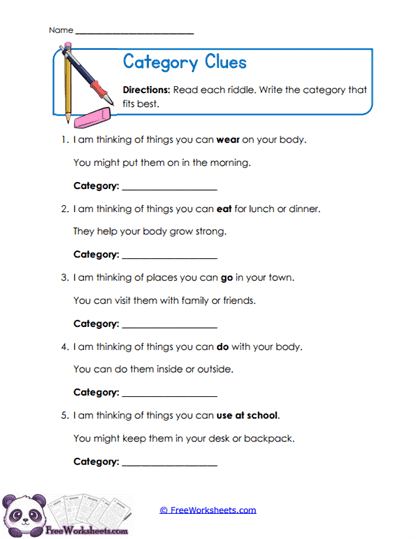
Category Riddles
What Kids Do:
Children read five short riddles describing familiar groups of words without directly naming the categories. Clues reference everyday ideas such as things people wear, foods they eat, places they visit, actions they perform, and supplies they use at school. Students interpret each description and write the category name that best fits all the clues, turning vocabulary classification into a reasoning challenge.
Target Skill:
This activity strengthens the ability to identify broader vocabulary categories through descriptive clues and shared characteristics. Students practice interpreting language, recognizing semantic relationships, and selecting precise category labels, supporting 2nd grade reading comprehension and the development of meaning-based reasoning skills.
Category Swap
What Kids Do:
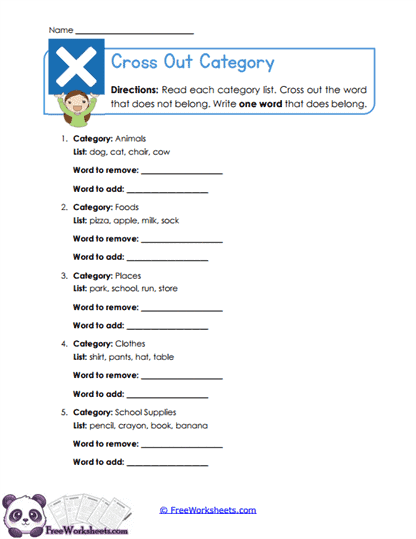
Students examine five vocabulary groups labeled animals, foods, places, clothes, and school supplies. Each group contains four words, including one that does not belong. Children identify the incorrect word, write it on the designated removal line, and then generate a replacement that fits the category. They complete both steps for every group, checking that the revised lists contain only appropriate category members.
Target Skill:
The two-step process develops category recognition, error identification, and flexible vocabulary retrieval. Students must understand why a word does not fit before generating a correct alternative, strengthening 2nd grade classification skills while encouraging more deliberate reasoning about word meanings and shared category characteristics.
Everyday Sorting
What Kids Do:
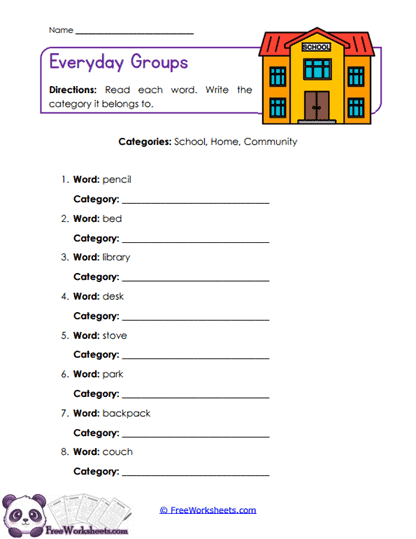
Children read eight familiar vocabulary words, including pencil, bed, library, desk, stove, park, backpack, and couch. For each word, they decide whether it is most closely associated with school, home, or the community and write the appropriate category on the answer line. The activity requires students to consider where objects are commonly found or used rather than relying solely on their physical characteristics.
Target Skill:
This worksheet develops the ability to classify vocabulary according to real-world context and typical use. By connecting familiar words with meaningful settings, 2nd grade students strengthen semantic associations, practical reasoning, and their understanding that vocabulary can be organized through relationships beyond simple object types.
Group Labels
What Kids Do:
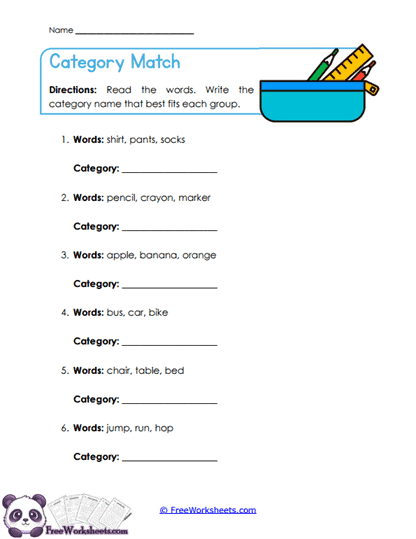
Students examine six sets of three related words and determine the category that describes each complete group. Examples include shirt, pants, and socks for clothing, or pencil, crayon, and marker for school supplies. Children write an appropriate category name on each answer line, using their understanding of all three words to identify a broader label that accurately includes every item.
Target Skill:
The activity strengthens the ability to move from specific examples to a general category concept. Students develop 2nd grade vocabulary organization and classification skills by identifying shared meanings, selecting accurate group labels, and understanding why a broad category must include every word rather than describing only one or two examples.
Group Naming
What Kids Do:
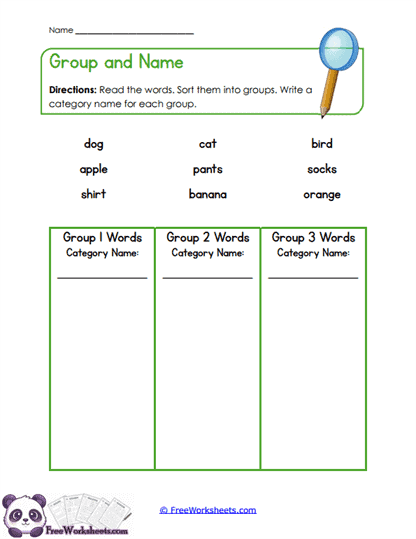
Children receive nine mixed vocabulary words, including dog, cat, bird, apple, banana, orange, shirt, pants, and socks. They organize the words into three groups based on shared meanings and then write a suitable category name for each group. Unlike activities that provide the headings first, this worksheet requires students to discover the relationships independently and decide how the words should be organized.
Target Skill:
This activity combines semantic sorting with independent category identification. By determining both which words belong together and what each group should be called, 2nd grade students strengthen vocabulary relationships, classification reasoning, and the ability to recognize broader concepts from specific examples without relying on supplied category labels.
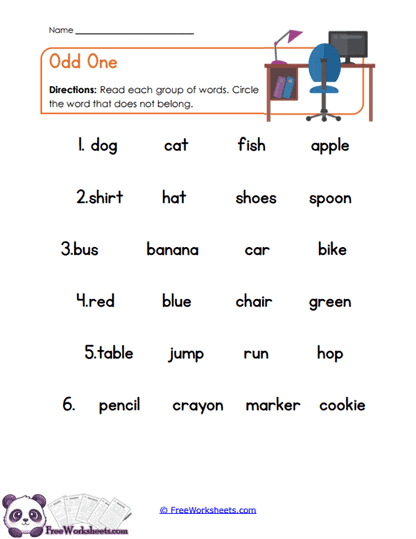
Odd Word
What Kids Do:
Students work through six rows of four familiar vocabulary words, identifying the single word that does not belong with the other three. For example, a group containing dog, cat, fish, and apple requires children to recognize that three words name animals while one names a food. They circle the mismatched word in each row, considering categories involving animals, clothing, vehicles, colors, actions, and school supplies.
Target Skill:
The worksheet develops vocabulary discrimination and logical classification by asking students to identify shared meaning patterns and recognize exceptions. This strengthens 2nd grade semantic reasoning because children must evaluate relationships among multiple words and determine which item falls outside the category established by the majority.
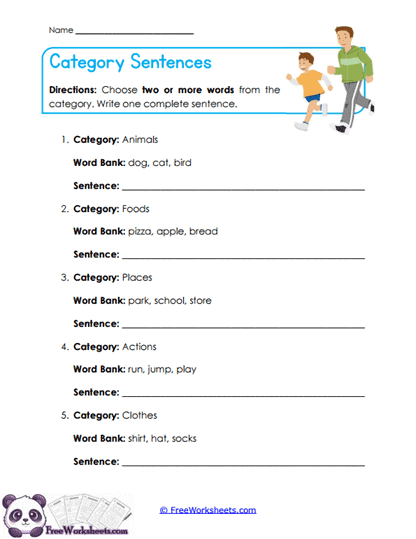
Sentence Groups
What Kids Do:
Children use vocabulary from five categories, including animals, foods, places, actions, and clothes, to construct complete sentences. Each section provides a small word bank, and students choose at least two words from the same category to include in one meaningful sentence. They write their responses on the provided lines, making sure the selected words work together naturally rather than appearing as an unrelated list.
Target Skill:
This worksheet extends category understanding into practical language production and sentence writing. Students demonstrate that they understand related vocabulary well enough to use multiple words within a coherent thought, strengthening 2nd grade expressive language, contextual word usage, sentence construction, and connections between vocabulary knowledge and written communication.
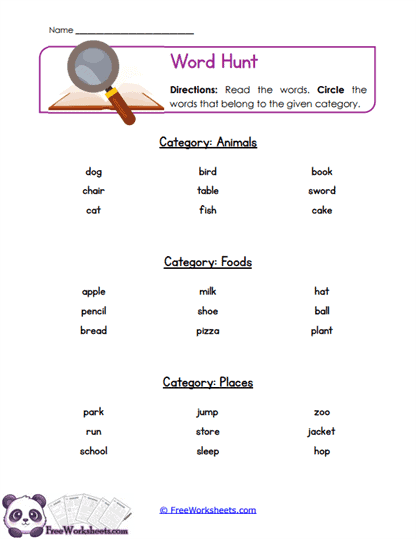
Word Hunt
What Kids Do:
Students examine three sections of mixed vocabulary words organized around the headings animals, foods, and places. Each section contains words that belong to the target category alongside unrelated choices. Children read through the entire list and circle only the appropriate category members, such as identifying dog, bird, cat, and fish as animals while leaving unrelated words unmarked.
Target Skill:
This search-and-circle activity develops rapid category recognition and accurate vocabulary classification. By locating relevant words among distractors, 2nd grade students strengthen word recognition, selective attention, and semantic processing while learning to distinguish true category membership from words that may only be loosely associated with the topic.
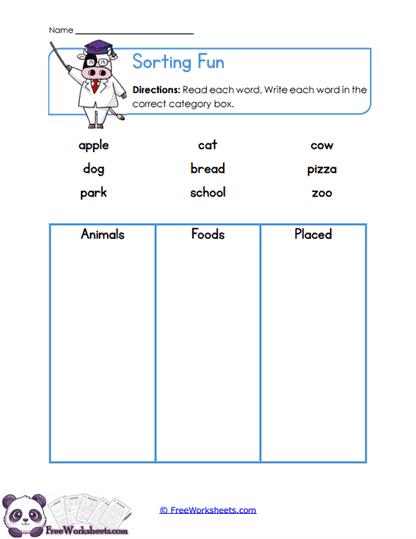
Word Sorting
What Kids Do:
Children read nine familiar vocabulary words, including apple, cat, cow, dog, bread, pizza, park, school, and zoo. They classify each word under one of three headings: Animals, Foods, or Places. Students write the words into the corresponding columns and can review their completed groups to check that each item shares the defining characteristic of its assigned category.
Target Skill:
This foundational sorting activity strengthens the ability to recognize similarities among word meanings and organize vocabulary into established categories. Students practice distinguishing animals, foods, and locations while building the semantic classification and word relationship skills expected in 2nd grade vocabulary development.