
Prefixes and Suffixes Worksheets
Adding un- to happy or -less to fear changes what the original word communicates. These grade 2 prefixes and suffixes worksheets help children investigate how word parts influence meaning through matching exercises, word-building challenges, and sentences containing incorrectly formed words. The free printable PDFs introduce common prefixes and suffixes before asking learners to apply them in context. For children unfamiliar with these word parts, highlight the base word first and discuss its meaning before examining what the added letters contribute.
About This Collection of Worksheets
Understanding prefixes and suffixes helps young learners recognize how words are constructed and how their meanings change when new parts are added. These 2nd grade vocabulary worksheets introduce common prefixes such as un-, re-, and pre-, along with useful suffixes such as -ful, -less, -er, and -est. Students learn that prefixes appear at the beginnings of base words, while suffixes appear at the ends, and that each addition can change the meaning or function of the original word. By examining familiar examples such as unhappy, replay, hopeful, and fearless, children begin to recognize meaningful patterns that support vocabulary growth, decoding, spelling, and reading comprehension.
The collection includes a variety of engaging activities that guide students from recognizing word parts to applying their meanings independently. Children match prefixes and suffixes with definitions, underline meaningful word parts, identify base words, and combine prefixes or suffixes with familiar words to create new vocabulary. Other worksheets challenge students to compare how word meanings change, choose appropriate affixes to complete sentences, recognize correctly formed words, and repair words containing incorrect prefixes or suffixes. Context-based exercises also encourage children to interpret unfamiliar vocabulary by combining their understanding of word parts with clues from surrounding sentences.
Teachers can incorporate these printable worksheets into vocabulary lessons, phonics instruction, guided reading, literacy centers, and independent word study. Parents, tutors, and homeschool educators can reinforce the concepts by encouraging children to separate longer words into meaningful parts, explain how an affix changes a base word, and use newly formed words in everyday conversations. Some worksheets provide structured support through matching exercises, multiple-choice questions, and word banks, while others require children to construct or correct words independently. This range of activities helps educators introduce foundational morphology skills, address common misconceptions, and provide meaningful practice for students developing stronger word-analysis abilities.
Paul’s Teacher Tip
Begin by writing a familiar base word such as happy on the board, then add un- to demonstrate how the meaning changes from happy to unhappy. Use different colors for prefixes, base words, and suffixes so students can visually recognize the function of each word part. When children encounter an unfamiliar word, teach them to identify the base word first, explain its meaning, and then determine what the added prefix or suffix contributes. For students who confuse affixes, provide simple meaning reminders such as re- meaning again, pre- meaning before, and -less meaning without, while reinforcing each one through several familiar examples. Extend the lesson by asking students to build word families from a single base word and explain how each new form changes the original meaning.
Worksheet Collection Skill Spotlights
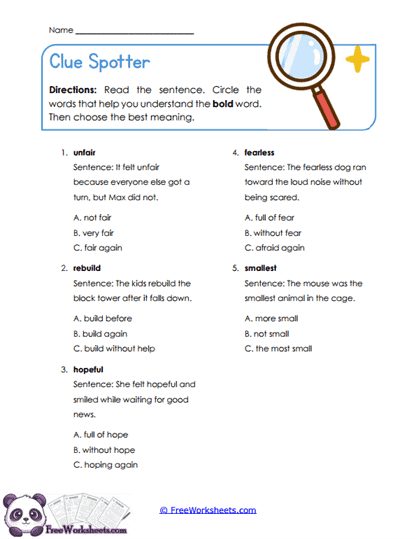
Clue Spotting
What Kids Do:
Students read five short sentences containing bold vocabulary words such as unfair, rebuild, hopeful, fearless, and smallest. They examine each sentence and circle the surrounding words that provide clues about the target word’s meaning. After identifying helpful context, children compare the available definitions and select the meaning that best fits the sentence, using both the affix and surrounding information to guide their decisions.
Target Skill:
This activity strengthens the ability to combine morphological analysis with context clues when interpreting unfamiliar vocabulary. Students practice recognizing how prefixes and suffixes contribute meaning while checking their interpretations against sentence evidence. These strategies support 2nd grade reading comprehension, vocabulary development, and increasingly independent word-solving skills.
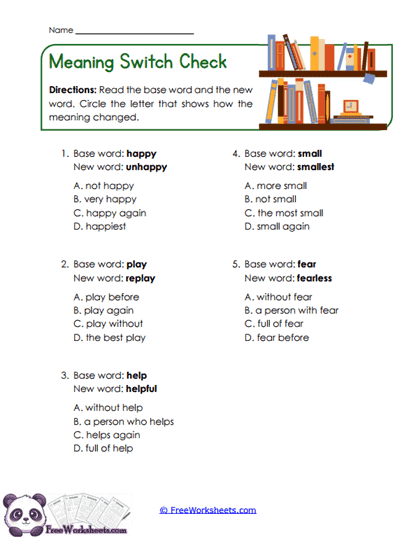
Meaning Changes
What Kids Do:
Children examine five pairs of related words, including happy/unhappy, play/replay, help/helpful, small/smallest, and fear/fearless. For each pair, they consider the meaning of the original base word and compare it with the word containing an added prefix or suffix. Students then review four possible definitions and circle the choice that correctly explains how the new word’s meaning differs from the original.
Target Skill:
This worksheet develops understanding of how meaningful word parts modify the definitions of familiar vocabulary. Students learn to recognize the contributions of prefixes such as un- and re- and suffixes such as -ful, -less, and -est, strengthening 2nd grade morphological awareness, word analysis, and the ability to interpret unfamiliar words through their recognizable components.
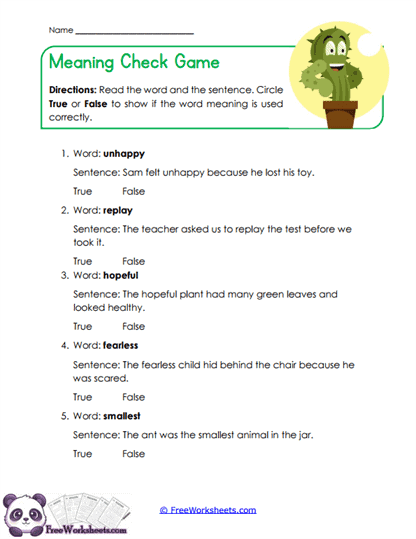
Meaning Test
What Kids Do:
Students examine five words containing familiar prefixes or suffixes, including unhappy, replay, hopeful, fearless, and smallest. Each word appears with a sentence intended to demonstrate its meaning. Children read the sentence, consider how the affix changes the base word, and circle True or False to indicate whether the word is being used correctly. They must evaluate the complete meaning rather than recognizing the word alone.
Target Skill:
This activity reinforces vocabulary comprehension by requiring students to verify whether an affixed word is used appropriately in context. Students strengthen 2nd grade word analysis and reading comprehension by connecting the meaning of a prefix or suffix with the meaning of its base word, then determining whether the resulting interpretation matches the sentence.
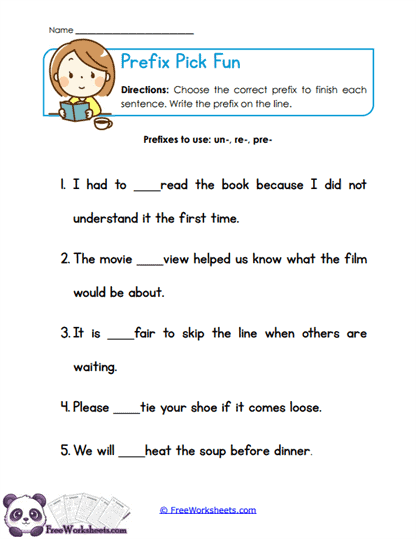
Prefix Choices
What Kids Do:
Children read five sentences containing base words that need a prefix to express the intended meaning. Using a small word bank with un-, re-, and pre-, they decide which prefix belongs in each blank. Students complete words such as reread, preview, unfair, untie, and preheat, then reread the sentences to confirm that the newly formed words make sense within the surrounding context.
Target Skill:
This worksheet strengthens the ability to select prefixes according to their meanings and the demands of a sentence. Students practice distinguishing between actions that happen again, events that occur beforehand, and words that express negation or reversal, supporting 2nd grade vocabulary knowledge, spelling development, and contextual word formation.
Prefix Power
What Kids Do:
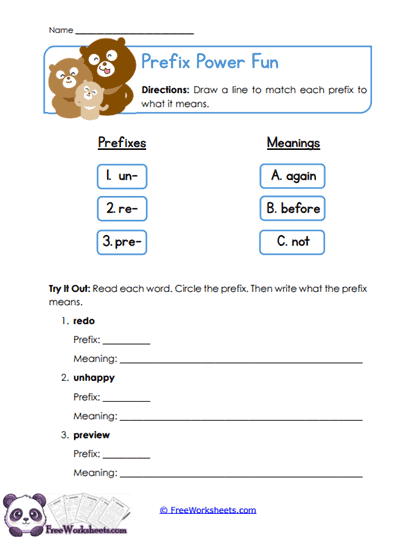
Students begin by matching three common prefixes-un-, re-, and pre–with their meanings of not, again, and before. They then examine words such as redo, unhappy, and preview, circle the prefix within each word, and write both the prefix and its meaning on the provided lines. The two-part activity helps children move from recognizing affix definitions to identifying those same word parts in complete vocabulary words.
Target Skill:
This introductory worksheet develops foundational prefix recognition and understanding of how prefixes change base-word meanings. Students learn to identify meaningful beginnings rather than treating every initial letter combination as a prefix, strengthening 2nd grade morphological awareness, decoding strategies, spelling, and vocabulary comprehension.
Real Words
What Kids Do:
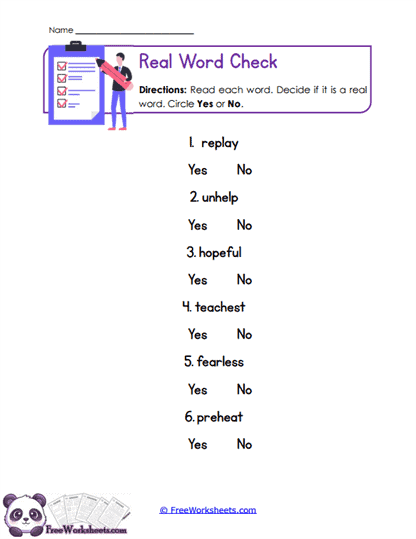
Children examine six words created by adding prefixes or suffixes to familiar base words, including replay, unhelp, hopeful, teachest, fearless, and preheat. They decide whether each combination forms a correctly constructed English word and circle Yes or No beside it. Students consider both the structure and meaning of each word instead of assuming that any familiar affix can be attached to any base word.
Target Skill:
This activity builds awareness that word formation follows recognizable patterns and that not every combination of a base word and affix creates a conventional word. Students strengthen 2nd grade vocabulary judgment, spelling recognition, and morphological reasoning by evaluating whether a newly formed word is structurally appropriate and meaningful.
Suffix Choices
What Kids Do:
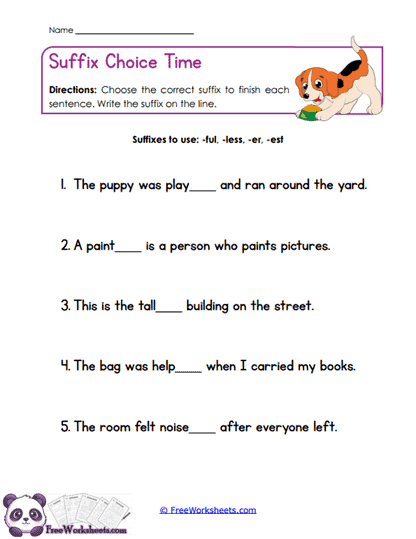
Students read five sentences featuring base words with missing endings. They choose from the suffixes -ful, -less, -er, and -est to create words such as playful, painter, tallest, helpful, and noiseless. Children write the correct suffix on each blank and reread the completed sentence to verify that the resulting word communicates the intended meaning and fits grammatically.
Target Skill:
This worksheet develops the ability to choose suffixes based on their meanings and functions within sentences. Students learn to recognize endings that describe qualities, indicate absence, name someone performing an action, or express the greatest degree of a characteristic. These skills strengthen 2nd grade vocabulary analysis, grammatical awareness, spelling, and word formation.
Suffix Meanings
What Kids Do:
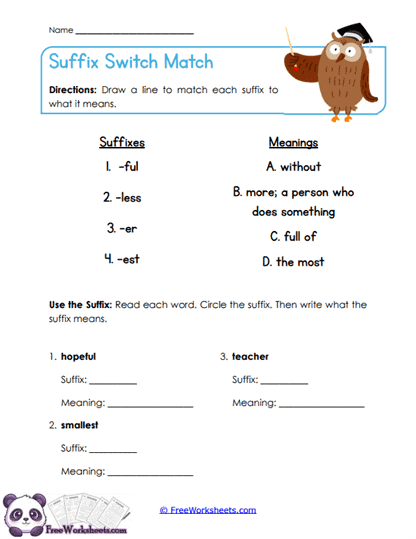
Children begin by matching four common suffixes–ful, -less, -er, and -est-with definitions such as full of, without, a person who performs an action, and the most. They then examine familiar words including hopeful, smallest, and teacher, circle the suffix, and explain its meaning. Students use the examples to connect each ending with the change it creates in the complete word.
Target Skill:
This activity strengthens understanding of how suffixes contribute meaning and sometimes change the grammatical function of a base word. Students practice recognizing common word endings, connecting them with appropriate definitions, and interpreting the resulting vocabulary, supporting 2nd grade morphological awareness, reading comprehension, and spelling development.
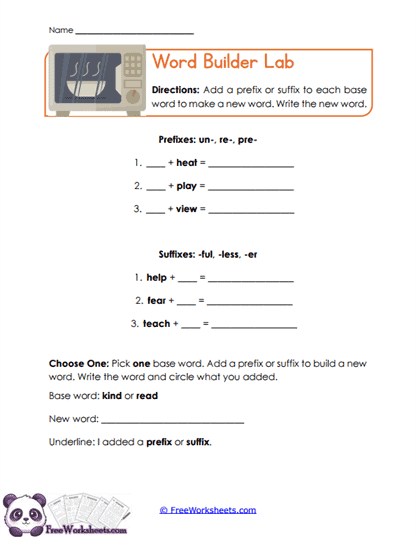
Word Building
What Kids Do:
Students construct new vocabulary words by adding familiar prefixes and suffixes to base words. They combine prefixes such as un-, re-, and pre- with words including heat, play, and view, then use suffixes such as -ful, -less, and -er with help, fear, and teach. A final challenge asks children to choose a base word, add an appropriate affix, write the new word, and identify whether they used a prefix or suffix.
Target Skill:
This worksheet develops active word-building skills by requiring students to combine meaningful components into correctly formed vocabulary. Students strengthen 2nd grade spelling, morphological understanding, and vocabulary expansion while learning to distinguish prefixes from suffixes and recognize how each affix influences the meaning of a familiar base word.
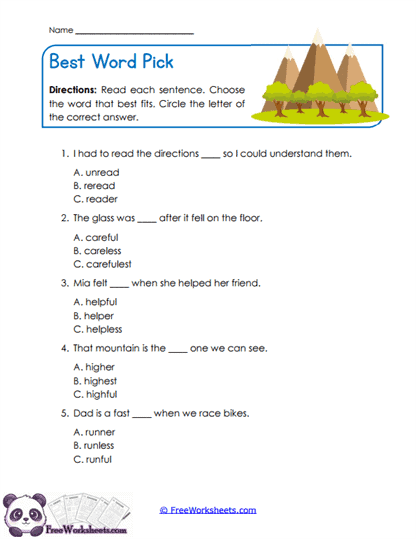
Word Choices
What Kids Do:
Children read five sentences and select the vocabulary word that best completes each one from three related choices. The options include forms such as unread, reread, reader, careful, careless, helpful, helper, helpless, higher, highest, and runner. Students compare how prefixes and suffixes affect each word’s meaning, circle the most appropriate answer, and check that the completed sentence communicates a logical idea.
Target Skill:
This activity strengthens contextual word selection and the ability to distinguish between related vocabulary forms. Students practice analyzing affixes and determining how they influence meaning or grammatical function, supporting 2nd grade vocabulary comprehension, word-building knowledge, and accurate language use within complete sentences.
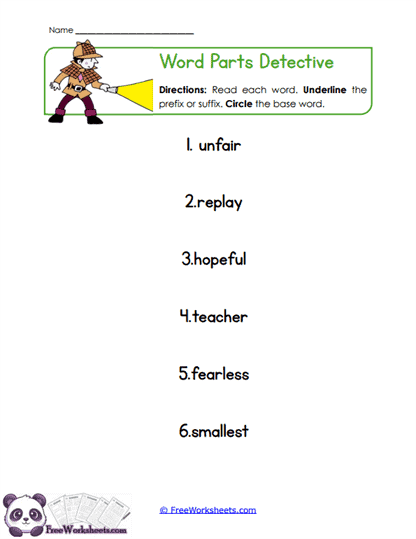
Word Detective
What Kids Do:
Students examine six words containing common prefixes or suffixes, including unfair, replay, hopeful, teacher, fearless, and smallest. For each word, they underline the added prefix or suffix and circle the remaining base word. Children identify the meaningful components visually, such as separating un- from fair or -er from teach, to see how longer words are constructed from familiar parts.
Target Skill:
This worksheet develops structural word analysis by teaching students to identify base words and the affixes attached to them. Through repeated recognition of meaningful components, 2nd grade students strengthen morphological awareness, decoding, spelling knowledge, and the ability to interpret longer vocabulary words without treating each one as an entirely unfamiliar term.
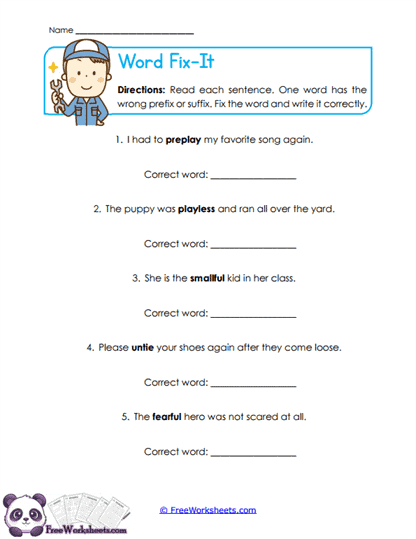
Word Repair
What Kids Do:
Children read five sentences containing words with incorrect prefixes or suffixes. Examples include forms such as preplay, playless, smallful, and other words whose affixes do not match the intended sentence meaning. Students identify the incorrectly formed vocabulary, determine which prefix or suffix would create a more appropriate word, and write the corrected form on the provided line before rereading the sentence.
Target Skill:
This activity strengthens vocabulary editing and the ability to recognize when an affix creates an inappropriate meaning or word form. Students combine base-word knowledge, prefix and suffix meanings, and sentence context to make corrections, supporting 2nd grade morphological reasoning, spelling accuracy, and increasingly deliberate word choice.