
About This Worksheet
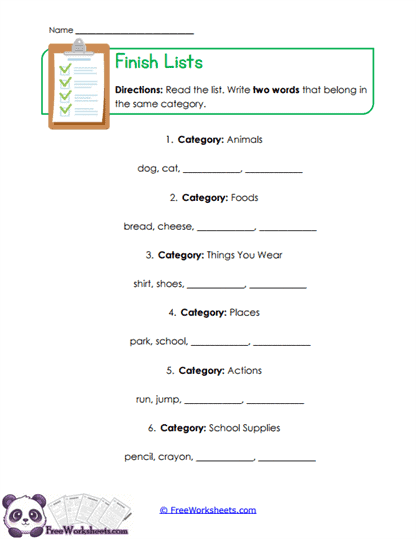
This Grade 2 vocabulary worksheet helps children complete familiar categories by adding more words that belong. Students see groups such as Animals, Foods, Things You Wear, Places, Actions, and School Supplies. Each category already includes two example words, and students add two more of their own. This gives them practice building stronger word groups from what they already know.
Learning Goals
The main goal is to help children expand vocabulary within common categories. Students practice using examples as clues and thinking of additional words that fit the same group. This strengthens classification, vocabulary recall, and the ability to connect words by meaning.
Student Tasks
Children read each category and the two example words already listed. They then write two more words that belong in the same group. For example, after dog and cat in Animals, they might add bird and cow. Students complete all six categories in the same way.
Common Challenges
Some children may repeat one of the example words or choose a word that is related but does not truly belong. Others may get stuck after thinking of one answer. A parent or teacher can ask the child to picture where the items might be found or how they are used to help generate more ideas.
Teaching Suggestions
Teachers can brainstorm extra examples for one category before students begin. Parents and homeschool educators can turn the activity into a quick verbal game by taking turns naming category members. It may help to say the category aloud before each response. Encourage different correct answers so children see that one category can include many words.
Worksheet Features
The worksheet includes six everyday categories with two starter examples for each one. The open blanks give students room to add their own vocabulary choices. The variety of groups includes objects, places, actions, and clothing. This printable works well for vocabulary development, homework, literacy centers, or word-recall practice.