
About This Worksheet
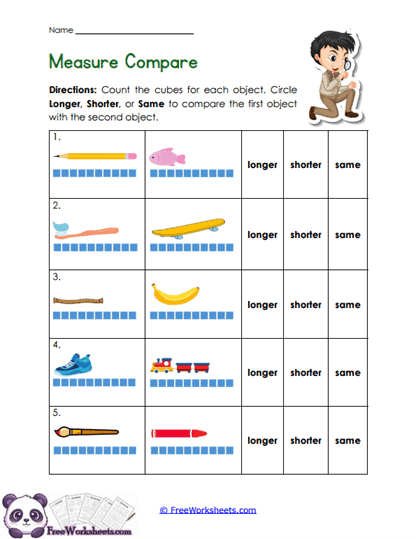
Measure Compare is a kindergarten activity that helps children compare the lengths of two objects after looking at the cube units beneath them. Each row shows a pair of familiar objects, such as a pencil and fish, toothbrush and skateboard, rope and banana, shoe and train, or paintbrush and crayon. Children count or compare the cube strips and then circle longer, shorter, or same to describe the first object. For example, if the first object reaches across fewer cubes than the second, the first object is shorter. This helps children understand that measurement numbers can be used to compare length.
Curriculum and Grade Alignment
This worksheet is made for kindergarten learners who are ready to compare measurements made with nonstandard units. The main goal is to help children decide whether one object is longer, shorter, or the same length as another. Before using this page, your child should be able to count cube units beneath an object and understand that more cubes usually mean a longer length. The next step is ordering several objects from shortest to longest and measuring real items independently. This activity supports early measurement learning by connecting counted units with comparison words.
Student Tasks
On this worksheet, students will work through five object pairs. They will look at the cube rows beneath both pictures and compare the measured lengths. Children then circle longer, shorter, or same to tell how the first object compares with the second. Because each row uses a different pair of familiar objects, students get repeated practice applying the same comparison idea. This builds measurement vocabulary, counting, and logical thinking.
Common Challenges and Misconceptions
Some children may compare the picture size instead of looking at the cube units. Others may forget that the question asks about the first object, not the second. A child may also mix up longer and shorter when the difference is only one cube. Encourage your child to say both measurements aloud first, such as, “The pencil is 7 cubes and the fish is 6 cubes.” Then ask, “So is the first one longer, shorter, or the same?”
Implementation Guidance
Teachers can use this worksheet after students have practiced measuring single objects with cubes. It works well as a next step because children use their measurements to make a comparison. Parents can measure two small household objects with equal-size blocks and ask which is longer before starting the worksheet. If your child is unsure, write the two cube counts beside the pictures. Comparing the numbers can make the relationship easier to see.
Details and Features
This worksheet includes five side-by-side length comparisons with cube units shown beneath every object. Each row provides the same three choices: longer, shorter, and same. The table format keeps the object pairs and answer choices clearly organized. Familiar pictures make the measurement situations easy for kindergarten children to understand. The printable supports nonstandard measurement, comparison vocabulary, counting, and early reasoning.