
About This Worksheet
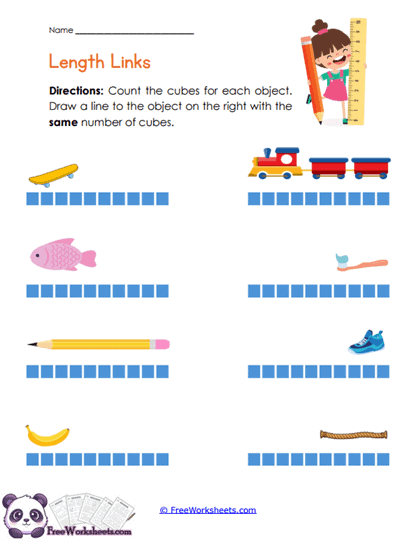
Length Connections is a kindergarten matching activity that helps children find objects with the same measured length. Objects appear on both sides of the page, and each one has a row of blue cubes underneath it. Children count the cubes for one object and then look across the page for another object with the same number of cubes. For example, an object measuring 7 cubes should be connected to another object that also measures 7 cubes. This helps children understand that two very different objects can still have equal lengths.
Curriculum and Grade Alignment
This worksheet is made for kindergarten learners who are ready to use nonstandard measurements to compare objects. The main goal is to help children count cube units and recognize when two measurements are equal. Before using this page, your child should be comfortable measuring one object by counting repeated units. The next step is comparing measurements as longer, shorter, or the same. This activity supports early measurement learning by connecting numerical length with equality.
Student Tasks
On this worksheet, students will count the cube units under each object on the left side of the page. They will then count the cubes beneath the objects on the right and look for an equal measurement. Children draw a line between objects that have the same number of cubes. The pictures include items such as a skateboard, fish, pencil, banana, train, toothbrush, shoe, and rope. This builds measurement, matching, counting, and visual comparison.
Common Challenges and Misconceptions
Some children may try to match objects by picture type or size instead of by the number of cubes. Others may remember a measurement incorrectly while looking across the page for its partner. A child may also count too quickly and miss a cube in a longer row. Encourage your child to say each measurement aloud before searching for a match. Lightly writing the cube count beside each object can also help if remembering the totals is difficult.
Implementation Guidance
Teachers can use this worksheet after children have practiced measuring individual objects with cubes. It works well as a next-step activity because students must use their measurements to make comparisons. Parents can measure two different household objects with the same kind of block and ask whether they are equal in length before beginning the page. If the printed matching lines become confusing, complete one pair at a time. This helps keep attention on the measurement rather than the crossing lines.
Details and Features
This worksheet includes four measured objects on each side of the page with cube strips shown underneath. Children count and connect objects with equal measurements. The open layout leaves plenty of room for drawing matching lines. Familiar pictures make the comparison easy to discuss with kindergarten learners. The printable supports nonstandard measurement, equal-length comparison, counting, and visual matching.