
About This Worksheet
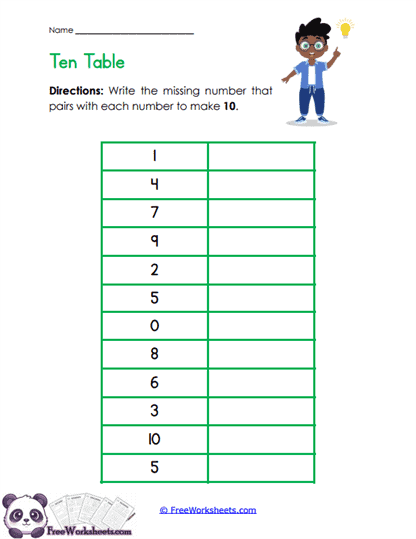
Partner Table is a kindergarten number-combination activity that helps children write the number that pairs with each given number to make 10. One column shows numbers such as 1, 4, 7, 9, 2, 5, 0, 8, 6, 3, and 10. Children think about the matching number and write it in the empty column beside it. For example, 4 pairs with 6 because 4 + 6 = 10. This gives children repeated practice recalling make-10 facts in a clean number-only format.
Curriculum and Grade Alignment
This worksheet is intended for kindergarten learners who have already practiced combinations of 10 with pictures, counters, or ten-frames. The main goal is to help children recall the partner that joins with each number to make 10. Before beginning, your child should understand simple number pairs such as 1 and 9 or 5 and 5. The next step is using these facts quickly in addition and subtraction equations. This activity supports early fact fluency by helping children move from visual models toward number relationships they can remember mentally.
Student Tasks
On this worksheet, students will look at each number in the left side of the table. They will decide what number is needed to make 10 and write that partner in the empty box beside it. The table includes a wide range of starting numbers, including 0 and 10. Some values appear more than once, giving children extra practice with important pairs such as 5 and 5. This builds recall, addition readiness, and number-partner fluency.
Common Challenges and Misconceptions
Some children may write the total 10 in every empty box instead of the missing partner. Others may reverse a pair incorrectly because they are still counting from the beginning each time. A child may also forget that 0 pairs with 10 and that 10 pairs with 0. Encourage your child to say a complete equation aloud, such as, “Seven plus three makes ten.” This makes it easier to check whether the written partner is correct.
Implementation Guidance
Teachers can use this worksheet after students have had plenty of visual practice making 10. It works well as independent work because the layout is simple and the skill stays the same throughout the page. Parents can use fingers, counters, or a homemade ten-frame if a certain pair is not yet remembered. Over time, encourage the child to answer familiar pairs without counting. This helps move the skill toward quicker recall.
Details and Features
This worksheet includes a two-column table with given numbers on the left and empty partner boxes on the right. The numbers cover combinations from 0 through 10. The simple green grid keeps the work organized and easy to scan. Repeated values provide a little extra practice without changing the directions. The printable supports number bonds, complementary pairs, missing addends, and fact fluency to 10.