
About This Worksheet
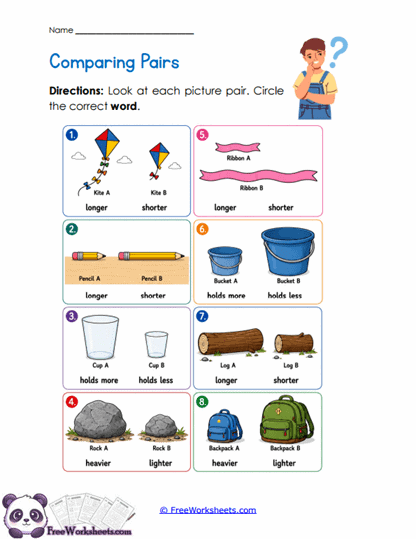
Compare Pairs is a kindergarten review activity that helps children compare length, weight, and capacity using simple everyday pictures. Each problem shows two objects and asks children to choose the word that makes the comparison true. For example, one pair may ask which kite is longer, while another asks which bucket holds more. This gives children practice switching between different measurement ideas instead of working with only one skill at a time. It also helps them learn that words such as longer, shorter, heavier, lighter, more, and less describe different kinds of comparisons.
Curriculum and Grade Alignment
This worksheet is made for kindergarten learners who have already practiced basic comparisons with length, weight, and capacity. The main goal is to help children look at a pair of objects and decide which comparison word is correct. Before using this page, your child should understand the basic meanings of longer, shorter, heavier, lighter, holds more, and holds less. The next step is measuring or testing objects with simple tools to confirm these comparisons. This activity supports early measurement learning by helping children choose the correct vocabulary for different measurable features.
Student Tasks
On this worksheet, students will study eight picture pairs. They will decide whether each pair is being compared by length, weight, or how much a container can hold. Children then circle the correct word under the pictures. The examples include kites, pencils, cups, rocks, ribbons, buckets, logs, and backpacks. This gives students repeated practice with comparison language and careful visual reasoning.
Common Challenges and Misconceptions
Some children may know which object is different but choose the wrong comparison word. Others may confuse overall size with weight or capacity. A child may also forget that different problems ask about different features. Encourage your child to say what is being compared first, such as “This one is about length,” before choosing an answer. That small step can make the word choice much clearer.
Implementation Guidance
Teachers can use this worksheet as a review after teaching length, weight, and capacity in separate lessons. It works well in a small group because students can explain why they chose each word. Parents can read each comparison aloud and ask the child what kind of measurement they are thinking about. If your child is unsure, use a quick real-world example of the same idea before returning to the page. This keeps the focus on understanding rather than guessing.
Details and Features
This worksheet includes eight comparison problems using familiar kindergarten objects. Each pair has two simple answer choices placed directly below the pictures. The page mixes several measurement concepts, which makes it useful for review. Colorful images keep the activity easy to understand and talk about. The printable supports comparison vocabulary, visual reasoning, and early measurement skills.