
About This Worksheet
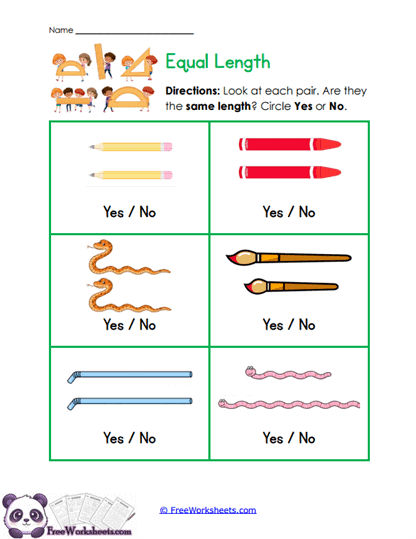
Equal Length is a kindergarten comparison activity that helps children decide whether two objects are the same length. Each box shows a matching pair, such as pencils, crayons, snakes, paintbrushes, straws, or worms. Children compare how far both objects stretch and circle Yes if their lengths match or No if they do not. For example, two pencils that end at the same point are the same length. This helps young learners understand that equal length means two objects measure the same from one end to the other.
Curriculum and Grade Alignment
This worksheet is intended for kindergarten learners who are learning to compare objects directly by length. The main goal is to help children recognize when two objects have equal lengths. Before beginning, your child should understand the words longer and shorter. The next step is comparing and measuring equal lengths with simple tools or nonstandard units. This activity supports early measurement learning by helping children notice when two measurable lengths are the same.
Student Tasks
On this worksheet, students will study each pair of objects and compare their lengths carefully. They will decide whether the two objects are the same length. Children then circle Yes or No under each pair. Six problems give practice with pencils, crayons, snakes, paintbrushes, straws, and worms. This builds direct comparison, measurement vocabulary, and careful visual attention.
Common Challenges and Misconceptions
Some children may focus on color or picture size instead of comparing the length from end to end. Others may think two objects are the same length because they are the same kind of object. A child may also be confused if the two items do not begin at exactly the same place. Encourage your child to imagine lining up one end of both objects. Asking, “Would the other ends meet?” can help make equal length easier to understand.
Implementation Guidance
Teachers can use this worksheet after children have practiced lining up real objects to compare length. It works well in a small group because students can explain why they chose Yes or No. Parents can place two pencils, crayons, or strips of paper side by side with one end lined up and ask whether the other ends match. Then use the same idea on the worksheet. This helps children see that equal length is about both objects reaching the same distance.
Details and Features
This worksheet includes six picture pairs with simple Yes or No choices. The matching object types help children focus on the length comparison. Large pictures make the differences easy for kindergarten learners to see. The two-column layout keeps every comparison clear and separate. The printable supports equal-length understanding, observation, vocabulary, and early measurement skills.