
About This Worksheet
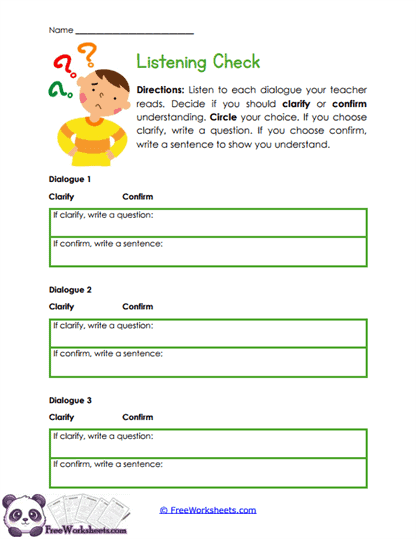
This Grade 3 listening and speaking worksheet helps children learn what to do when they hear something that is not fully clear. Students listen to three short dialogues read aloud by the teacher. After each one, they decide whether they need to clarify the message by asking a question or confirm that they understood it correctly.
This is a very useful classroom skill because children often hear directions, explanations, or partner comments that they only partly understand. Instead of guessing, this page teaches them to stop, think, and respond in a helpful way.
Learning Goals
The main goal is to help students become more active listeners. Children practice noticing when information is confusing, deciding whether they need more explanation, and showing understanding when the message is clear.
They also build speaking skills by learning how to ask a useful follow-up question or restate what they understood in a complete sentence.
What Students Will Do
The teacher reads Dialogue 1 aloud. Students listen carefully and decide whether the best response is Clarify or Confirm. They circle their choice.
If they choose Clarify, they write a question that would help them understand better. If they choose Confirm, they write a sentence that shows what they understood.
Students repeat this process for Dialogue 2 and Dialogue 3. The goal is not only to pick a box, but to explain the next step in a clear way.
Common Challenges
Some children may think they should always ask a question, even when the information is already clear. Others may say they understand without actually showing what they understood.
A parent or teacher can ask, “Do you need more information, or do you just need to show that you got the message?” That usually helps children see the difference.
Teaching Suggestions
Before starting, model one quick example. Say something unclear and show how to ask a clarifying question. Then say something clear and model a confirming response such as, “So you want me to put the books on the shelf.”
Teachers can also encourage students to use polite question starters like, “Can you explain…?” or “Do you mean…?” This makes the practice useful for real classroom conversations.
For stronger students, ask them to create one unclear statement and let a partner decide whether to clarify or confirm.
Worksheet Features
The page includes three listening situations, a Clarify or Confirm choice for each one, and writing space for a follow-up question or confirming sentence. The repeated format helps students build the habit of checking understanding during conversations.
This worksheet works well for classroom communication lessons, partner work, listening centers, or social language practice.