
About This Worksheet
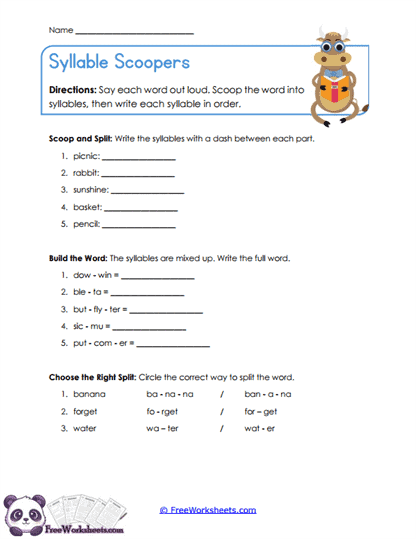
This Grade 3 spelling worksheet helps children slow down and hear the smaller sound parts inside longer words. Students work with familiar words such as picnic, rabbit, sunshine, basket, and pencil. They say each word aloud, break it into syllables, and write the parts in order with a dash between them.
The page then changes the task so children have to work with syllables in a different way. They put mixed-up syllables back together to make real words and finish by choosing the correct syllable split from two choices. This gives students several ways to practice the same spelling skill instead of simply repeating one exercise.
Learning Goals
The main goal is to help children understand that longer words are made of smaller spoken parts called syllables. Being able to hear and separate those parts can make a difficult word much easier to read and spell.
Students practice saying a word slowly, hearing each beat, placing the syllable break correctly, and putting syllables back together again. They also begin noticing that a good syllable split should match how the word is actually pronounced.
These skills can help children when they meet longer words in reading because they learn that they do not have to tackle the whole word at once.
What Students Will Do
The first section is called Scoop and Split. Children read five words aloud and break each one into syllables. They write the word again using a dash between each spoken part.
Next comes Build the Word. Here, the syllables have already been separated, but they are mixed up. Students rearrange the pieces and write the complete word. This checks whether they can recognize how syllables fit together to form a familiar word.
The final section asks students to Choose the Right Split. They see two possible ways to divide words such as banana, forget, and water. They circle the choice that shows the correct syllable breaks.
By the end, students have practiced taking words apart, putting words together, and checking where a word should be divided.
Common Challenges
Some children may count letters instead of listening for syllables. Others may split a word wherever it looks convenient on the page instead of paying attention to how it sounds.
A parent or teacher can have the child say the word slowly and clap, tap, or touch the table once for each syllable. For basket, for example, the child should hear two clear beats.
Another common problem is adding an extra syllable because a word has many letters. Remind students that syllables are based on the sounds they hear, not simply the length of the word.
Teaching Suggestions
Start by saying a few everyday words together and clapping the syllables. Names are especially fun for this. Once children are comfortable hearing the beats, move into the written activity.
For students who need support, let them say each word several times before writing anything. They can also place a small mark under each syllable they hear.
Teachers can use the three sections to see where a student needs help. A child who can split words but cannot rebuild them may need more practice blending syllables. A child who can rebuild the words but chooses incorrect breaks may need more oral practice hearing where one syllable ends and the next begins.
Worksheet Features
The page contains three different types of syllable practice: dividing whole words, rebuilding scrambled syllables, and selecting correct word divisions. That variety makes the activity useful for spelling review, phonics centers, homework, or small-group work.