
About This Worksheet
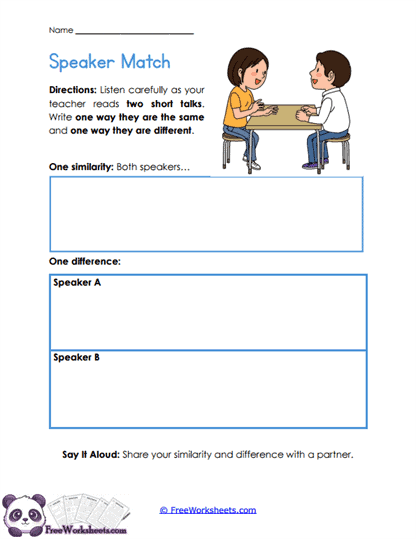
This Grade 3 listening and speaking worksheet helps children compare two short talks. The teacher reads both speakers aloud, and students listen for one way the speakers are the same and one way they are different.
This skill is useful because children need to do more than understand one speaker at a time. They also need to compare ideas, details, and viewpoints across different people.
Learning Goals
The main goal is to help students compare spoken information. Children practice listening for a shared idea and then noticing what makes each speaker different.
This supports careful listening, comparing and contrasting, note-taking, and discussion skills. It also teaches students to pay attention to more than one source of information.
What Students Will Do
The teacher reads Speaker A and Speaker B aloud. Students listen carefully to both talks.
In the first box, they write one similarity that both speakers share. Then they use the two lower sections to explain one difference between Speaker A and Speaker B.
After writing, students say the similarity and difference aloud to a partner.
Common Challenges
Some children may remember one speaker well but forget details from the other. Others may write two separate facts without actually explaining how they are the same or different.
A parent or teacher can ask, “What do both speakers have in common?” and then, “What does one say or think that the other does not?”
Teaching Suggestions
Teachers can read the talks twice if needed. On the first read, students can listen for the big idea. On the second read, they can focus on one similarity and one difference.
It may help to use the sentence starters “Both speakers…” and “Speaker A…, but Speaker B…”. Those frames make the comparison much clearer.
For a challenge, ask students whether the two speakers agree or disagree overall and explain why.
Worksheet Features
The page includes one large similarity box, separate spaces for Speaker A and Speaker B, and a final oral-sharing prompt. The layout makes it easy for students to organize what they heard before discussing it.
This worksheet works well for compare-and-contrast lessons, partner work, listening centers, or oral comprehension practice.