
About This Worksheet
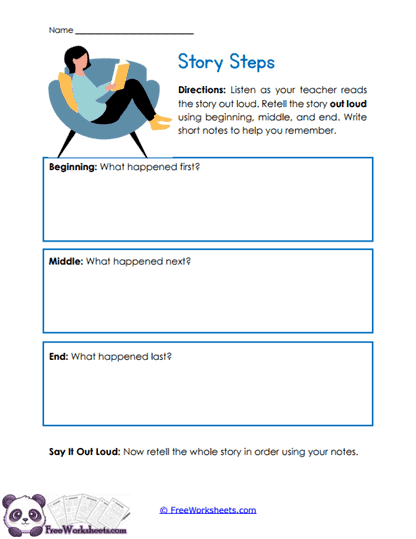
This Grade 3 listening and speaking worksheet helps children listen to a story and organize what they heard into three simple parts: beginning, middle, and end. The teacher reads the story aloud, and students use the boxes on the page to jot down short notes about what happened first, what happened next, and how the story finished.
This is a helpful skill because children often understand a story when they hear it, but retelling it in order can be harder. The page gives them a clear structure so they can hold onto the important events without trying to remember every single detail.
Learning Goals
The main goal is to help students listen for sequence. Children practice deciding which events belong at the beginning, which events make up the middle, and what happens at the end.
They are also building retelling skills. Once they have short notes in each box, they use those notes to tell the whole story out loud in the correct order. This supports listening comprehension, memory, sequencing, and oral language.
What Students Will Do
First, the teacher reads the story aloud while students listen without writing. They pay attention to the order of events and think about what is most important.
Next, students fill in the three boxes. In the Beginning box, they write a short note about what happened first. In the Middle box, they record what happened next or what the main event was. In the End box, they write how the story finished.
After the notes are complete, students use them to retell the whole story out loud from start to finish.
Common Challenges
Some children may write too much and try to copy the whole story into the boxes. Others may choose a small detail that does not really represent the beginning, middle, or end.
A teacher or parent can ask, “If you could only remember one thing from this part, what would it be?” That helps children keep the notes short and useful.
Teaching Suggestions
Before starting, remind students that notes do not need to be full sentences. A few key words are enough if they help the child remember what happened.
Teachers can model a very short story first and show how to pull out one note for each part. Parents can also ask the child to say “first, next, last” before writing.
For stronger students, ask them to retell the story without looking at the notes a second time.
Worksheet Features
The page includes three large boxes labeled Beginning, Middle, and End, followed by a speaking prompt that asks students to retell the whole story aloud. The simple layout keeps the focus on listening, sequencing, and speaking.
This worksheet works well for read-aloud lessons, oral retelling practice, small groups, or listening comprehension checks.