
About This Worksheet
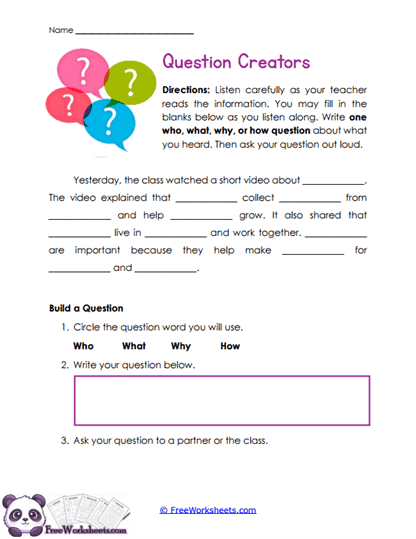
This Grade 3 listening and speaking worksheet helps children turn information they hear into a useful question. The teacher reads a short piece of information aloud, and students listen closely enough to fill in missing details. After that, they choose a question word such as who, what, why, or how and write one question about what they heard.
This is helpful because strong listeners do more than remember information. They also think about it, notice what they want to know more about, and ask clear questions.
Learning Goals
The main goal is to help students listen for important information and then form a relevant question. Children practice understanding a short oral passage, remembering key details, choosing an appropriate question word, and writing a complete question.
This supports listening comprehension, curiosity, speaking, sentence formation, and classroom discussion skills.
What Students Will Do
First, the teacher reads the information aloud. Students listen and fill in the blanks on the page with the missing words or ideas they hear.
The passage includes information about a video the class watched, what was explained, and why certain things are important. Students use what they heard to complete the short summary.
Next, they move to the Build a Question section. They choose one question word: Who, What, Why, or How.
Then they write one question about the information they just heard. Finally, they ask that question aloud to a partner or the class.
Common Challenges
Some children may write a question that does not really connect to the information they heard. Others may choose a question word but forget to write a full question.
A teacher or parent can ask, “Could someone answer your question using what we just heard?” If yes, the question is probably on topic.
Some students may also forget the question mark at the end, so this is a good chance to review that writing rule naturally.
Teaching Suggestions
Before starting, give a quick example. Read one short fact and show how it could lead to several questions. For example, “Bees collect nectar from flowers” could lead to “What do bees collect?” or “Why do bees visit flowers?”
Teachers can encourage students to listen for one idea they are curious about rather than trying to remember every word.
For students who need help, provide question frames such as “Why do _____?” or “How does _____?” For stronger students, ask them to write two different questions using two different question words.
Worksheet Features
The page includes a listening fill-in section, a choice of four question words, a large writing box, and a final speaking step. It combines listening, writing, and oral discussion in one activity.
This worksheet works well for whole-group listening lessons, partner practice, discussion skills, or question-building review.