
About This Worksheet
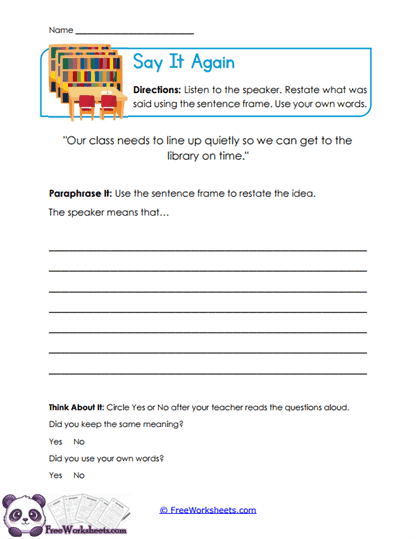
This Grade 3 speaking and listening worksheet helps children practice paraphrasing, which means saying the same idea again using different words. Students listen to a short statement about lining up quietly so the class can get to the library on time. Then they restate that message in their own words without changing the meaning.
This is a very useful skill because children often need to show that they understood directions, explanations, and class discussions. Being able to say an idea back in a new way is one of the clearest signs that the student really understood it.
Learning Goals
The main goal is to help students keep the meaning of a message while changing the wording. Children practice listening carefully, picking out the important idea, and then expressing that idea in a fresh way.
This strengthens comprehension, oral language, vocabulary, and communication. It also helps students understand the difference between repeating someone word for word and actually explaining what they heard.
What Students Will Do
The teacher reads the sentence aloud: the class needs to line up quietly so they can get to the library on time.
Students listen to the message and then use the sentence frame, “The speaker means that…” to restate the idea.
They write their version on the lines provided. The wording should be different from the original, but the meaning should stay the same.
At the bottom, students complete a quick self-check. They decide whether they kept the same meaning and whether they used their own words.
Common Challenges
Some children may copy most of the original sentence and change only one word. Others may change the wording so much that part of the original meaning gets lost.
A parent or teacher can ask two questions: “Did you say it differently?” and “Does your sentence still mean the same thing?” Both parts matter.
Students may also need reassurance that there can be more than one correct paraphrase as long as the meaning stays accurate.
Teaching Suggestions
Teachers can model paraphrasing with a very simple sentence first. For example, “Please close the door” could become “The speaker wants the door shut.”
Parents can do the same thing with everyday directions at home. Say a short message and ask the child, “Tell me what I meant in your own words.”
For students who need support, have them identify the most important words in the original message before rewriting. For stronger students, ask them to create two different paraphrases that both keep the same meaning.
Worksheet Features
The page includes one short spoken message, a sentence starter, several writing lines, and a self-check section. That makes it easy for teachers to see whether the child can both paraphrase and reflect on the quality of the response.
This works well for oral-language lessons, listening centers, partner practice, or review of paraphrasing skills.