
About This Worksheet
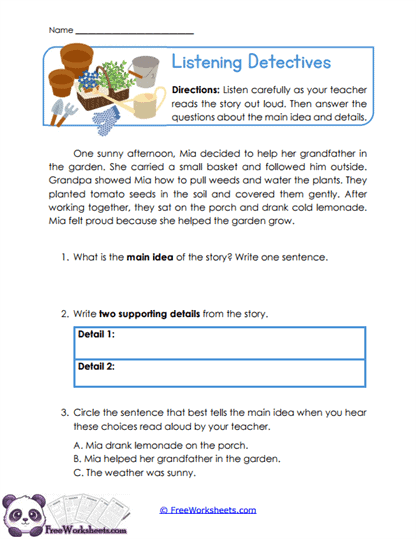
This Grade 3 listening and speaking activity helps children practice listening for the big idea and the details that support it. The teacher reads a short story aloud about Mia helping her grandfather in the garden. Students do not just listen for random facts-they have to think about what the whole story is mostly about and which details prove that idea.
This is valuable because listening comprehension works a lot like reading comprehension. Children need to hold information in their mind, decide what matters most, and separate the main idea from smaller details. That skill helps them during classroom lessons, read-alouds, discussions, and directions.
Learning Goals
The main goal is to help students identify a main idea after hearing a passage read aloud. They also practice choosing supporting details that connect directly to that main idea.
Students learn that the main idea is not just one small event from the story. It is the bigger message that ties the story together. They also practice listening carefully enough to remember important details without seeing the passage as they hear it.
What Students Will Do
The teacher reads the short garden story aloud. Students listen as Mia carries a basket outside, helps pull weeds, waters plants, and plants tomato seeds with her grandfather.
After listening, students write one sentence explaining the main idea of the story. Then they write two supporting details they remember that help prove that main idea.
The final task gives three possible main-idea sentences. Students listen as the choices are read aloud and circle the one that best tells what the whole story is about.
Common Challenges
Some children may choose a detail instead of the main idea. For example, they may focus on the lemonade or the tomato seeds because those details are easy to remember.
A helpful question is, “What happened through most of the story?” If the answer only covers one moment, it is probably a detail rather than the main idea.
Some students may also remember the big idea but struggle to write two supporting details. In that case, ask, “What did Mia actually do that showed she was helping?”
Teaching Suggestions
Read the story once without stopping so students can focus on understanding it as a whole. If needed, read it a second time and tell students to listen especially for actions that show the main idea.
Teachers can also ask students to quietly tell a partner what they think the story was mostly about before writing. That quick verbal rehearsal often helps children organize their thinking.
For students who need more support, give the sentence frame, “The story is mostly about ______.” For a challenge, ask students to explain why one of the incorrect answer choices is only a detail.
Worksheet Features
The page includes one teacher-read story, a main-idea response, space for two supporting details, and a multiple-choice check at the end. The mix of writing and listening gives teachers a clear look at whether students can understand and organize spoken information.
This worksheet works well for listening-comprehension lessons, small groups, whole-class read-aloud practice, or quick skill checks.