
About This Practice
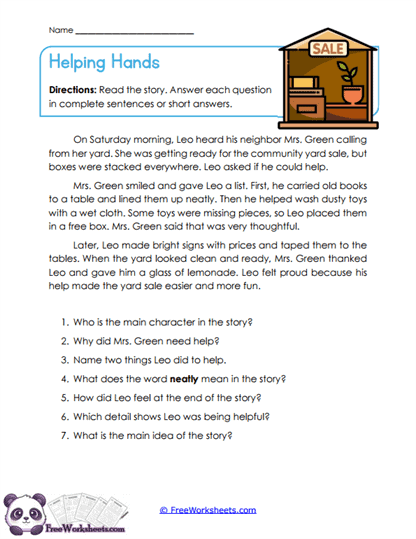
This Grade 3 reading activity gives children a full short story and then asks them to show what they understood. Students read about Leo helping his neighbor, Mrs. Green, prepare for a yard sale. He carries books, sorts toys, helps with signs, and works until the yard is ready.
The questions that follow are not all the same. Some ask for a basic detail, while others ask about character actions, word meaning, feelings, and the main idea. That makes this a strong comprehension page because children have to think about the story in several different ways.
Learning Goals
The main goal is to help students read for meaning instead of only reading the words correctly. Children practice identifying the main character, remembering important events, using context to understand vocabulary, and explaining the main idea.
They also think about character traits. When Leo offers help and keeps working, students can connect those actions with words such as helpful or thoughtful.
What Students Will Do
Students first read the full story about Leo and Mrs. Green. Then they answer seven questions.
They identify the main character, explain why Mrs. Green needed help, and name two jobs Leo completed. They also explain what ready means in the story and describe how Leo felt at the end.
The final questions ask students to choose a detail that shows Leo was helpful and then explain the main idea of the whole passage.
Students should go back to the story whenever they are unsure. The answers are supported by the text.
Common Challenges
Some children may answer from memory and leave out an important detail. Others may confuse the main idea with one small event from the story.
A good reminder is, “What is the story mostly about from beginning to end?” If the answer only describes one small part, the child may need to think more broadly.
Teaching Suggestions
Teachers can ask students to underline the sentence that supports each answer before writing. This is especially helpful for questions about character actions and the meaning of ready.
Parents can have the child answer orally first and then write. That often helps children who understand the story but struggle to organize their thoughts on paper.
For extra discussion, ask, “What kind of person is Leo?” and have the child use one event from the story as proof.
Worksheet Features
The page includes one complete narrative and seven comprehension questions that cover characters, events, vocabulary, feelings, evidence, and main idea. That variety gives adults a fuller picture of the student’s reading understanding.
This practice works well for guided reading, homework, independent comprehension, or a reading check after a story unit.