
About This Practice
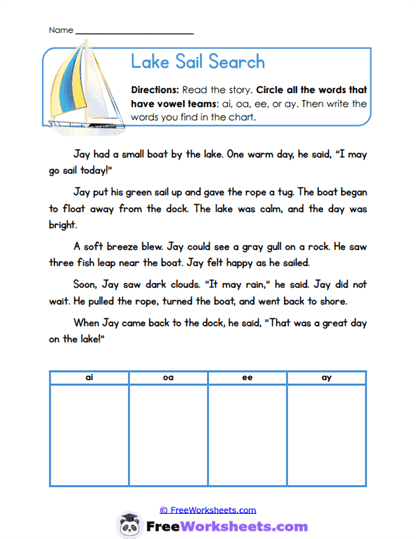
This Grade 3 reading activity helps children practice common vowel teams while reading a short story that actually uses them in context. Students follow Jay on a sailing trip at the lake and look closely for words that contain ai, oa, ee, and ay. Instead of seeing those patterns in a simple word list, children find them inside real sentences, which helps make the skill more useful for everyday reading.
This page is especially helpful for students who can read many vowel-team words but still need practice noticing the spelling pattern inside longer text. By reading the story first and then sorting the words, children get to connect sound, spelling, and meaning all at once.
Learning Goals
The main goal is to help students recognize common vowel teams quickly and accurately. Children practice seeing that two vowels can work together to make one main vowel sound, as in words like rain, boat, see, and day.
They also strengthen decoding, spelling, and word recognition because they have to pay attention to the exact letters in each word. For teachers, this activity gives a simple way to see whether students can identify vowel teams while reading a full passage instead of only during isolated phonics practice.
What Students Will Do
Students begin by reading the sailing story from beginning to end. As they read, they circle every word that contains one of the target vowel teams: ai, oa, ee, or ay.
After the story, they return to the words they found and sort them into the four boxes at the bottom of the page. A word with ai goes in the ai column, a word with oa goes in the oa column, and so on.
This second step is important because students are not just spotting the words-they are organizing them by spelling pattern. That helps them see which words follow the same sound pattern even when the words have very different meanings.
Common Challenges
Some children may circle words simply because they contain two vowels next to each other, even when those vowels are not one of the target patterns. Others may find a word correctly in the story but accidentally place it in the wrong column.
A parent or teacher can keep the directions simple: “Look at the two vowels in the word. Which pair do you actually see?” Having the child read the word aloud after sorting it can also help catch mistakes.
Teaching Suggestions
Before students begin, quickly review one example for each vowel team. You might say rain for ai, boat for oa, see for ee, and day for ay. Then let students read the passage once for meaning before asking them to go back and hunt for patterns.
For students who need more support, have them use a different colored pencil for each vowel team. For students ready for a challenge, ask them to add one new word of their own to each column after the page is complete.
This reading can also be used for fluency practice. Once the vowel-team hunt is finished, have students reread the story and see whether those words now feel easier to recognize.
Worksheet Features
The page includes a full decodable-style passage, four targeted vowel teams, and a large sorting chart. The combination of story reading and word sorting gives teachers a useful way to check both reading accuracy and spelling-pattern knowledge.
It works well for phonics review, literacy centers, small-group instruction, independent reading practice, or homework.