
About This Practice
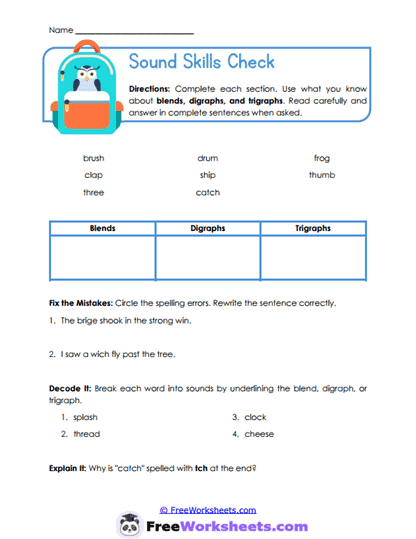
This Grade 3 review page brings several sound-pattern skills together in one place. Students sort words into blends, digraphs, and trigraphs, correct spelling mistakes in sentences, break words into their sound parts, and explain a spelling rule. Because the tasks change from section to section, this gives teachers and parents a much fuller look at what a child really understands.
Rather than practicing just one small skill, children must show that they can recognize patterns, apply them to spelling, and explain their thinking. That makes this a strong end-of-unit review or progress check.
Learning Goals
The main goal is to see whether students can use what they have learned about blends, digraphs, and trigraphs in several different ways. They practice identifying patterns in words such as brush, clap, three, drum, ship, catch, frog, and thumb. They also work with incorrect spellings and explain why a word such as catch ends with tch.
These tasks strengthen phonics, spelling, decoding, proofreading, and the ability to talk about how words work.
What Students Will Do
The first section asks students to sort the given words into three groups: Blends, Digraphs, and Trigraphs. They must look carefully at the important letter pattern in each word before placing it in the correct box.
Next comes an editing section. Students read sentences that contain spelling mistakes, circle the errors, and rewrite the sentences correctly. This shows whether they can apply sound-pattern knowledge when a word is used in real writing.
In the decoding section, students work with words such as splash, thread, clock, and cheese. They underline the blend, digraph, or trigraph and think about how the letters work together to make the word.
Finally, students answer a short explanation question about why catch is spelled with tch at the end. This final task asks them to put a spelling rule into their own words instead of simply selecting an answer.
Common Challenges
A child may do very well with sorting but struggle when the same skill appears inside a sentence. That is useful information. It often means the student recognizes a pattern when it is obvious but needs more practice applying it during reading and writing.
The explanation question may also be harder than the rest because children sometimes know which spelling looks correct without knowing how to explain why. If that happens, ask them to say the vowel sound in catch and think back to the short-vowel spelling rule they have practiced.
Teaching Suggestions
This page works especially well as a check-in before moving on to a new phonics topic. Instead of correcting every mistake immediately, look for a pattern. Is the child mixing up blends and digraphs? Are trigraphs the problem? Can the student recognize a sound pattern but not spell it correctly?
For parents, the goal is not simply to count right and wrong answers. Ask your child to explain one or two choices. A simple question like, “How did you know that?” can tell you much more about whether the skill is truly understood.
Teachers can also use individual sections separately. The sorting section can be a warm-up, the sentence corrections can become partner work, and the final explanation can serve as an exit ticket.
Worksheet Features
The page combines four different kinds of practice: sorting, proofreading, sound analysis, and written explanation. That variety makes it useful for review because students cannot rely on one familiar question format.
It can be used as independent work, a small-group check, homework, or a final review after teaching blends, digraphs, and trigraphs.