
About This Practice
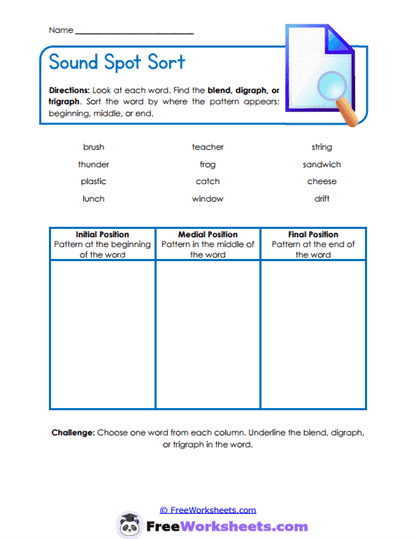
This Grade 3 phonics activity helps children notice where a blend, digraph, or trigraph appears inside a word. That is the big skill on this page. Your child will look at words such as brush, thunder, plastic, lunch, teacher, frog, catch, window, string, sandwich, cheese, and drift. Instead of only finding the special letter pattern, students have to decide whether that pattern comes at the beginning, middle, or end of the word.
This is helpful because children often learn to spot patterns like br, th, or ch, but recognizing where those sounds appear takes a little more careful reading. This page slows them down and teaches them to look at the whole word from beginning to end.
Learning Goals
The main goal is to help students become better at pulling words apart and noticing how they are built. Children practice finding blends, digraphs, and trigraphs and then thinking about their location in the word. That extra step strengthens spelling, decoding, and word recognition.
For a Grade 3 reader, this is important because longer words start showing up more often. A child who can quickly spot familiar sound patterns has an easier time reading a word instead of guessing at it.
What Students Will Do
First, students read every word in the word bank. They look for the blend, digraph, or trigraph inside each one. Then they sort the words into three large boxes: Initial Position, Medial Position, or Final Position.
“Initial” simply means the pattern comes at the beginning of the word. “Medial” means it is found somewhere in the middle. “Final” means the sound pattern appears at the end.
After the sorting is complete, students choose one word from each column. They underline the blend, digraph, or trigraph in those words. This final step gives you an easy way to check that they actually found the pattern and did not simply guess where the word belonged.
Common Challenges
A child may know that brush contains br and sh but become unsure about which pattern the activity wants them to focus on. That is normal when a word contains more than one useful letter pattern. Encourage the student to look closely at the pattern being identified and then decide where that specific pattern sits in the word.
Students may also mix up “medial” and “final.” You can keep it simple: beginning, middle, end. Once the child understands those everyday words, connect them back to initial, medial, and final.
Teaching Suggestions
Before starting, take three easy examples and say them slowly together. Ask, “Do you hear this sound at the beginning, in the middle, or at the end?” You can even point to the left, center, or right side of the page as you say each position.
For students who need more support, let them underline the letter pattern first and sort the word second. That gives them one job at a time. For children who are ready for a challenge, ask them to find a word that contains more than one blend or digraph and explain what they notice.
This activity is especially useful during phonics review because it shows whether a student can recognize a pattern inside a whole word, not just when the pattern is given by itself.
Worksheet Features
The page provides 12 words, three clearly labeled sorting columns, and a short challenge at the bottom. The layout gives children plenty of room to organize the words before showing what they know about each sound pattern.
Teachers can use this as independent practice, a literacy-center task, or a quick check after teaching beginning, middle, and ending sound patterns. Parents can also use it at home by having the child read each word aloud before deciding where it belongs.