
About This Practice
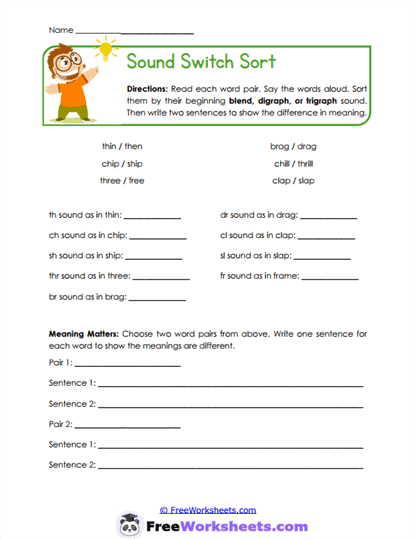
This Grade 3 phonics activity helps students sort words by the sound pattern they hear at the beginning. Children compare pairs such as thin/then, chip/ship, brag/drag, and clap/slap, then place the sounds into the correct blend, digraph, or trigraph category. The second half asks them to use selected words in sentences, which helps connect sound recognition with meaning.
Learning Goals
The main goal is to help students hear and identify the difference between blends, digraphs, and trigraphs. They practice listening for beginning sounds, matching those sounds to letter patterns, and recognizing how similar-looking words can sound very different. This builds stronger decoding, spelling, and phonemic awareness.
Student Tasks
Students read each word pair aloud and sort the target sounds into the proper group. After completing the sound sort, they choose two word pairs and write sentences that clearly show the meanings of the words. This makes the activity more than a phonics drill because students also have to think about vocabulary and context.
Common Challenges
Some students may confuse blends and digraphs because both involve more than one consonant. Others may correctly hear the sound but struggle to name the pattern. A teacher can remind students that blends keep each sound, while digraphs and trigraphs work together to create one main sound.
Teaching Suggestions
This page is useful for small-group phonics instruction or as a quick review before spelling work. Have students say the pairs aloud before writing anything, then ask them to explain what they hear. For extra support, teachers can model one example from each sound type and let students use hand motions or sound boxes to separate what they hear.
Worksheet Features
The page includes paired words, sound-sorting prompts, and a short sentence-writing extension. That mix gives teachers a clear way to check both sound awareness and whether students understand the words they are using.