
About This Worksheet
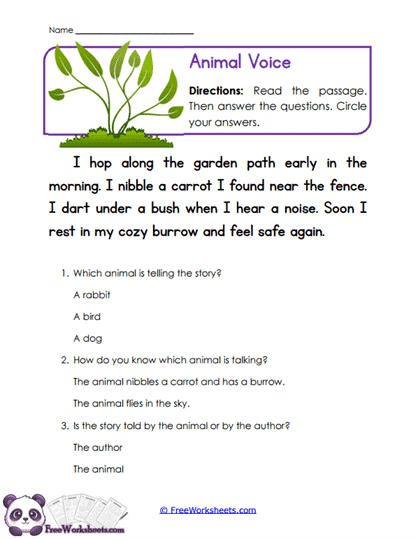
This 1st grade reading worksheet helps children identify an unusual first-person narrator by using story clues. Students read about an animal hopping along a garden path, nibbling a carrot, darting under a bush, and resting in a burrow. They then determine which animal is telling the story and explain how they know. This helps children understand that first-person narrators can be animals as well as people.
Learning Goals
The main goal is to help students infer who is speaking when the narrator is not named directly. Children practice using first-person pronouns together with action clues such as hopping, eating carrots, and living in a burrow. They also strengthen their understanding that I means the speaker is inside the story. These skills support point-of-view recognition, inference, and character comprehension.
Student Tasks
Children read the animal passage and answer three multiple-choice questions. They decide which animal is telling the story, choose the clue that best supports their answer, and determine whether the story is being told by the animal or by an outside author. Students can underline the action clues before choosing.
Common Challenges
Some children may focus only on the word I and know the story is first person without figuring out which animal is speaking. Others may choose a bird because the story happens outside. A parent or teacher can ask, “Which animal hops, eats carrots, and rests in a burrow?” to connect the narrator with the evidence.
Teaching Suggestions
Teachers can list the clues from the passage and have students decide what animal fits all of them. Parents and homeschool educators can ask children to act out the movements described in the story. It may also help to compare the sentence “I nibble a carrot” with “The rabbit nibbles a carrot” to show how point of view changes. Encourage students to use more than one clue when explaining the narrator.
Worksheet Features
The worksheet includes one short first-person animal passage and three comprehension questions. The narrator is not named directly, so students must combine pronoun clues with story actions. The multiple-choice format provides support while still requiring careful reading. This printable works well for guided reading, inference practice, homework, or point-of-view lessons.