
About This Worksheet
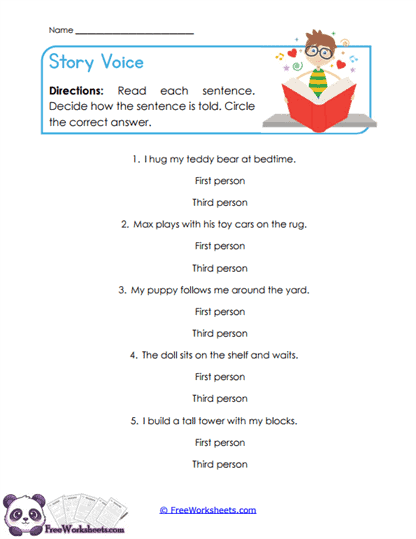
This 1st grade reading worksheet helps children compare first-person and third-person sentences. Students read five short statements about familiar topics such as teddy bears, toy cars, puppies, dolls, and blocks. For each sentence, they decide whether the speaker uses a first-person voice or tells about someone else in third person. This gives students repeated practice noticing how pronouns reveal point of view.
Learning Goals
The main goal is to help students distinguish between first-person and third-person narration in simple sentences. Children learn to look for words such as I and my as first-person clues and names or pronouns such as he and she as third-person clues. They also begin to understand that point of view changes depending on who is speaking. These skills support comprehension, grammar awareness, and narrator recognition.
Student Tasks
Children read each of the five sentences and circle either First person or Third person. They pay close attention to the subject and pronouns in each sentence before making a choice. After completing the page, students can reread the first-person sentences together and then reread the third-person examples as a second check.
Common Challenges
Some students may focus on the action in a sentence instead of the pronoun that signals point of view. Others may think a sentence about a child is automatically first person even when it uses a name such as Max. A teacher or parent can ask, “Is the speaker talking about themselves, or about someone else?” Highlighting I, my, names, he, and she can make the pattern more visible.
Teaching Suggestions
Teachers can make two headings on the board labeled First Person and Third Person and sort a few oral examples before students begin. Parents and homeschool educators can have the child change “I hug my teddy bear” into “She hugs her teddy bear” and discuss what changed. It may help to say each sentence aloud and identify who is doing the action. Encourage children to use the pronoun as evidence for every answer.
Worksheet Features
The worksheet includes five short sentences with two point-of-view choices for each one. The familiar vocabulary allows children to focus on the reading skill rather than difficult decoding. Examples include both first-person and third-person forms, giving students quick comparison practice. This printable works well for reading centers, grammar connections, homework, or introductory point-of-view review.