
About This Worksheet
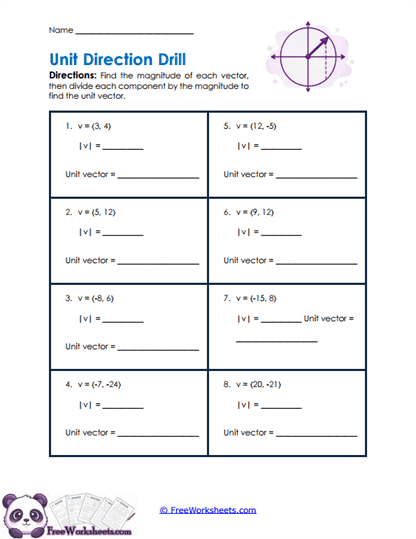
This worksheet helps students turn ordinary vectors into unit vectors, which are vectors with a magnitude of exactly 1. Students first find the magnitude of each vector and then divide each component by that magnitude. This keeps the vector pointing in the same direction while changing its length to 1. For Grade 12 pre-calculus students, this is an important step in understanding how vectors can describe direction without carrying the original size.
Learning Goals
The main goal is for students to understand how to find and write a unit vector. Students should already know how to calculate vector magnitude and simplify fractions or radical expressions. They will practice using the original vector and its magnitude together to create a new vector of length 1. This skill prepares students for more advanced work with direction vectors, vector equations, and applications involving motion and force.
Student Tasks
Students complete eight problems using vectors written in component form. For each one, they first calculate the magnitude using the vector magnitude formula. They then divide both components by that magnitude and write the resulting unit vector. Because the problems contain different positive and negative values, students also get practice keeping the original direction of the vector correct.
Common Challenges
Students may find the magnitude correctly but forget to divide both vector components by it. Another common mistake is dividing the magnitude by the components instead of the components by the magnitude. Negative values can also cause confusion because the signs must stay with the proper components. Encourage students to check that their final unit vector points in the same general direction as the original vector.
Teaching Suggestions
Teachers can introduce the idea by explaining that a unit vector tells direction while always having a length of 1. Drawing the original vector and a shorter unit vector along the same line can make this idea easier to understand. Parents and homeschool educators can have students say the two steps aloud: “find the magnitude, then divide each component.” As an extra check, students can calculate the magnitude of their final vector to confirm that it equals 1.
Worksheet Features
The worksheet provides eight structured problems with separate spaces for the magnitude and unit vector. Positive and negative component values give students practice with vectors pointing in several directions. The clear layout encourages students to show the two main steps instead of jumping straight to an answer. This page works well for guided practice, homework, independent review, tutoring, or test preparation.