
About This Worksheet
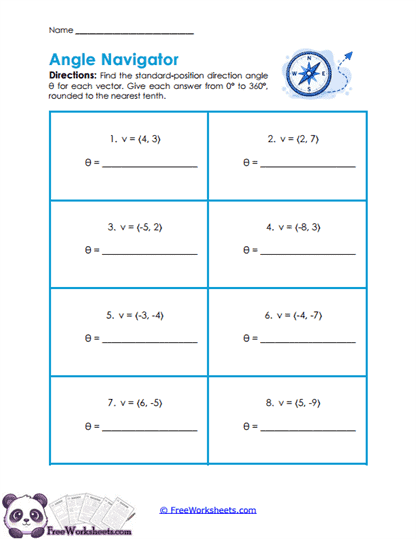
This worksheet helps students find the standard-position direction angle of a vector. Students use the horizontal and vertical components to determine the angle the vector makes with the positive x-axis. The problems require more than simply using a calculator because students must also think about which quadrant the vector lies in. This is an important Grade 12 pre-calculus skill because direction angles help describe where a vector is pointing, not just how large it is.
Learning Goals
The main goal is to help students connect vector components to angle measure. Students use trigonometric relationships, usually involving tangent, to find a reference angle and then adjust that angle based on the quadrant. They should already understand the coordinate plane, quadrants, inverse tangent, and degree measure. Mastering this skill prepares students for converting between component form and magnitude-direction form and for solving motion and force problems.
Student Tasks
Students solve eight problems, each giving a vector in component form. They use the x- and y-components to calculate a direction angle between 0 degrees and 360 degrees. Each answer is rounded to the nearest tenth, so students need to use their calculator carefully. The different sign combinations force students to pay attention to the quadrant instead of relying only on the inverse tangent result.
Common Challenges
One common mistake is accepting the calculator’s inverse tangent answer without checking the quadrant. Students may also mix up which component goes in the numerator and which goes in the denominator when using tangent. Negative components can make the angle feel confusing, especially in Quadrants II, III, and IV. Encourage students to sketch a quick coordinate plane first so they can see where the vector should point before calculating the final angle.
Teaching Suggestions
Teachers can begin by reviewing standard-position angles and the four quadrants. Working one example in each quadrant can help students see why the same basic tangent calculation may lead to different final direction angles. Parents and homeschool educators can ask students to predict the quadrant before touching the calculator. That quick prediction gives students a simple way to catch answers that do not make sense.
Worksheet Features
The worksheet provides eight focused problems in a spacious two-column layout. Vectors are chosen from different quadrants so students get practice with several kinds of direction angles. The directions clearly state that answers should fall between 0 degrees and 360 degrees and should be rounded to the nearest tenth. This page can be used for classwork, homework, test review, tutoring, or extra practice with vector direction.