
About This Worksheet
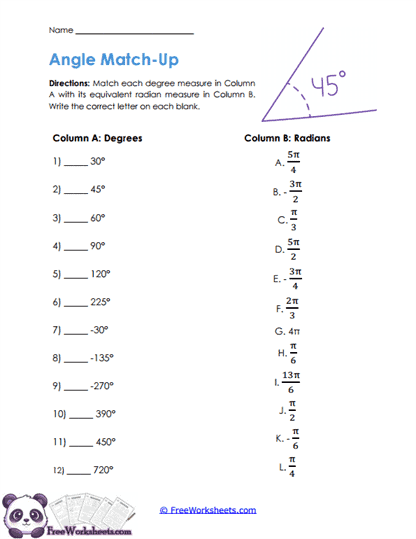
This worksheet helps twelfth-grade Pre-Calculus students practice matching angle measures written in degrees with their equivalent measures in radians. Students work with twelve common angles, including positive angles, negative angles, and angles that make more than one full rotation. Their job is to connect each degree measure in Column A with the correct radian measure in Column B.
The activity begins with familiar special angles such as 30, 45, 60, and 90 degrees, then moves into larger and negative angles. Students also work with angles greater than 360 degrees, which helps reinforce that radians can describe any amount of rotation, not just angles inside one circle.
What Students Practice
Students practice moving between the two most common systems used to measure angles. Degrees divide a full rotation into 360 parts, while radians measure an angle based on the radius of a circle. Students use familiar benchmark relationships to make the matches.
The worksheet also reinforces important special-angle conversions. By seeing these values repeatedly, students begin to recognize common degree-radian pairs without having to work through a full conversion every time.
Negative angles give students practice thinking about clockwise rotation, while large positive angles reinforce the idea that an angle can continue beyond one complete revolution.
Why This Skill Matters
Radians are used throughout Pre-Calculus and Calculus because they connect angle measure directly with circles and trigonometric functions. Students who are comfortable switching between degrees and radians will have an easier time working with the unit circle, trig graphs, identities, and equations.
This skill also helps students recognize equivalent angles quickly. Instead of seeing degrees and radians as unrelated systems, they learn that both are simply different ways of describing the same rotation.
Common Challenges
Students may mix up the direction of the conversion. A helpful reminder is that 180 degrees corresponds to pi radians. Students can use that relationship as the main reference point.
Another common mistake is assuming negative angles need a completely different rule. They do not. The same conversion relationship works; the negative sign simply shows that the rotation moves in the opposite direction.
Angles larger than 360 degrees can also feel unfamiliar. Remind students that these simply represent more than one full turn and can still be written normally in radians.
How To Use It
Teachers can use this worksheet as a quick review before beginning unit-circle work or trigonometric equations. It works well for independent practice, partner matching, homework, or a warm-up.
Parents and homeschool teachers can start with the easiest anchor: “Remember that 180 degrees is pi radians.” From there, students can reason through halves, thirds, fourths, and multiples of a full turn.
Grade Alignment
This worksheet is designed for Grade 12 Pre-Calculus students reviewing trigonometry. It supports fluency with angle measurement in degrees and radians and prepares students for unit-circle and trigonometric-function work.
Students should already understand basic angle measurement. After this practice, they can move into recalling exact unit-circle coordinates and trig values.