
About This Worksheet
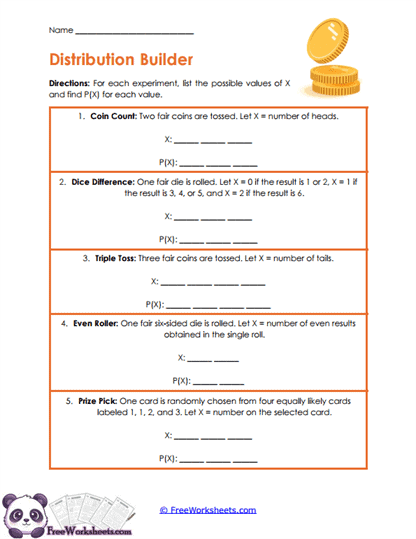
This worksheet helps twelfth-grade Pre-Calculus students practice building simple discrete probability distributions from small experiments. Students work through five situations involving coin tosses, dice, and equally likely selections. For each experiment, they list the possible values of X and then find the probability connected with each value.
The activity moves students from simply naming the random variable to building a complete probability distribution. For example, if X represents the number of heads from two coin tosses, students first list the possible counts and then determine how likely each one is.
What Students Practice
Students practice listing all possible values of the random variable and matching a probability to each one. They may need to think through equally likely outcomes, count how many outcomes create each value, and write the probabilities in a clear table-like format.
The worksheet includes different kinds of random variables. Some count the number of heads or tails, some group die outcomes into categories, and some come from randomly selecting an item. This helps students see that a probability distribution can be built in several ways.
Why This Skill Matters
A probability distribution is more than a list of outcomes. It shows how likely each value is. Students need this skill before they can calculate expected value, variance, standard deviation, or cumulative probability.
Building the distribution by hand also helps students understand where the probabilities come from. Later, when technology gives them a distribution automatically, they will have a better sense of what the numbers mean.
Common Challenges
Students may list the possible X-values correctly but give each one the same probability even when the outcomes are not equally likely. Encourage them to count how many basic outcomes lead to each value.
Another common mistake is forgetting that all of the probabilities in the distribution must add up to one. This is a useful final check.
Students may also confuse individual outcomes with values of X. Several different experiment outcomes can lead to the same random-variable value, so those probabilities may need to be combined.
How To Use It
Teachers can use this worksheet after students understand random variables and discrete outcomes. It works well for guided practice, independent work, homework, or a transition into checking whether a probability distribution is valid.
Parents and homeschool teachers can ask, “What values can X be?” and then, “How many ways can each value happen?” Once those counts are known, students can turn them into probabilities.
Grade Alignment
This worksheet is intended for Grade 12 Pre-Calculus students studying discrete probability distributions. It builds the foundation for expected value, standard deviation, and later distribution analysis.
Students should already understand simple probability and sample spaces. After this practice, they are ready to decide whether a proposed probability distribution is valid.